


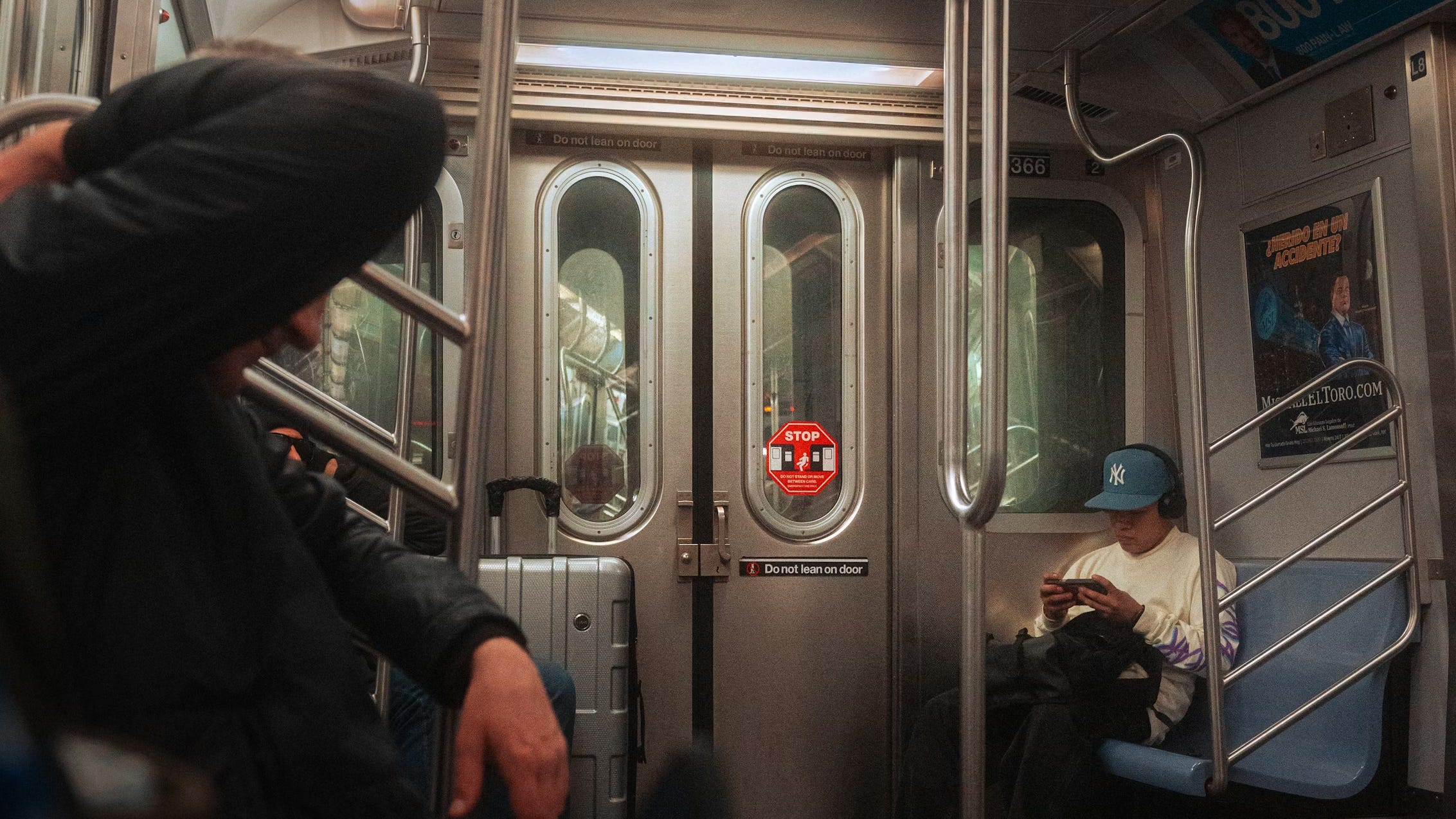
Community in America isn’t absent—it’s stratified. The poor maintain networks built on necessity. The elite preserve networks built on inheritance. But the petite bourgeoisie, caught between both, are encouraged to compete instead of connect, to climb instead of gather. This is the group the American Dream targets most directly — isolating people by convincing them that proximity to wealth is the same as belonging. This essay, which first appeared at the Dahlier Papers, unpacks how that design dismantled third spaces and created a nation of isolated strivers.
Loneliness in America is not a personal failure. It’s the country’s most predictable symptom. You feel it in the way people avoid eye contact while taking the elevator together, in the scarcity of public seating, in cafés where the chairs are intentionally uncomfortable so you won’t stay too long. The isolation we internalize as individual shame is, in reality, the architecture of American life.
I’ve spent most of my adult years traveling solo, and my nervous system always knows the difference before I do. In Europe, cities are built around the assumption that people deserve places to linger—plazas, riverbanks, café terraces, parks that invite conversation instead of policing it. You can sit with a coffee and fall into a twenty–minute exchange with a stranger who becomes a small part of your day. It isn’t a miracle. It’s design.
Every time I return to the U.S., the same question rises in me: Why doesn’t America have this?
Why is there nowhere to simply… linger?
To sit without buying something?
To exist without performing productivity?
The answer is embarrassingly clear: America wasn’t built for community. It was built for aspiration. And aspiration requires isolation. You can’t cultivate solidarity in a culture that rewards climbing. You can’t build a village in a society that worships the individual.
So America eliminated the places where gathering happens.

In most parts of the world, third spaces—the places between work and home—are where society breathes. They are where we witness the full spectrum of a community: children running, elders resting, neighbors in casual conversation, cultures overlapping without effort. Third spaces create connection through proximity, not performance.
In the United States, third spaces exist too—but only behind a paywall. They’re privatized, aestheticized, members-only. Instead of public plazas, we have private lounges. Instead of communal cafés, we have curated co-working spaces with $8 matcha and time limits. Instead of places to gather, we have brands selling the idea of belonging.
I understand the appeal. I’ve been inside these spaces. They’re beautiful — soft lighting, warm textures, plants in every corner. There’s a reason for that: beauty regulates the nervous system. Wealthy people don’t just buy access; they buy regulation. They buy environments that soothe them. Meanwhile, the public spaces accessible to poor and working-class people are fluorescent, concrete, overstimulating, and harsh.
In America, beauty is rationed.
Leisure is rationed.
Belonging is rationed.
But even the beautiful spaces offer a counterfeit form of community. They’re performance-based. People orbit each other without ever fully meeting. Everything feels curated — not intimate, not spontaneous. And even when I’m in the room, I often feel like I’m watching a joke I was never given the punchline to. Present, but not woven in. Near, but not held.
Access is not belonging.
Proximity is not intimacy.
Beauty is a gate, not a bridge.

This becomes even sharper when you consider how the nuclear family reshaped American life. The idealized image—two parents, two kids, a house—was sold as stability, but it quietly dismantled the extended networks that once held people together. Instead of a village, you got a living room. Instead of many hands, you got two overworked adults. And instead of collective responsibility, you got constant comparison.
“Keeping up with the Joneses” wasn’t a quirk. It was the logical outcome of a social model that privatized human life. The nuclear family didn’t strengthen society. It fragmented it. It turned neighbors into competitors and stripped away the communal scaffolding that makes people feel rooted.
And this fracture doesn’t just exist in theory—it organizes the entire American class landscape. Community here isn’t absent; it’s stratified. The poor still have one another because necessity builds a kind of village that wealth can’t replicate. When resources are scarce, people share what they have — childcare, meals, couches, rides, time. Survival requires interdependence, and interdependence creates its own culture.
The elite have community as well, but theirs is inherited. Their worlds are gated not only by money but by lineage, legacy institutions, and last names that open doors before they arrive. They live inside ecosystems designed to protect and reproduce their status—the closest thing America has to a true, stable village.
And then there is the petite bourgeoisie—the class suspended between both worlds. Close enough to the wealthy to see what belonging looks like, but never close enough to be accepted into it. This is the class the American Dream targets most aggressively. The strivers. The self-reinventors. The people told that if they polish themselves correctly, they might be granted a seat close enough to proximity to feel like inclusion. But proximity is not acceptance.
This is where competition becomes culture. Where comparison becomes currency. The petite bourgeoisie inherit the worst of both worlds: no communal safety net born of necessity, and no inherited network born of privilege. Only striving. Only performance. Only an endless audition for belonging.
And this is precisely why the absence of third spaces hits this class the hardest. Without a village guaranteed by birth and without a village guaranteed by circumstance, they are left with nothing but aspiration—and aspiration does not gather people. It scatters them.
America doesn’t behave like a country.
It behaves like a corporation.
Productivity is the currency.
Connection is the cost.

Travel makes the contrast obvious.
Paris at night—people sharing bread and wine along the Seine.
Italy—elders playing chess outside cafés owned by their grandfathers.
Lisbon—strangers who become companions by the time your espresso cools.
These places are not more inherently social.
They simply built the conditions for social life.
America built conditions for ambition.
Which is why protests feel natural in France but fractured in the U.S. Protest requires communal muscle memory—a sense that your life is tied to the lives of others. You cannot organize a people who never gather. You cannot build solidarity in a country that eliminates the physical spaces where solidarity begins.
Los Angeles reveals this fracture in its purest form.
No commons— only curated ecosystems.
People circulate more than they connect.
They mingle more than they meet.
They socialize more than they see each other.
Generational wealth gravitates toward generational beauty—across genders. Youth becomes capital. Beauty becomes mobility. Influence becomes oxygen. It’s not romance. It’s not empowerment. It’s the marketplace that forms when a society has no village.
I say this as someone who has lived adjacent to it. I grew up poor, but I always had a quiet certainty that I would not remain poor. Not because I was motivated by the possibilities of upwards mobility, but because I knew something in me wasn’t meant to stay where I began. When I moved to LA, my decisions reflected that knowing: the cafés I chose, the neighborhoods I walked, the rooms I entered, the men I dated.
I reached the world I imagined.
And still, I often found myself orbiting.
In the room but not of the room.
Recognized, but not rooted.
There is a particular loneliness in arriving at a life you always sensed was yours and realizing that life doesn’t recognize you back.
Assimilation deepens that rupture.
To become “American” is to understand—often without being told—that the markers of your culture must be softened for survival. Immigrant parents arrive with ritual, language, ancestry. Their children grow up learning to mute it. Don’t be “too Mexican,” “too Indian,” “too Haitian,” “too Caribbean.” Belonging is framed as proximity to whiteness. Progress is framed as erasure.
Assimilation is not integration.
It is subtraction.
And when a nation subtracts culture and fails to replace it with communal structure, people are left with nothing to root themselves in—no village, no commons, no continuity.
Everyone is isolated in different ways.
Everyone is performing Americanness.
Almost no one feels held by it.
This is especially stark for neurodivergent people.
As an autistic, ADHD person, hierarchy makes no sense to me. I don’t mask for status. I don’t perform submission for access. I don’t kiss up to climb ladders I don’t believe in. American culture rewards conformity and punishes difference. Without third spaces—the environments where neurodivergent people actually thrive—the country becomes not just lonely, but inhospitable.
The ladder was never built for minds like mine.
And without a village, there is nowhere else to stand.
There’s another truth we rarely speak aloud: not everyone begins life with a support system. I didn’t. I grew up without family to rely on, without a partner to split the weight, without a built-in network to cushion the fall. Everything I have, I built alone—through strategy, intuition, and relationships that were mutually beneficial because there was no other option. If I didn’t have something to offer, I wouldn’t have been invited into the rooms I eventually reached.
And that’s the part America refuses to account for:
What happens to people with no village in a country that provides no communal structures to replace it?
What happens when self-construction is the only path, and belonging is something you have to pay for?
For people like us, the absence of third spaces is not an inconvenience.
It is a threat.
Because if you were never given a village, and the culture refuses to offer you one, what are you supposed to hold on to?
So here is the truth beneath everything:
Your loneliness is not a personal flaw.
It is the logical outcome of a culture that removed the conditions for belonging.
You cannot form community in a country that never built the spaces for community.
You cannot feel grounded in a culture that rewards erasure.
You cannot feel held in a society that replaced gathering with striving.
We didn’t choose this loneliness.
We inherited it.
Naming it is the first step toward imagining something beyond it.
So I’ll ask you:
Where have you felt community?
Where has your nervous system softened instead of bracing?
Where have you been allowed to linger without paying for your presence?
Where have you tasted even a glimpse of the village this country forgot to build?
Because sometimes the village begins with the people willing to admit they miss it.
