


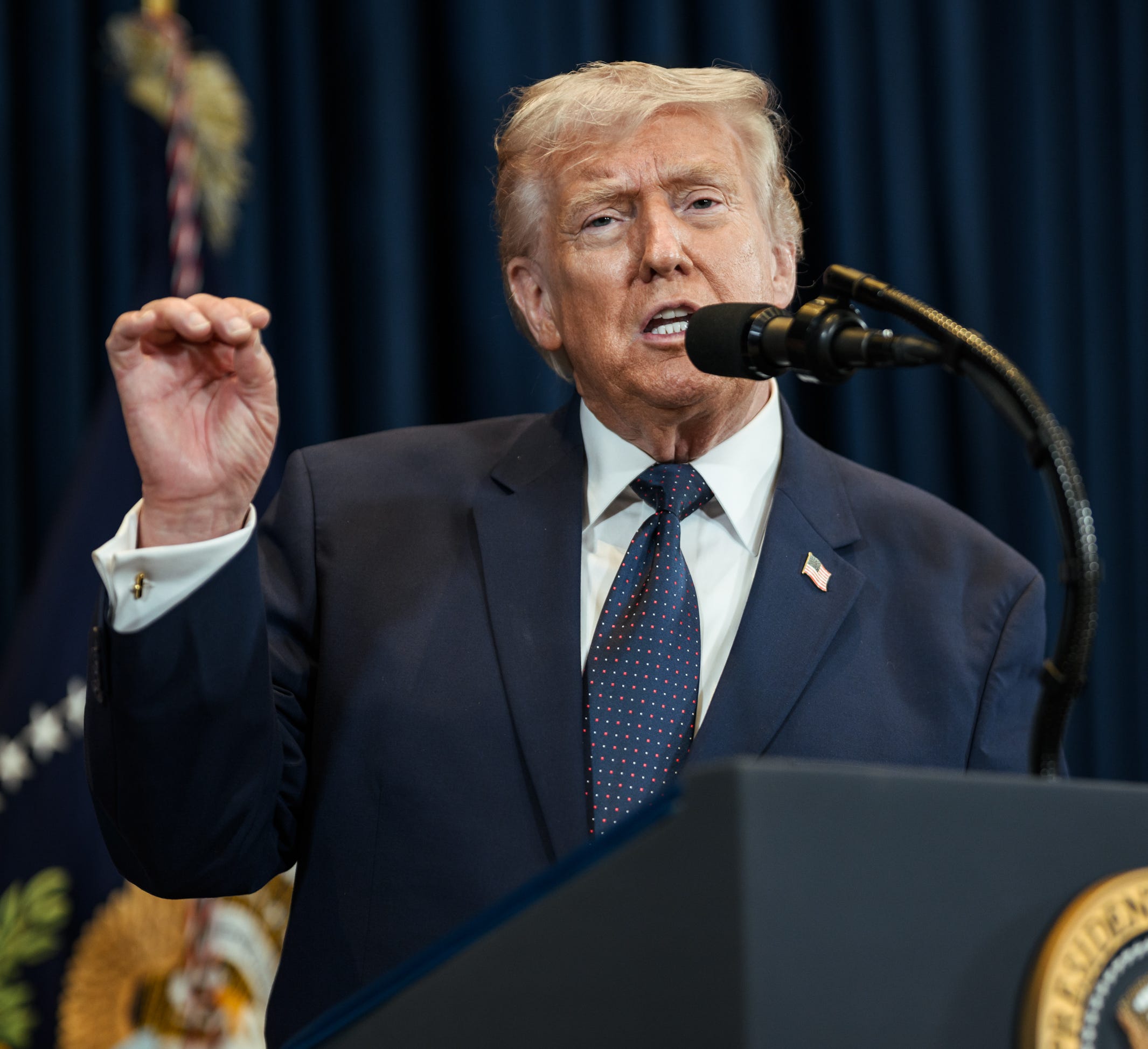
President Donald Trump’s recent attacks on Pope Leo XIV shouldn’t be dismissed merely as a bizarre sideshow to the illegal war on Iran. Rather, the president’s invective illuminates the fundamental illegality of his war-making, the weakness of his political position and the decline of his political acumen, his broader authoritarian ambitions, and the fragility of a MAGA movement that rules through propaganda, violence, and the chaotic, deranged psyche of Donald Trump.
To refresh the reader’s memory: Just after the U.S.-Israeli attack on Iran began at the end of February, Pope Leo expressed “deep concern” and called on the warring parties to “stop the spiral of violence before it becomes an irreparable abyss.” But on April 8, after Trump threatened to wipe out Iranian civilization, the Pope’s critique grew sharper, as he labeled Trump’s genocidal remarks “unacceptable”; he also said that, “I would invite citizens of all the countries involved to contact the authorities, political leaders, congressmen, to ask them to work for peace and to reject war always.” Two days later, Leo wrote on social media that Christians are “never on the side of those who once wielded the sword and today drop bombs; the next day, in a prayer service, he noted the “delusion of omnipotence that surrounds us and is becoming increasingly unpredictable and aggressive.”
President Trump first responded with a social media post. Pope Leo is “WEAK on Crime, and terrible for Foreign Policy,” opined the president, and further declared that, “I don’t want a Pope who thinks it’s OK for Iran to have a Nuclear Weapon.” He also wrote that, “I don’t want a Pope who criticizes the President of the United States because I’m doing exactly what I was elected, IN A LANDSLIDE, to do, setting Record Low Numbers in Crime, and creating the Greatest Stock Market in History.” Soon afterward, Trump doubled down on his comments in remarks to reporters: ”I’m not a big fan of Pope Leo. He’s a very liberal person, and he’s a man that doesn’t believe in stopping crime. He’s a man that doesn’t think that we should be toying with a country that wants a nuclear weapon so they can blow up the world.”
Coming on the heels of a ceasefire that reflected the failure of the U.S. attack to achieve its vaguely stated and shifting objectives, Trump’s assault on the pope should in the first place be seen as an expression of the president’s fundamental weakness and fragility – a tacit admission of his policy failures and his personal inability to take responsibility for them. His plaints were those of a man who felt that his mistakes had been plainly seen and publicly called out by an authority figure. And by reacting so angrily to the pope’s quite basic pleas for peace and respect for life, Trump only highlighted his one-note stance of belligerence – a belligerence that had brought the U.S. to the brink of strategic defeat, as Iran exerted its power to control shipping through the Strait of Hormuz in a move predicted by literally decades of war games by the American military. The position of weakness was only emphasized by Trump’s application of bog standard political critiques against the pontiff — in particular, the absurd allegation that the pope is “WEAK on crime,” as if the papacy were a district attorney position whose contenders bragged of how many thieves they’d crucified during their tough-on-crime careers. As so often, Trump’s attack on someone else for their alleged failing exposed his own deepest fears – that he himself had been shown to be weak.
Trump’s felt need to lash out also likely lay in his understanding that he has no actual leverage over the pope – a frustrating state of affairs that he attempted to overcome through insults and vitriol, and his suggestion that the pope is “weak” and thus actually no possible threat to Trump. This points to a more concrete threat that Trump is in fact right to perceive – that the pope’s critique of Trump, and its potential power, lies in a realm quite separate from a president’s ability to rain down bombs and death on Iranian targets. The pope was speaking in the language of morality, of persuasion, of self-restraint. Leo lay down basic principles: it’s bad to bomb people if you can avoid it; he counseled a different path; he implied that the belligerents should listen to him; and he asserted that ordinary people should express their similar beliefs by contacting their elected representatives.
And though he lacks the power to dictate anyone’s actions, the pope most certainly does have the power to command attention and to provoke people of all faiths to ask questions about a patently illegal war. Trump, perhaps history’s most avid publicity hound, instinctively understands the pope’s ability to garner attention, and the president’s remarks can also be viewed as a (backfiring) attempt to nullify the pope’s St. Peter’s Basilica-sized megaphone.
Critically, the anti-papal offensive wasn’t limited to President Trump. Vice President JD Vance attempted to offer pseudo-theological cover fire, asserting that the pope should think more carefully about matters of church doctrine before he speaks. And House Majority Leader Mike Johnson suggested that the Iran war is in fact a just war according to Catholic precepts. These attacks by high-ranking GOP officials shared a common thread that was only implicit in Trump’s attacks: that the pope’s authority on matters of morality and church doctrine is not only fallible, but in fact wrong-headed. Even more incredibly, though, Vance and Johnson managed to draw attention to a jaw-dropping aspect of Trump’s position: not only was the pope mistaken, but also that Trump is the superior authority on religious matters. This is a staggering assertion, and one that Matt Sheffield has delved into here at Flux as an aspect of a larger merger between Trump and the evangelical movement in the U.S. It’s worth lingering on the scope of power claimed by Trump and his allies: the presidency is a position that should be seen as sitting atop our society, above even the realm of religion which most Americans see as separate from government control (i.e., our bedrock faith in the separation of church and state). It’s an authoritarian vision that sees no limits to the scope of the president’s power and social reach.
Taken together, Trump’s flailing display of weakness wrapped in braggadocio and outlandish claims about the pope (weak on crime, not permitted to talk about religious matters that contradict Trump’s opinions) add up to a near-perfect storm of reckless self-owning that should not be considered as just another Trump outburst. Out of a blend of megalomania and fear, Trump has attacked the pope for the crime of urging peace on earth. And we haven’t even touched on the fact that Trump followed up his comments with an AI-generated image of himself as a Christ-like figure laying a healing hand on a sick man (who, to my mind, bore a strange and incongruous resemblance to the actor Ethan Hawke — a wholly separate secular blasphemy against the iconic Gen X film star).
In combination with his full-frontal attack on the pope to, well, be a pope, such sacrilegious imagery raises the question of whether Trump and his closest allies consider Catholics to be true members of MAGA. And this AI-enabled insult reaches beyond the one specifically leveled at Catholics. You don’t have to be a practicing Christian to recognize the nauseating sacrilege of this Trump-as-Christ image, or to recognize the fundamental absurdity of Trump attacking the pope as erroneous and unworthy – particularly when the pope’s intervention has essentially been to call for peace and an end to a war that few around the world support. Indeed, given the unpopularity of this MAGA war on Iran, and the outlandishness of Trump’s attacks on Pope Leo, he’s arguably managed to create a sacrilegious line of attack that offends even atheists.
It’s hard to overstate the recklessness of Trump stoking a fight with the pope, which hardly serves as a distraction from his disastrous war, but instead appears as yet one more aspect of Trump’s Middle East shit show, focusing public attention on his self-made quagmire and incompetence. In fact, by engaging with the pontiff, he arguably helped focus particular public attention on the war’s basic immorality – a crucial aspect of the conflict separate from its waste of money and hits to the U.S. economy that I would guess are currently foremost in most Americans’ minds. We could not ask for a better gauge of Trump’s desperation and fecklessness at this moment; he has mired himself in a stupid war replete with war crimes and damage to American interests, without a way of getting out that doesn’t objectively draw attention to his unfitness for the presidency. Donald Trump has assuredly done hundreds if not thousands of dumb political things over the last decade, but leveling vitriol at the pope in defense of an unpopular war rises to the top of the pack. Trump, confusing the impulse to lash out defensively with cunning political instinct, remains unapologetic about what he’s said. But in unfurling his authoritarian freak flag in the name of bringing the Catholic Church to heel while drawing attention to the immorality of his insane war, he is more or less only succeeding in punching himself in the face, repeatedly and pathetically. In honor of the famous “rope-adope” boxing strategy, we might think of this as Trump’s own “rope-a-pope” maneuver, one in which attempts to launch roundhouse swings at Pope Leo look a lot more like the president repeatedly punching himself in the face.
But let’s be clear: it’s not just that the pope has attacked a religious authority figure, which he of course has the right to do. Rather, it’s that he’s done so in a way that disparages faith itself. It’s not just that his lackies have implied he’s a superior arbiter of morality than the pope. In the president’s profane depiction of himself as Christ, he was at best practicing a deep disregard for people of faith by making fun of a sacred figure. At worst — and this is the possibility that I believe is most likely — he was displaying his contempt for the religious voters on whom he has relied for the bedrock of his political power. In fact, it’s his debt to them that fuels his contempt and need to dominate them — and what better way to dominate Christians than to make them eat shit by submissively accepting a depiction of Donald Trump as the son of God?
The most effective way to make Trump pay a political price in the coming months is to remind American Christian voters, particularly but not exclusively Catholics, of his profane pretension to religious authority. There has already been extensive reporting of Republican discontent with the president’s remarks, and Democrats should rightly and righteously encourage these misgivings. Democrats should not hesitate to remind voters of Trump’s apparently irresistible desire to follow up his war on Iran with a war on the Vatican.