


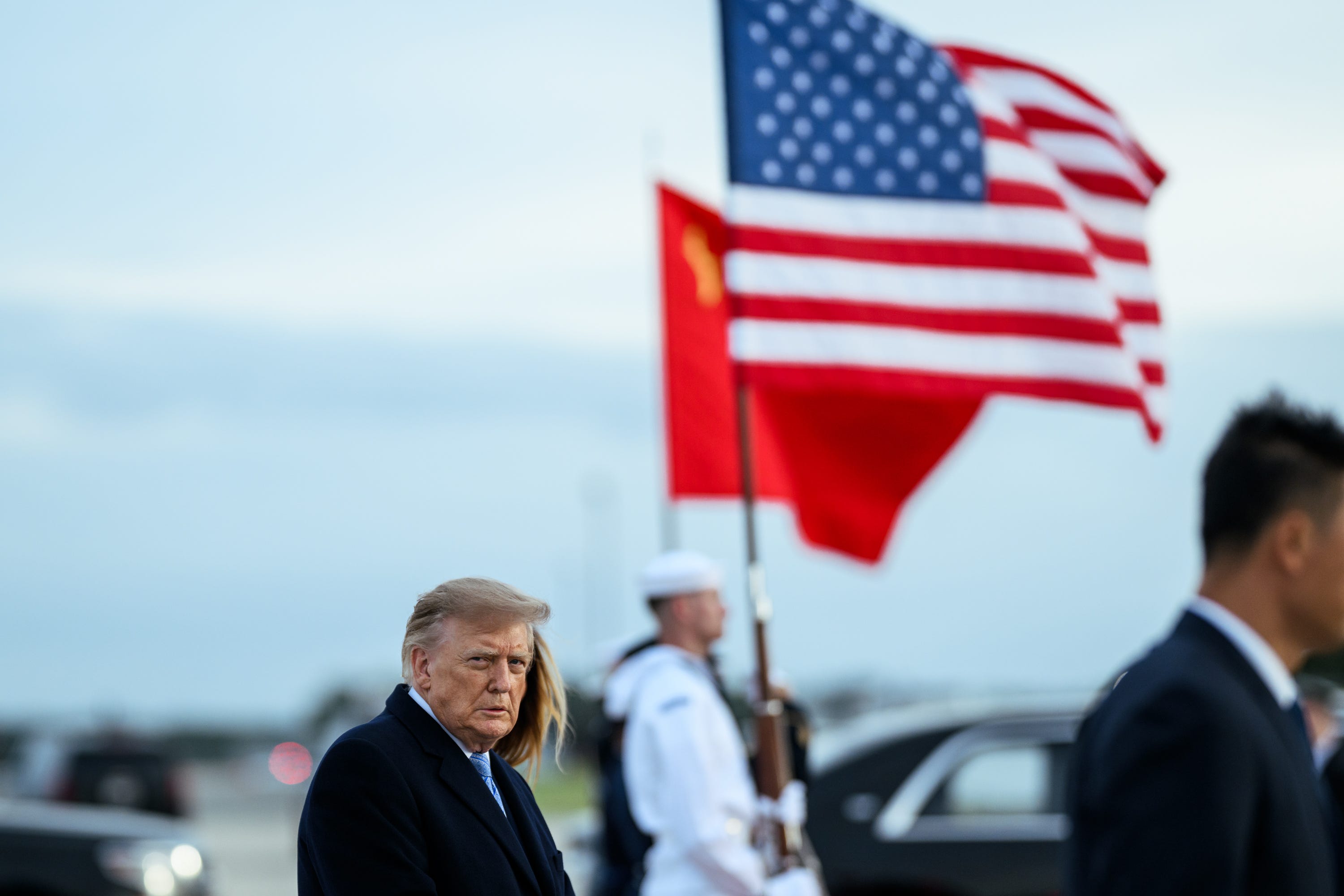
After Donald Trump’s 2024 election win returned him to the White House, millions of appalled Americans grappled not only with the shock of his victory, but with the challenge of imagining how to endure a second term of a president who had literally tried to overthrow American democracy just four short years before. Even the 2026 midterms seemed a century away. Meanwhile, Democratic politicos were presented with the daunting task of contending with a president and a party that not only controlled all three branches of government, but were clearly intent on securing permanent dominance at the federal level. This fight appeared all the more challenging as many Democratic politicians self-flagellatingly embraced a Republican and media narrative that Donald Trump had effected a permanent realignment of U.S. politics, attracting substantial shares of traditional Democratic voting blocs like young voters and Latinos.
If, nearly two long years later, we have arrived at the cusp of those once-inconceivable midterms, we should in the first place take some solace in the country having thus far more or less survived a second Trump term that has been about as bad as many imagined it would be. Second, we might (cautiously) take courage in the apparent fact that many millions of Americans appear to have withdrawn their former support from Trump and the GOP, and are prepared to either abstain from voting in November or to cast ballots for Democratic candidates.
Although it is always good sense to be reasonably skeptical of political polling, the staggering numbers regarding Trump’s growing unpopularity, as well as the general trend towards increasing support of Democratic candidates both in generic congressional surveys and polls of individual candidates, suggest the swelling of a possible “blue tsunami,” in the words of various observers. Take these recent results highlighted by New Republic’s Greg Sargent, who has been a careful observer of the president’s falling support. A recent Reuters poll shows Trump’s approval at 32%, a new low, with an average of national polls putting his approval at a mere 35%; approval of his performance on cost of living at a dismal 17%; and only 29% supporting his foreign policy actions (with a smaller 18% agreeing that the president’s handling of the war against Iran is helping the country).
After Trump’s pair of head-spinning wins over the last decade, we can be forgiven for only cautiously accepting what is increasingly obvious: the president and the GOP, having engaged in all manner of lawlessness, incompetence, and general mismanagement of the country, appear to be forcing a decisive public judgment against their actions and their ideology. This judgment is being rendered not just by Democratic-leaning voters, but by a decisive turn by unaffiliated voters, as well as in a small but sure erosion of GOP-affiliated ones. It’s also being signaled through the flight from the GOP of those very demographics — Latinos, African-American males, younger Americans — that had created the myth of a realignment in 2024 (for those looking for a good time, I encourage you to look at some of the recent polling around the collapse of Latino approval of Donald Trump).
Just as back in 2024, many of us feared to speculate what it would be like to live another two years, let alone four, under a second Trump presidency, I’d wager that many didn’t dare imagine a time or circumstances when GOP politicos might begin to break from Trump. After all, they had rallied around his third candidacy even after he had shown himself to be a lawless insurrectionist and aspiring dictator. If that didn’t sour them on him, what ever would?
As it turns out, what is finally turning a handful of Republican candidates to seek space (or at least the appearance of it — more on this below) from Trump isn’t necessarily any particular action by the president, but his measurably catastrophic loss of support among American voters — which in turn threatens their own political survival. In other words, GOP politicians have openly supported or turned a blind eye to Trump’s warmongering (with hundreds of civilians dead from his Iran and Caribbean) campaigns and ICE-inflicted sadism, but only flinched when Trump’s falling poll numbers raised the prospect of their own personal political apocalypse.
And so, as Paul Waldman has helpfully summarized, a slice of GOP candidates around the country has started to distance themselves from some of the president’s policies:
Florida Representative Maria Elvira Salazar released a video in which she said some Hispanic supporters of Trump feel “betrayed” by his immigration policies
GOP senatorial candidates in Iowa and Nebraska have criticized his plan to import more beef to lower prices for consumers
two Iowa GOP representatives voted to support a Democratic resolution opposing the Iran war
Multiple Republicans support restrictions on data centers and AI, in contradiction with Trump’s gung-ho (and deeply self-serving) support of the industry
Such developments, in prior decades, would have generally signaled the healthy operation of democratic politics: politicos listening and responding to the public, and critiquing a president with whom they disagree. In our era, when the GOP has appeared to be in lockstep with Donald Trump, there is a clear temptation to see such “traditional” political maneuvers as a sign not just of Trump’s waning power, but also of outright democratic health. “See that?” we can imagine a political analyst exclaiming. “The Trump fever is breaking, just like we always said it would.”
But it would be a grave political error for Democrats to treat attempts by GOP politicians to distance themselves from a few specific, unpopular Trump policies as a decisive break with Trump, or from their complicity in the larger retrograde political project he has enabled. That they are afraid for their own political survival based on souring public opinion in a turbulent midterms environment is not the same as repudiating a host of noxious ideas that they’ve largely been happy to support, and which constitute not simply Trump administration policies but mainstream beliefs of the current GOP. Here are some of the most prominent presidential moves welcomed by both federal and state Republican elected officials: the unceasing attempts to use all manner of state power to rig elections to support permanent Republican majorities not only in dozens of states, but also at the national level; the advancement of Christian nationalist ideology and goals; the evisceration not only of crucial public health entities like the CDC and NIH, but relentless efforts to sow doubt in basic medical science; the advancement of a white supremacist vision of America, which has encompassed everything from racially-motivated mass deportations of even documented immigrants, to the purging of non-white general officers from the U.S. military, to endless lies that the United States is being invaded by non-white “aliens” who seek to literally replace white Americans; the deployment of the U.S. military to seize the country of Venezuela as a sort of surplus oil-producing vassal state, signaling a depraved neo-imperialist vision of the U.S. in Latin America; and a vast, party-wide corruption in which the president and his allies abuse their levers of power for illicit personal enrichment.
With two years left of his final term in office, Democrats need to grasp the risks of any over-emphasis on Donald Trump as the root cause of America’s ills, and his eventual departure from the American scene as synonymous with the return of normalcy. The authoritarian inclinations, misogynistic worldview, racist assumptions, and essential corruption of which Trump is such an exemplar have taken strong root in the Republican Party; indeed, many of these pathologies pre-date the president’s personal hold over the GOP. And while a good number of prominent Democrats have argued for structural changes to root out corruption and revive American democracy, there has been much less stress on what it would mean to hold the GOP accountable for its radicalization into an extremist, far-right, anti-democratic party.
All this means that the phenomenon of Republicans making a show of opposing particular Trump administration policies is a test case for how well the Democrats grasp the authoritarian threat of the radicalized GOP that they will still face in two years, even after Trump is no longer in power. While there undeniably are some political advantages in pointing to Trump’s weakening personal hold on the GOP, these should be balanced with a necessary, long-term effort to remind the public that there is in fact little daylight between most GOP officials and Donald Trump on a host of vital issues. It is not so much that Trump has placed the GOP in his thrall against the party’s basic beliefs — the reason he has the party in thrall is because there is very little that fundamentally separates Trump from the lickspittle politicos who have enabled his worst instincts for the past decade.
To credit GOP politicians for actually changing their beliefs now, rather than simply dissimulating to buy themselves votes in a desperately adverse midterm environment, would be an incredible act of generosity to opponents who deserve neither the benefit of the doubt nor such an extension of grace.
The need to impugn and diminish the GOP goes beyond mere political maneuvering. If the goals and policies of the GOP are truly existentially threatening to U.S. democracy and modern American society — if the mortal threat transcends Trump’s two presidencies — then Democrats should be aiming not just to defeat the GOP in 2026, 2028, and beyond, but to fundamentally discredit its immoral ideologies and its very basis for existence. The Republican Party has become the vehicle for a mass reactionary movement encompassing tens of millions of Americans, one that aims to roll back the social advances of the last century and even to crush democracy if it stands in the way of reviving discredited hierarchies of race, gender, and religious identity.
So as we see GOP politicos begin to try to distance themselves from Donald Trump, it is vital that both ordinary citizens and Democratic politicos treat their proclamations and motives with the greatest skepticism and scrutiny. If a Republican politician is truly ready to decry the fundamentals of Trump, then such a politician should be willing to place themselves in opposition to the mainstream of the GOP, and to essentially declare themselves in favor of reforming the party so that it conforms with the basics of American democracy. Otherwise, the significance is only superficial; such politicians simply cannot be trusted to serve the United States, even after Donald Trump has shuffled (or been escorted) off the political stage. If it’s true, as Paul Waldman observes, that the relatively small numbers of GOP politicians voicing dissent from particular Trump policies is set to escalate, then Democrats need to be ready with a take-no-prisoners politics that paints them not as true critics of Trump, but as cowards and liars whose superficial opposition to heinous policies and ideas only confirms the moral rot that has consumed the GOP.
After so many years of Trumpist chaos and reactionary victories — the overturning of the right to an abortion, the brutalization of thousands of non-whites across the country at the hands of ICE, the deliberate erosion of common belief in vaccines and public health — it is likely that some Democrats will, in the coming years, argue in favor of whitewashing the conflicts of the last decade, towards the end of societal healing and moving forward.
Instead of asserting that the United States has endured a de facto ten-year-long insurrection at the hands of authoritarian-minded politicians and radicalized voters, they may point to issues like affordability and inflation as the actual seismic forces in American politics. Indeed, we can already see some version of this at play, as Democrats emphasize anxieties about the economy as key arguments to persuade voters to support their party in the midterms. And while in the abstract and as a matter of political expedience, there is nothing wrong with hitting a prominent weakness that has millions of Americans of various party affiliations riled up, it would be self-defeating to pretend that the conflicts of the Trump years have been merely about the cost of things, and not primarily about fundamental questions of American identity; merely about affordability, and not about basic issues of whether Americans of all kinds deserve to share equally in the American dream, as well as fundamental questions about whom the economy should serve.