


Given the blitzkrieg of horror that has become our average news cycle, it’s understandable that the plight of Venezuela has slipped from front of mind; Early January’s kidnapping of a sovereign head of state has already been eclipsed by Trump’s attempts to snag Greenland and Stephen Miller’s personal military abducting children and shooting civilians at home. The aphorism about decades where nothing happens and weeks where decades happen has become understatement.
But this compression of attention does more than push foreign crises out of view. It flattens them into spectacle, making it harder to see both the sinews connecting them and the forms of survival people are already building in response. Exactly one month before “Operation Absolute Resolve” and a couple days after ICE’s “Operation Metro Surge” began in the Twin Cities, I conducted my first of two interviews with Ricardo Vaz, the editor at Venezuela Analysis, an independent English language outlet based in Caracas. I have long been fascinated by the expansive grassroots networks of mutual aid programs and communal councils that stretch across Venezuela. I wanted to discover how those networks, and the Bolivarian Revolution in general, had held up through the years of relentless American economic warfare, CIA destabilization campaigns, and (at the time of the first interview) impending US military action. Given the news out of Minneapolis, I hoped the interview might provide not only insight into how Venezuelans were dealing with the brutality of empire, but also how we might also prepare ourselves for the returning “Imperial Boomerang.” By the time of our second interview last week, Maduro had been illegally abducted by US special forces and ICE was turning US cities into war zones.
We mustn’t view these horrors as isolated shocks, but rather as connectable dots along a discernible bearing. How the United States operates in Latin America or Gaza for that matter can prepare us domestically. It stands to reason that we should learn from the structures built in these regions to provide security and material stability under immense pressure.
When I asked Vaz why the often touted Venezuelan air defenses hadn’t been activated that night, his answer underscored how much remains unclear, even as a few details stood out. There were reports of a single rocket being fired and missing its target, he said, after which the launcher was “immediately neutralized by helicopters.” Beyond that, there was no confirmed evidence of a coordinated Venezuelan air defense response at all. But what remained most striking was how the operation was able to locate the president at all. As Vaz told me, “it was known that he was changing where he slept every night,” a fact that immediately raised questions about the level of intelligence involved. Vaz stressed there was no indication of a dramatic, high-level betrayal inside the government, but the precision of the strike made it difficult to believe it occurred without some form of leakage. Reports of casualties emerged slowly and unevenly, adding to confusion. Rumors of sleeper-cell JSOC operators and even the fabled Havana ray gun continue to circulate. But while some tools reflect new capabilities, what truly distinguished the operation was its brazenness. The message was familiar, but newly explicit, delivered without pretense and meant to be understood far beyond Venezuela.
“The Constitution, which is very advanced, unfortunately, does not have a provision on what to do if your president is kidnapped by a foreign empire. I think that was an oversight on their part.” Vaz dryly described in our second interview the Venezuelan response to Operation Absolute Resolve. “From the very first moment, the Chavista instinct is, when there’s a crisis, you go to the presidential palace, and then you figure out what to do next. I think it goes back to the 2002 coup when people rallied outside the presidential palace and finally managed to overthrow the coup plotters.” Vaz continued, referencing how popular support toppled the short-lived US backed coup against former Venezuelan president Hugo Chavez in 2002: “One day, it will be communes, the next day, trade unions, the day before, it was women’s organizations and so on.” Despite how it has been portrayed in US media, Vaz reports that condemnation of Maduro’s abduction is nearly universal within Venezuela even among the opposition parties, highlighting one of the clearest gaps between reality and U.S. propaganda.
“There wasn’t any kind of public celebration or expressions of joy,” Vaz said, “The early sense was just absolute shock—shock and trauma.” Even among Venezuelans critical of Maduro, Vaz noted, the response was not jubilation but rejection: “They didn’t want the country bombed and the president kidnapped to answer for whatever imaginary crimes in a foreign court.”
Vaz reports that the average Venezuelan’s response to American hostility, thus far, has been overwhelmingly negative. Which exposes the hollowness of an already thin U.S. narrative which frames the intervention as a rescue and justice served. The people most affected understood immediately what American audiences were encouraged not to see: this was not about democracy, human rights, and especially not about drugs or machine guns but about enforcing compliance. As Vaz put it mildly, the idea that Venezuelans would welcome such an act “was never realistic.”
The Maduro kidnapping and its aftermath has made Venezuela a live expression of the Monroe Doctrine’s shift into the “Donroe Doctrine.” That is mafia rule without even the pretense of trusteeship. Any political reforms being made to Venezuela’s oil industry or its relationship to Cuba should be seen in this light. “All of this is happening at gunpoint,” Vaz said. While Venezuela nominally retains sovereignty, “the U.S. government is intermediating the oil sales,” with revenues deposited into shady Treasury accounts in Qatar with conditions imposed on how funds may be spent. The message, Vaz warned, is that Washington no longer needs to govern directly to rule effectively. “If we allow this,” speaking both of Venezuela and other nations in the region. “It’s just going to set the precedent.” That precedent is Donroe in practice: obedience rewarded with limited access to survival, defiance punished through economic strangulation and your heads of state lopped off, with the “legality” retrofitted if necessary at all. Venezuela is not the exception but the proof of concept.
It is precisely the continuity, rather than rupture, that liberal accounts of the present moment struggle to grasp. The basic “lib” understanding of our current political crisis points to Donroe and Trump in general as an aberration from an otherwise reasonable political arc. However, those on the Left, say no. Trump and his policies are entirely in keeping with the American trajectory and very little of the legal framework used to justify Venezuela or Minneapolis for that matter is novel or even solely Republican made. I have said it before, Trump sits on a throne forged by both parties. What is new is the shedding of vestments once required to dress the omnipresent imperialism, or dare I say fascism integral to the “American Dream.”
Those vestments, often described as the “rules-based order”, functioned less as restraint than as fig leaf. They concealed a mode of operation nichely referred to, both provocatively and usefully, as the Fourth Reich. The Fourth Reich is not a continuation of twentieth-century fascism in its theatrical form, though Greg Bovino and the DHS are really trying, but a framework for understanding how the United States has exercised authority abroad and, increasingly, at home. The powers now being wielded openly, extraterritorial abductions, collective punishment, permanent emergency rule, legal exception, and the fusion of corporate and state power did not originate with Trump. They represent a perpetuation and refinement of practices developed long ago, including those pioneered under the Third Reich and later absorbed, along with tens of thousands of literal Nazis, within the postwar Western order.
For decades, these techniques were deployed largely against distant populations and insulated by the language of norms and humanitarian necessity. No need to go hunting for clues of this. The goose stepping footprints are evident in a long record of U.S. interventions abroad, and have even been frankly acknowledged in recent remarks by Canadian Prime Minister Mark Carney at Davos. What distinguishes the current moment is not the sudden emergence of fascistic power, but the abandonment of the rituals that once concealed it. The dropping of the fig leaf if you will. The system has not changed its logic; it has simply stopped pretending otherwise. And, as is the tendency with all imperialist cruelties, what was once resigned to the frontiers, whether sociological or geographical, is now being implemented at home.
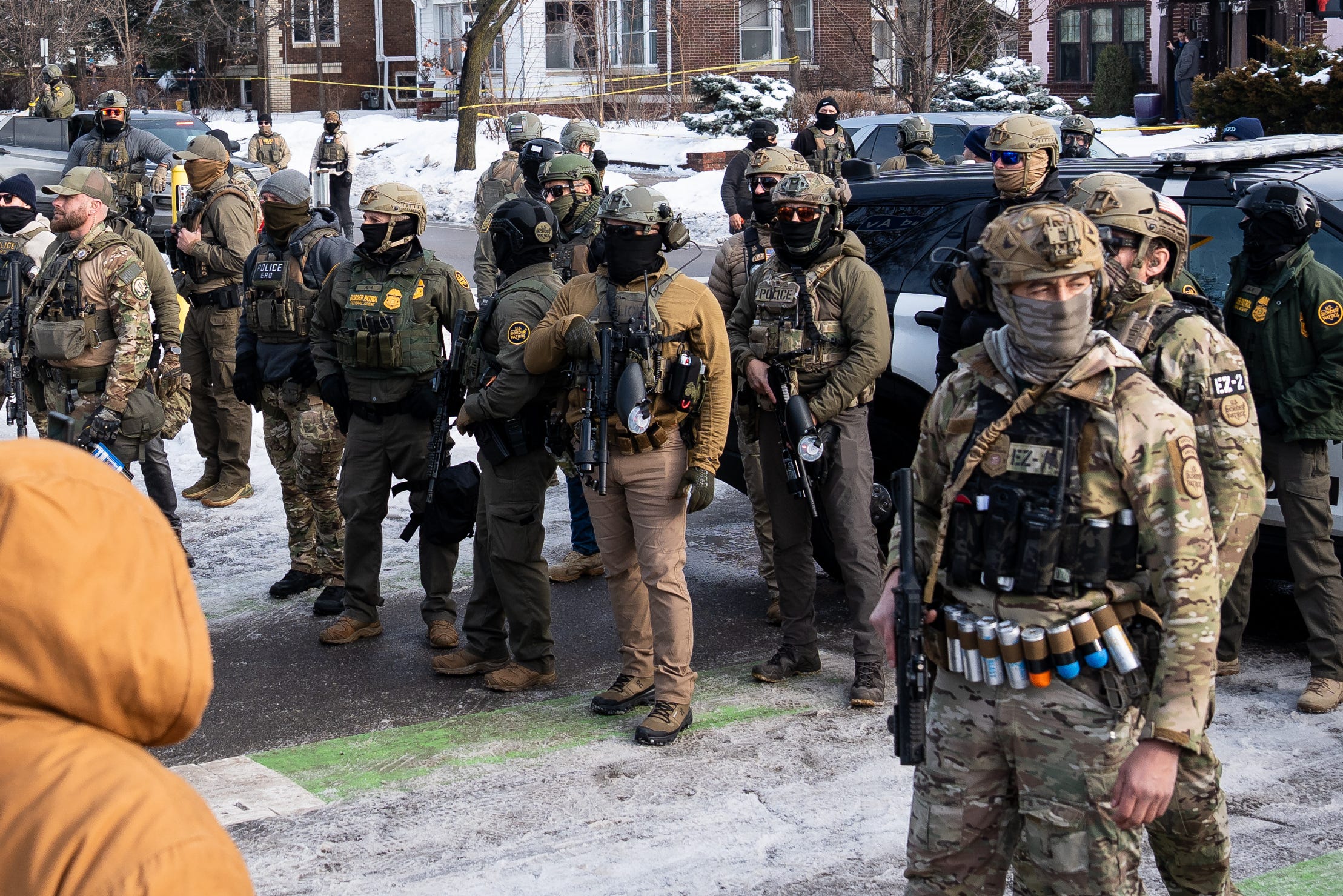
ICE raids and federal deployments to US cities like Minneapolis replicate counterinsurgency playbooks developed in Iraq, Afghanistan, and Syria, complete with night raids and IDF training on how to best abuse a population. Whether it’s calling everyone a pedophile, or litter boxes in classrooms it’s long been understood that behind every Republican accusation sits an admission. Trump’s warning that America would become “Venezuela on steroids” fits neatly into that tradition. Not that the country would collapse into scarcity, (although that’s not off the table) but that he was willing to treat American cities and states with the same contempt that has long defined U.S. policy toward Venezuela. Donroe logic, brought home.
The lesson of the Bolivarian response is not that Venezuela avoided state failure, but that millions of people learned to organize as if the state could not, or would not, save them. Rather than wait for repair from outside, communities built parallel capacities for food distribution, healthcare, and collective survival. That’s a lesson to learn from. It speaks directly to conditions at home, where the state increasingly oscillates between neglect and outright hostility toward popular governance, where federal forces are deployed not to resolve crisis but to discipline it. In that context, the Chavismo wager to construct durable, democratic infrastructure outside formal state channels offers a concrete model for survival. “These examples are very powerful,” Vaz told me of the communes, “because even if they are localized, they show that an alternative exists.” Donroe depends on the belief that there is no alternative, that force is inevitable and submission rational. Venezuelans refute that premise not only in theory, but in practice. The alternative is not abstract, it has already been built. The real question is not whether another future is possible, but whether we will learn from the ones that already exist before we are denied the chance.