



Former Apple CEO Steve Jobs was sometimes criticized for his ability to create a “reality distortion field” with his marketing skills. They were formidable indeed, but they were nowhere close to the power that Republicans and right-wing media have demonstrated in their attempts to make transgender rights the subject of a massive national debate.
This is a political controversy that simply should not exist.
Regardless of your stance on trans rights, the fact is that implementing them would have very little impact on most cisgender people’s lives since transgender people are around 1 percent of the population according to most estimates. They are much less numerous in the world of sports: National Collegiate Athletic Association president Charlie Baker told Congress in 2024 that there were fewer than 10 trans athletes out of about 510,000 in his leagues. That means that 0.002 percent of NCAA players were trans, according to the official numbers. A few trans athletes have competed in the Olympic games, but none of them has ever won an individual medal.
But in the Republican alternative universe, trans athletes are an omnipresent menace. Curiously, it’s one that did not exist until Glenn Youngkin won a 2021 race to become governor of Virginia while heavily incorporating anti-trans messages into his campaign. Republicans and the mainstream media became convinced that transphobia had given him the victory, rather than the fact that Youngkin was from the opposite party of then-president Joe Biden and that such candidates historically have done very well the year following a presidential election.
Despite thin evidence that fear-mongering about trans people had been electorally effective for them, Republicans and allied groups have made it a centerpiece of their final campaign messaging and advertising. Donald Trump’s 2024 campaign set the tone with an ad accusing his Democratic rival Kamala Harris of being “for they/them” and claiming that “Donald Trump is for you.” The Trump operation spent more money on the ad than on the topics of housing, immigration, and the economy combined, according to independent journalist Erin Reed. Trump repeatedly attacked trans people on the campaign trail, falsely claiming that schools were taking children to gender surgeries.
The effectiveness of the they/them campaign is disputed. Video advertising in presidential elections is regarded as largely ineffective by political scientists, but both parties seem to believe otherwise based on their campaign disclosures. The pro-Harris PAC Future Forward has claimed it moved votes, but the group has never released any public details to support these assertions, whereas a study commissioned and released publicly by GLAAD found that the campaign had no significant effects.
In any case, the catchiness of the attack line is undeniable, and it, along with other trans-panic messages, has since become a fixture of Republican and allied political messaging.
The large constellation of reactionary media outlets has followed suit, making transphobic segments a big part of their content. According to a 2025 Media Matters study, Fox News Channel aired more than 400 stories about trans athletes in a four-month span, including one week in which it aired 59 stories.
This year, gender fear-mongering is especially important to Republicans. Amid a weak economy, high inflation, a disastrous foreign war, and record-breaking fuel prices, Trump and his party are understandably eager to shift campaign conversations to anything else. The anti-trans hoax has thus become the core of a desperate plan to avoid a wipeout in next month’s elections. Fox host Jesse Watters underscored the strategy in explicit detail earlier this month, saying that Republicans needed to produce “fear porn” in order to terrify disgruntled conservatives into voting against Democrats.
Despite Republicans’ reliance on them, however, transphobic messages have not been able to carry their candidates to victory. Last year, Virginia Republican Winsome Earle-Sears, who was running to succeed Youngkin, lost in a 15-point blowout despite spending 57 percent of her campaign’s ad budget on anti-trans bigotry. Her victorious opponent Abigail Spanberger estimated that Earle-Sears and outside groups favoring her spent about $30 million on these commercials. A similar barrage of ads targeting New Jersey gubernatorial candidate Mikie Sherrill failed to prevent her from winning a 14-point victory. Neither candidate backed down in her support for trans rights.

While anti-trans messaging has not been a panacea for Republican candidates, the far right’s years of propagandizing against trans people seem to have influenced public opinion. According to a study released last year by the Pew Research Center, support for anti-trans policies increased significantly between 2022 and 2025. In 2022, 58 percent of American adults supported laws requiring athletes to compete with others of their birth sex; by 2025, that figure had risen to 66 percent. Notably, the increase in support for restrictive laws came from Democrats. In the first survey, 37 percent of self-identified Democrats indicated that they supported making trans athletes compete against people of their birth sex, while in the second, the number had increased to 45 percent.
Similar declines in Democratic support for trans rights were observed across every question, including bathroom restrictions, censoring teachers who wanted to teach about gender identity, and even laws prohibiting discrimination in employment, housing, and public accommodations such as restaurants. (The study did not provide percentages for self-described political independents.)
The increase in negative attitudes toward trans people among Democrats is so recent that few studies have examined its potential causes. Among Democrats, overestimating the share of the U.S. adult population that is trans—about 1 percent—appears to be correlated with negative attitudes toward trans rights.
That was one finding of a study published last April by YouGov that examined people’s estimates of the sizes of social minority groups and their opinions about those groups. Among Democrats who thought that trans people made up 5 percent or less of the population, only 13 percent supported laws banning people from bathrooms matching their gender identity; 66 percent were opposed. The contrast with Democrats who thought that trans people made up more than 5 percent of Americans was stark: 41 percent backed the bathroom restrictions, while only 24 percent opposed them.
Among Republicans, the correlation between accurate knowledge and support for bathroom laws was reversed. Eighty-six percent of Republicans who estimated the trans population more accurately supported restroom restrictions; 75 percent of Republicans with less accurate estimates backed the discriminatory policy. Just 3 percent of Republicans with more accurate estimates said they opposed the laws, while 15 percent of those with less accurate estimates opposed them.
More broadly, Americans seem to greatly overestimate the size of the trans population. The same YouGov study found that respondents estimated that 12 percent of Americans were trans, much greater than the more accurate number of 1 percent.
A similar pattern seems to exist in perceptions of trans athletes. In a YouGov survey conducted earlier this month for The Bulwark and podcaster Pablo Torre, only 31 percent of adults correctly answered that fewer than 1 percent of NCAA athletes were trans. Nine percent of respondents said that 11 percent or more of college athletes were trans.

It’s still unclear how substantial or durable the apparent increase in negative sentiment toward trans people among Democrats may be or which demographic groups might be particularly affected by anti-trans messaging.
In interviews with the New York Times’s Shane Goldmacher in 2024, Republican ad makers said that they liked anti-trans advertisements as a way of portraying Democrats as out of touch, an important component of Republican campaigning since reactionaries became increasingly dominant within the party. Operatives said that ads focusing on trans girls and women athletes seemed to have particular appeal to college-educated suburban women.
“One of the things you see in the focus groups is the moms get really visibly angry on this issue,” a consultant told Goldmacher. Republicans also believed the ads were effective among men from racial minority groups, Axios reported.
According to a validated voter study by the Pew Research Center in 2025, Trump’s share of the vote among Black men increased by 7 percentage points from 2020 to 2024. His share among Hispanic men rose by 11 points.
How much anti-trans fear-mongering influenced voters is impossible to know with certainty, especially since asking poll respondents to retrospectively characterize their decision-making is fraught. Among the problems are that people seem increasingly unable to recall how they voted as time passes. A poll released earlier this month by Strength in Numbers found that 6 percent of people who had previously said they voted for Trump now say that they did not. Four percent of self-described Harris voters now claim to have done something else.
Overall, transgender rights seem to be a low priority for most Americans. Pre- and post-election surveys from many pollsters showed this. A November 2024 study by More in Common found that only 9 percent of Democratic respondents listed LGBT or transgender policies as a top-three issue for them—far below other topics like inflation, healthcare, abortion rights, the economy, and the environment.
An immediate post-election study commissioned by the Human Rights Campaign, an LGBTQ advocacy organization, had similar findings. It found that only 4 percent of voters listed “opposing transgender surgeries and transgender kids in sports” as one of their reasons for choosing a candidate. That was roughly equivalent to the 5 percent who said that “advancing rights for LGBTQ+ people” had been one of their top issues.
Notably, when asked directly which candidate best represented their views on transgender people, Harris led Trump, 52 percent to 40 percent.
It is possible, however, that while opposing trans rights does not specifically motivate people to vote Republican, the party’s expansive transphobic campaign reinforces the party’s long-standing efforts to substitute cultural populism for economic populism and thereby distract the public from Republicans’ unpopular views on issues that Americans view as more important.
One possible explanation for that disconnect comes from a post-election survey by Blueprint, a Democratic-leaning polling organization. While the study could have been methodologically stronger, it is not entirely without merit and its findings are worth consideration. Given a list of reasons for not voting for Harris, the most popular choice (within the margin of error) among swing voters was the claim that she was “focused more on cultural issues like transgender issues rather than helping the middle class.”
For some swing voters, transgender rights seem to matter less as a particular issue and more as a synecdoche of their view of the Democratic Party as an institution run by a clique of highly educated people who don’t want them to have a place in society. This conception of the Blueprint finding is perfectly consonant with the fact that other studies find that specific Republican ad campaigns seem to have little or no impact.

As the pollsters and pundits have continued debating the impact of trans issues in 2024, Republicans have doubled down on transphobia in this year’s campaigns. Besides running ads featuring the familiar “they/them” line, party candidates and their allies have been making deliberately fake AI-generated videos of Democratic candidates. Texas senatorial candidate James Talarico has been a frequent target of deceptive ads, including one depicting him wearing a dress and another as a creepy ice cream van operator staring at children and wanting men to compete in sports against girls.
Aside from the unsettling visual imagery, the content of the ads presented deliberately false information regarding Talarico who had said that he opposes trans athletes in female sports “if it risks safety or fairness.” The concession he had made to anti-trans voters could be easily missed by them if their only source about his views was right-wing media and the communications of his opponent, Ken Paxton, Trump, and other Republicans, who have presented numerous totally false statements about Talarico’s positions on everything from trans equality to his diet—lying that he is a vegan and supports banning meat.
Other right-wing operatives appear to have taken the deception to possibly criminal levels in the Lone Star State where unknown individuals have mailed thousands of Texas households brochures containing inflammatory instructions about how transgender minors can become emancipated from their parents using information supposedly taken from the Transgender Education Network of Texas (TENT). The postal campaign set off a social media firestorm with numerous reactionary commentators and activists decrying the supposed outrage, even as TENT denounced the pamphlets as malicious fakes.
It’s not known as of this writing who sent the brochures, but a number of indications are pointing to various Republican firms. A Texas district attorney has opened an official investigation into the matter and TENT has gone to court to compel the direct mail operations that sent the brochures.
The pamphlet campaign recalls several earlier efforts by far-right posters on the website 4chan to create fake images from fictional LGBTQ advocacy organizations. In 2017, the forum users manufactured a hoax campaign to fool people into believing that sexual minority rights groups wanted to begin advocating for child molesters. A few years later, another 4chan initiative resulted in reactionary bloggers getting tricked by a supposed “Trans Rights Campaign” digital flier about cisgender heterosexual men dating trans women.
A 2023 hoax about a fake “Trans Day of Vengeance” was much more successful, although like the previous efforts, it only managed to ensnare right-wing media outlets including Breitbart, then-Fox News host Tucker Carlson, and the New York Post.
For their part, Democratic candidates have taken a split approach to Republican transphobia. Some have effectively adopted portions of the Republican position, apparently hoping to deprive their opponents of a political advantage. In Ohio, Democratic Rep. Marcy Kaptur released an advertisement touting her support for Republican efforts to censor gender instruction in schools and opposing trans girls’ participation in girls’ sports. Iowa congressional candidate Sarah Trone Garriott likewise has said she opposes trans women using women’s locker rooms. The party’s congressional and national leadership has remained uniformly supportive of gender equality, but the list of Democrats who have embraced anti-trans positions is growing, as Erin Reed has reported.
The knuckling-under approach will not work, and HRC president Kelley Robinson made the case well in a September blog post:
The hate-filled clickbait will run through November. Why? Because a gallon of gas costs $4.30. MAGA allies will cut more and more ads to distract Americans from rising costs, rising inflation, and an endless war. They have zero solutions for people, and millions of dollars for attacks. […]
Turning on a vulnerable community is not a winning political strategy — and it’s exactly what Trump, [Elon] Musk, and MAGA want. It legitimizes their side and weakens ours. And it harms transgender people.
It is worth noting in fairness that not all Democrats who have made concessions to opponents have done so to equal degrees. Talarico’s proviso about “safety and fairness” does actually give fairly wide room to trans participation in sports. So there are nuances.
But given that voters do not seem to place a high priority on trans issues, it does seem that overall, caving in broadly is unlikely to gain support. It would also seem unlikely that people with strong anti-trans viewpoints would even believe a Democrat’s claims that they oppose trans equality, since, as noted above in the case of James Talarico, the far-right political ecosystem has no qualms about lying about Democratic candidates’ policy views.
Even further, since anti-trans viewpoints are highly correlated with religious sectarianism, a Democrat shifting rightward on all trans issues but keeping her positions on other topics the same would be unlikely to gain votes. People who are strongly against trans rights are also strongly against progressive viewpoints on taxation, abortion rights, marriage equality, and social welfare spending.
While caving on transgender rights seems to provide few new votes for Democrats, a YouGov study conducted earlier this year in the UK suggests a strong possibility that Democrats adopting anti-trans positions may be demotivating LGBTQ rights supporters who lean toward the party but have no firm attachment to it.
Surveying voters who had previously picked Labour but subsequently switched to another party, the pollster found that Labour’s adoption of anti-trans policies under new leader Keir Starmer motivated 7 percent of those who switched to other parties to defect. Among those who had changed to the Green Party, 17 percent said that Labour’s stances on trans rights was the primary reason for their departure. An even larger number of defectors, 19 percent, said that Labour being “too right-wing” was the main reason they had switched.
Of course, the U.S. and the U.K. are completely different countries with different political systems, but the statistically significant effect observed within the YouGov survey strongly suggests that researchers in the U.S. should try to duplicate its methods for comparative purposes, especially since the number of people who are trans or have family members or close friends who are trans has been estimated to be between 11 and 21 percent according to PRRI and KFF. Of course, one need not know any trans people to be a very strong ally, so the percentage of Americans who have very strong pro-trans views could be quite considerable.
While the Democratic Party is obviously much more sympathetic to gender equality than Republicans, it is certainly conceivable that trans people and their allies may no longer wish to support politicians that they see as not advocating for their lives and civil rights.
Of course, gender equality-supporting citizens would be making a long-term mistake by staying home in a two-party system. But Democrats explaining why in sufficient detail are unlikely to find purchase.

The newness of trans rights as a political issue seems to be what has made it so important to Republican strategists. In the More in Common study mentioned earlier, while Democratic voters did not rank transgender policy as one of their top priorities, voters in general indicated that the Democratic Party had made trans rights its second-highest priority.
While the cost of living was far and away the top issue for Democratic voters at 40 percent, only 19 percent of the public said that it was.
The contrast between the public perception and the reality of what Democratic respondents wanted was starkest on the issues of abortion rights and trans rights. Among actual Democrats, 29 percent said that abortion was a top-three issue, but the public at large said they believed that 49 percent of Democrats placed it in the top three. Just 9 percent of Democrats said that LGBTQ policies were a top-three issue for them, but 34 percent of the public said that Democrats placed them as a highest-priority.
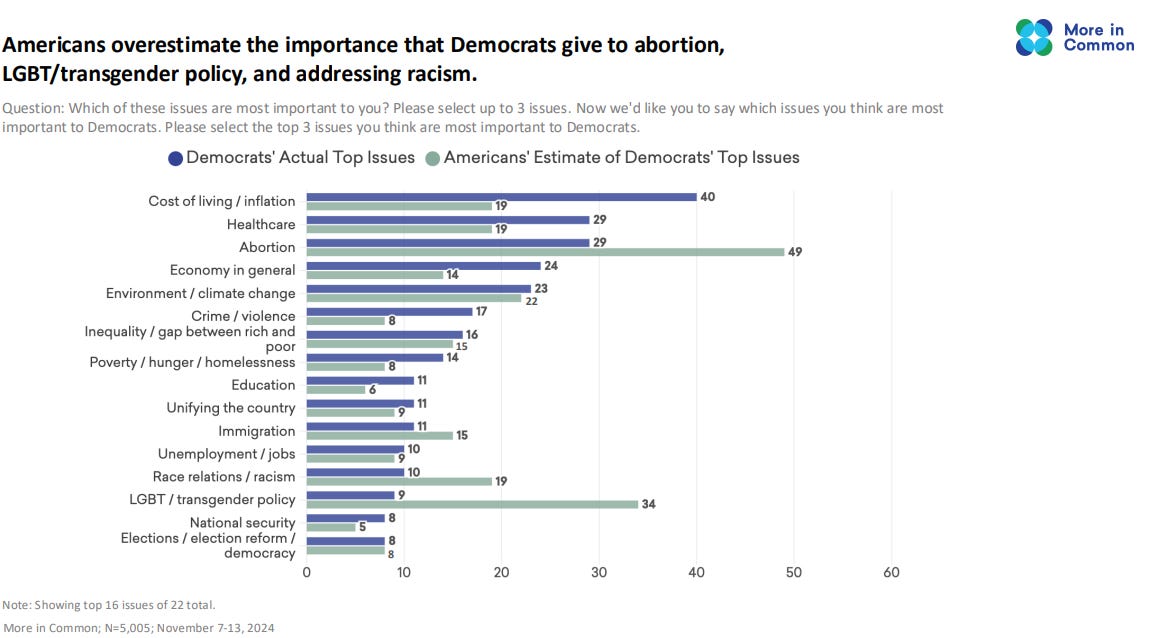
There really does seem to be what the More in Common authors call a “priority gap” in public opinion on the issue of trans rights, and it’s been made not by a few weeks of campaign advertisements but by the vast reach of Fox, other right-wing channels, and social media sites owned by right-wing billionaires like Elon Musk. Every day of the year, millions of Americans are exposed to news-imitating content which is highly biased against gender equality and trans people in particular.
That some voters might have a more psychological approach toward trans equality than a policy-based approach is consonant with an October 2024 YouGov study which asked registered voters whether they supported 64 policies of Kamala Harris and 64 of Donald Trump. The results were striking: 89 percent of Harris’s positions received majority support compared to just 48 percent of Trump’s. Harris’s policies were so popular that 51 percent of them received majority support among respondents who said they preferred Trump. By contrast, only 34 percent of Trump’s ideas were supported by Harris backers.
The takeaway from the survey is that many Americans are willing to vote against a presidential candidate with policy views that they support. Despite the overwhelming popularity of her positions, Harris lost the election to Trump. Clearly, millions of Americans do not view policy details as central to their voting choice.
Trump also seemed to benefit from the fact that many of his supporters imagined that he supported Harris’s policy ideas when he did not. This was observable across many different proposals including establishing a national paid family and medical leave program (22 percent), requiring criminal and mental background checks for all gun purchases (29 percent), and capping increases on food and grocery prices (21 percent).
Most relevant to this discussion, 26 percent of Trump supporters believed that he wanted a federal ban on discrimination on the basis of gender identity and sexual orientation. Despite Trump and Republicans spending hundreds of millions of dollars attacking trans people, more than a fourth of his supporters believed that he wanted to ban discrimination against them.
Democrats’ problem on gender equality is not their position on the issue but rather their ability to communicate it rhetorically and whether voters can hear the message at all.
The communication gap that Democrats face on trans equality is actually a manifestation of the party’s larger inability to directly reach the public, a problem that has far too many causes to cover here, but there are two main ones worth discussing. The first is that Republicans invest far more money in advocacy media than Democrats. This gives them an ability to continuously transmit messages to Americans—not just to their supporters, but also to anyone who happens upon the lifestyle, news, and sports content that gets funded.
As a former Republican media consultant, I have always found it odd that Democrats are so in love with television ads, despite the very large body of scholarly research showing their general ineffectiveness. The reluctance to invest is even stranger considering that Democrats under Bill Clinton coined the idea of the “permanent campaign,” continuing campaign warroom operations beyond November. Instead of Democrats building upon their own meritorious idea, it is Republicans who have taken the concept and scaled it up by billions of dollars a year by encoding political messages inside non-political and partisan news content that Americans will voluntarily watch, listen to, or read.
Democrats’ apparent fixation on ineffecient ad spending is even more bizarre because it is premised upon the idea that politicized video content is persuasive. If that is actually true, then it would seem obvious that voluntarily consumed advocacy media would be far more effective than blaring 30-second ads that political science has consistently found to be widely despised.
And indeed, the research is overwhelmingly clear that biased news-like content can be significantly influential. The far-right billionaire Elon Musk’s takeover of Twitter provided a perfect example of how content drives opinion. In a study published this past February in the science journal Nature, Twitter/X test subjects who utilized the Musk-inflected “For You” content feed were 4.7 percentage points more likely to prioritize Republican policy viewpoints higher than participants who used the older reverse chronological feed.
The study also found that For You participants were also 5.5 percentage points more likely to disapprove of criminal investigations of Donald Trump, 7.4 percentage points less likely to approve of Ukrainian president Volodymyr Zelenskyy, and 3.7 percentage points more likely to follow a right-leaning X account. Astonishingly, when participants who had used the For You algorithm were asked to switch to the reverse chronological feed, their opinions remained the same. Just a few weeks of using Musk’s algorithm warped people’s opinions for the duration of the study, a remarkable demonstration of the power of news-like content.
Nor are media effects limited to social platforms either. There is a large body of scholarly literature indicating that Fox News Channel, just one node of the giant Republican media ecosystem, has significant effects across voting choices, issue opinions, partisan identity, and many other relevent metrics.
In addition to insufficient media investment to carry their messages, Democrats have also struggled to develop effective rhetoric in the social media age. Instead of being able to confidently speak off-the-cuff about anything citizens want to hear about, they have often been stilted and poll-driven in their communications.
But some Democrats are finding the better path on communications in general and on gender equality in particular. Instead of caving to the radical right on transgender rights, they have taken more active approach, one that begins by noting that transphobia is nothing more than a distraction from Trump’s failed policies, and then transitions to explaining the pro-trans position.
Kentucky Gov. Andy Beshear has been particularly successful in this regard, using his Christian faith to show why he supports equality for trans people.
“We should always stand up for our convictions, and we should always push back against discrimination,” he said in an interview with The Advocate, an LGBTQ-interest magazine. “I don’t like bullies, and so I’m always going to push back.”
“I believe all children are children of God,” he continued. “It says, ‘Love your neighbor as yourself,’ not ‘love your neighbor, unless.’”
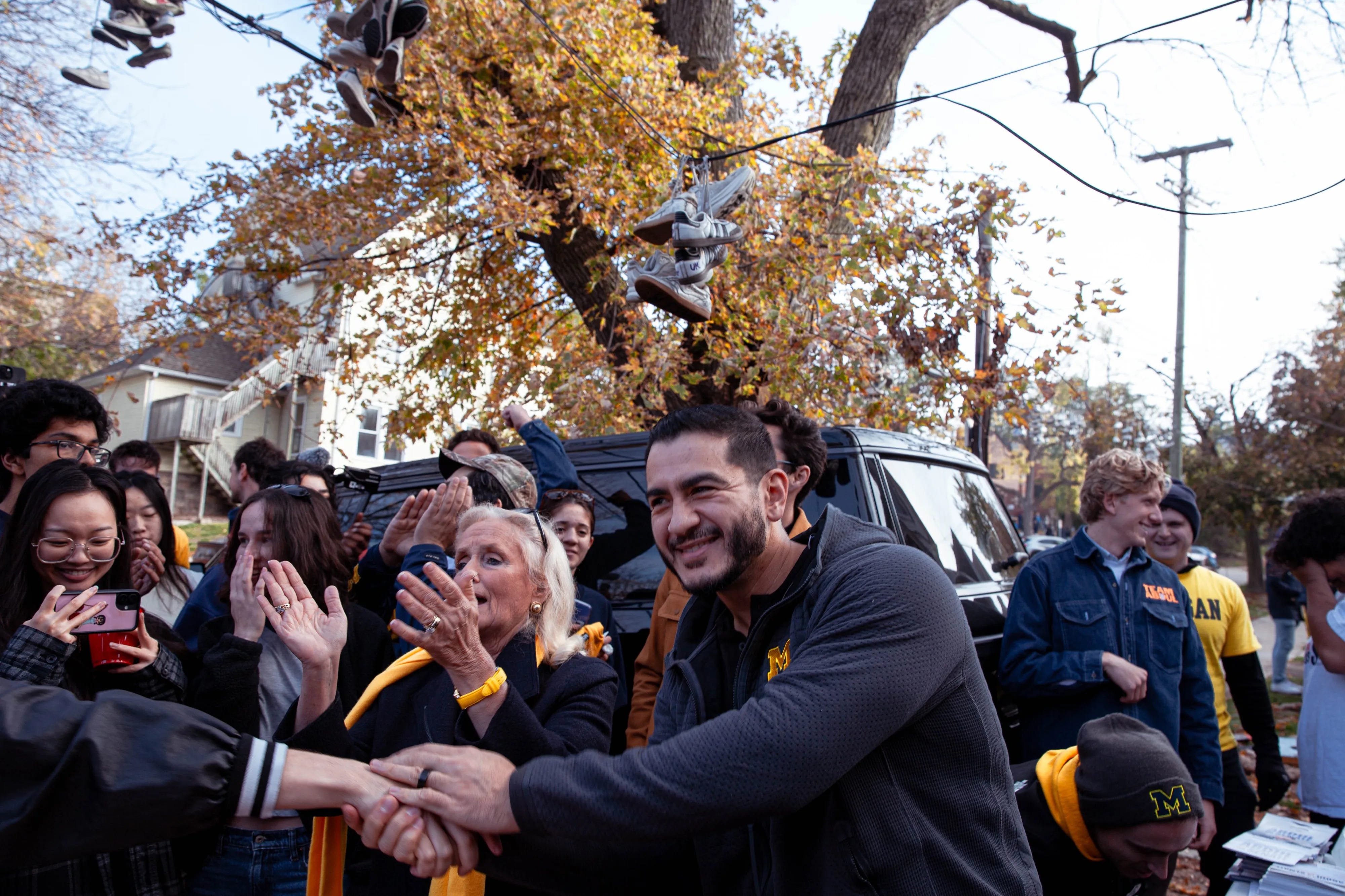
Michigan Democratic Senate candidate Abdul El-Sayed put transgender rights into a larger context during an interview with Pride Source, a Michigan-based LGBTQ publication:
There’s a reason that if I’m asked, I always say that I support trans rights because I believe in all rights. I want folks to see their own rights in the plight of a trans person who’s being discriminated against.
The real question here isn’t about whether or not we can discriminate against one group or another. The real question is whether or not we want a government that can discriminate against anybody at all. A government that is told that it’s allowed to discriminate against some people and not others will eventually discriminate against any and all people for whatever reasons it chooses. We are all in the fight for an America whose government does not discriminate against any of us.
I say that as somebody who puts my face on the ground many times a day praying in the way that I pray as a Muslim. Not everybody has to understand why I do that, but I damn well expect that they’re going to stand up for my right to do it. And similarly, you might not understand somebody else — but you work for their rights. We cannot build the relationships and love and community we need when government is weaponizing against any of us.
That larger context is critical because it enables Democrats and trans rights supporters to flip the latent narrative that the Blueprint study observed by showing that standing up for one group is standing up for everyone else.
What all of this analysis seems to indicate is that candidates who explain their position in detail—especially facts about how trans freedom would not impact almost any cisgender person—allows Democratic-leaning voters to have a better understanding of positions that are actually new within the American political conversation, and why they should support them.
But that dynamic works in the opposite direction as well. Martin Niemöller famously observed how authoritarians never stop at depriving just one group of their rights. In our own time this is very apparent. Trump and other reactionaries have succeeded at constraining personal liberties of trans people and sex workers in many ways, but they will not stop there. They frequently talk about their desire to roll back marriage equality, eliminate federal anti-discrimination agencies, ban birth control medication, eliminate women’s right to vote, and even prohibit men from voting unless they own property.
That litany above is only a small piece of what the radical right wants. It’s an extreme agenda that’s a threat to all Americans. But the only way to stop it is to keep moving forward buy building media, advocating passionately and coherently, and calling attention to the extremely unpopular policies that reactionary Republicans support. Standing up for others isn’t just the right thing to do, it’s smart politics.
We can only protect democracy by expanding it further. I am freed by your liberation, and you are by mine.
1 In fairness, in studying the effects of interventions within politics, establishing causation is notoriously difficult, and the foregoing analysis does not do so. I would nonetheless argue that it engages with a much larger literature than the analyses offered by strategists who argue for retrenchment on transgender rights, which means that it can offer a more comprehensive interpretation.
I am so angry at anti-trans Democratic candidates, with Josh Turek being the worst. It doesn’t gain any GOP voters and it just adds to the transphobic rhetoric.