


The long-running tension between moderate and progressive Democrats to steer the party’s direction saw a revealing development last month, as a prominent centrist group indicated it was declaring “war” on the Democratic Socialists of America. Alongside the allocation of $15 million dollars to attack the DSA and those who share its positions. Jonathan Cowan, president of Third Way, asserted that the DSA presents a “mortal threat” to the Democratic Party.
Before we delve into how misguided Third Way’s targeting of the DSA is, it’s important to say upfront that the DSA’s platform contains various positions that lie outside the American political mainstream, such as defunding the Pentagon, empowering Congress to choose the president, and extending voting rights to permanent residents. It’s also fair to note that the DSA organization contains some members whose views are arguably in direct opposition to American democracy itself. As Talking Point Memo’s Josh Marshall recently observed, DSA co-chair Megan Romer is a member of the organization’s Red Star caucus, which terms itself a “a Marxist-Leninist caucus in DSA” and has noted that “Our primary goal, the goal which informs all of our organizing work, is to abolish capitalism and, ultimately, to achieve communism. We do not believe that capitalism can be reformed into socialism – it must be overthrown and replaced.” Marshall correctly notes that, “This vanguard, Marxist-Leninist revolutionary party claptrap is [ . .] the seed corn of left-wing authoritarianism.”
In light of this glaring extremism displayed by a small subset of DSA members, though, what’s immediately notable about Third Way’s declaration of war is that the centrist group appears to have chosen to foreswear such obvious, self-discrediting targets in favor of a broader onslaught on positions Third Way deems to bear the stains of “democratic socialism” — positions, we should immediately note, that are held far beyond the DSA membership rolls. And so Third Way head Cowan told the New York Times that:
the effort would include opposition research into D.S.A., polling, social media programs and educating Democratic activists and leaders. It would target both proud democratic socialists and those such as Dr. El-Sayed, whom he derided as performing the “D.S.A. dodge” — flirting with democratic socialists enough to get their organizing manpower and support while remaining distant enough to avoid the explicit label.
The idea that Democrats might be damaged when the party nominates candidates who hold controversial or unpopular positions, and that it thus might have an interest in patrolling its ideological and policy boundaries, is not crazy on its face. White supremacists or those who advocate violence as a way to solve political differences are obvious, clear examples. But Third Way appears to be doing something quite different than calling for the exclusion of such truly outlandish ideas. Instead, it is denouncing as “democratic socialism” a whole host of policies in an effort to preemptively delegitimize them rather than engage with them on their merits. And while this might be an appropriate tack to take against, say, self-proclaimed Democrats who advocate for the overthrow of the U.S. government, it’s an overwrought and counter-productive strategy against simply controversial or unpopular ideas.
For the Democrats, a party that includes both moderate and progressive wings, the proposition that certain ideas can simply be excommunicated rather than repudiated with opposing ideas and arguments is simply not realistic — or desirable. A scorched-earth strategy by one faction — in this case, Third Way essentially promoting “moderate” policies and trying to exclude “extreme” ones — seems doomed to fail. At the broadest level, it signals not simply disagreement but contempt for opponents who in reality are simply too numerous to be dislodged from either the party’s elected officials or rank-and-file. Such contempt will tend to raise hackles and promote digging in by its targets. It’s also a strategy intended to bum rush rather than persuade more middle-of-the road Democrats; human nature being what it is, you’d expect more than a few of these voters to react badly to attempts to scare them into line.
Damningly, Third Way also radically misreads the political, economic, and sociological contexts currently making Americans more receptive to fresh ideas such as those propounded by the DSA and the left more generally. At the broadest level, we face a vexing constellation of challenges, including but hardly limited to: the extremely unsettled, perilous state of American democracy; an economic system that not only generates increasing levels of extreme inequality, but appears increasingly unstable and unable to meet the needs of ordinary people; the destabilizing and even apocalyptic specter of AI; and escalating climate chaos that threatens to undermine our very planetary home and hopes for collective prosperity.
Equally disqualifyingly, Third Way seems not to grasp the single most dangerous political threat of our time: the emergence of an authoritarian and racist Republican Party led by an increasingly unstable would-be dictator. In the face of this, are we really to believe that the highest priority in American politics is not to beat, discredit, and dismantle a fascistic GOP, but to administer a beatdown to the Democratic Socialists of America? The choice to declare war on the one but not the other only becomes more bizarre when you consider the centrality of pro-democracy and egalitarian policies within the DSA platform and general appeal to voters (more on this below). Agree with them or not, there is simply no comparison between the DSA and a Republican Party that is openly scheming to rig the 2026 midterms so as to avoid a much merited and growing public judgment against GOP rule; has unleashed a regime of ethnic cleansing against immigrants; and stands by as the president pursues a futile and self-destructive war against Iran. We need to be talking about de-legitimizing fascist ideas, not controversial or unpopular ideas that nonetheless lie within the democratic spectrum.
In such an extreme and unpredictable era, it is hardly surprising that many Democrats would be skeptical of moderate or centrist ideas associated with establishment politicians and factions. To be blunt, moderates were the ones who were in charge while extreme political and economic circumstances gestated and then exploded into our lives over the past two decades. This is in fact an extremely common assessment of our current anti-establishment era, a rejection of the status quo attributed to both Republican and Democratic voters in their very different ways. For Democrats, the single most powerful argument for extreme skepticism of policy moderation is the fact that moderate Democratic candidates lost twice to the openly authoritarian and racist Donald Trump, who both times ran on a fake populist message that he would help ordinary Americans do better economically while scourging immigrant “invaders.”
In the face of such failures, the idea that many millions of Americans might be excited by politicians and policy makers on the left is no surprise at all; and to the extent their ideas might succeed where other policies have failed, such discussion and excitement should be encouraged, not treated as an alien force to be held responsible for the shortcomings of the contemporary Democratic Party.
All of these are general observations; when we are talking about political policies and positioning, the devil really is in the details. But it is at the level of specifics that any sort of moderate “war” on democratic socialism becomes doubly objectionable. Here, it’s helpful to take a look at actual DSA policy positions — not as a guide to what every DSA member, self-labeled democratic socialist, or plain old progressive should be held responsible for, but as a reality check on what Third Way seems to consider threats to the very existence of the Democratic Party.
At its website, DSA policy positions are sorted into three categories: Thriving Working Class Communities; Working-Class Foreign Policy; and Working-Class Democracy. And so this is the first thing that draws your attention: these policies are specifically geared towards attracting working-class voters. Next, looking at the specific policies, you might notice their deeply aspirational quality. Housing for all; Healthcare for All; End the U.S. War Machine; Economic Democracy. Whatever you might think of the specific goals under each of these and other policy areas, there is a vision that combines worker power, pacifism, and egalitarianism.
If we stop here, at the broadest level — particularly in terms of social, gender, and economic justice — you can see how any Third Way or other moderate declaration of antipathy against democratic socialism or others lumped into the “too extreme” camp is already problematic. The DSA vision is pretty clearly on a continuum with mainstream Democratic interests. The emphasis, of course, is different — the stress on working-class people rather than appeals to the “middle class” that characterize so much Democratic rhetoric and policy appeals comes immediately to mind. (Not incidentally, the moderate war on the left also echoes and amplifies the GOP’s efforts to steer American politics in a far-right direction, which carries the danger of truly foreclosing democratic, just solutions to our dire challenges. An attempt to shut down a political movement associated with worker power is a lamentable accompaniment to the GOP’s anti-union, anti-worker policies (such as opposition to minimum wage increases and a veritable obsession with rolling back child labor laws)).
However, digging into the specifics, you will indeed find many policies that strongly diverge from the Democratic mainstream. “Establish public ownership of the largest corporations and essential industries to ensure democratic control and accountability to the people” is a straightforwardly socialist policy that few elected Democrats would get behind, and that a majority of rank-and-file Democrats would oppose. Likewise, “Replace the President and Supreme Court with an executive and judiciary chosen by and subordinate to Congress” are not commonly-held positions in the Democratic Party, to put it mildly; these would require major constitutional amendments re-conceiving our government as more of a parliamentary system, and at any rate, they far exceed more common proposals for reining in an over-bearing president and corrupted Supreme Court. And “Defund the Department of War” strikes me as a hard sell to all but the most devoted followers of pacifism; nearly every country in the world has at least a minimal military with which to defend itself.
Yet just about every policy listed at least addresses an actual real-world problem or concern in a rational fashion. Yes, corporations exercise too much power over our lives (exhibit A being tech companies which, through AI, seem poised to radically re-make the economy in ways that could well cause massive economic and social dislocation in service of funneling massive amounts of money to the richest among us). Yes, the current president and Supreme Court are wildly out of control, and even less deranged presidents have far too much unconstrained power (the unilateral power to commit the country to wars comes immediately to mind). Yes, the funding of the Pentagon is deeply corrupt and wasteful, as American are witnessing as we discover that a short war with a minor power like Iran has wiped out our reserves of essential munitions.
Alternatively, you will look in vain for DSA policies calling for the targeting of Americans based on their religious beliefs or sexual orientation. You will likewise fail to find claims that the United States is being overrun by illegal immigrants, requiring the harshest measures to seal the border and deport the “invaders.” And you will see no paeans to “heritage” white Americans as the truest citizens, deserving a greater say in the governance of the country than others less well-established here.
This essential contrast with mainstream positions of the GOP — a party that has devolved into a white supremacist, Christian nationalist party violently opposed to the rights and even existence of competing social and ethnic groups (and this is separate and apart from its complicity in the corruption of Donald Trump) — is another area where Third Way claims to both political leadership and righteous judgment as to who truly should be a Democrat hit the proverbial wall. While many DSA positions are certainly on the outer edges of political discourse, they are not fundamentally anti-American in the way so many GOP policies and stances are. The downplaying of such a key aspect of our current political context — that the GOP has radicalized into an authoritarian, ethno-nationalist party that not only serves the interests of the ultra-wealthy at the expense of the great majority, but actively seeks to ethnically cleanse the U.S. of non-whites, subjugate women into second-class status via elimination of equal rights like the right to an abortion and the promotion of tradwife domesticity, and deny trans people the very right to exist via gender affirming care — is a major flaw in efforts by Third Way and other moderates to promote a narrow orthodoxy regarding what issues we are allowed to discuss, and how.
Alternatively, a political faction that advances an egalitarian vision across the boundaries of race and gender is a direct repudiation of mainstream GOP pathologies, and should be encouraged and embraced, not ignored or downplayed in wholesale critiques of the DSA. Conversely, when groups like Third Way downplay these pro-equality aspects of the DSA, they are also effectively downplaying a central threat to American society posed by MAGA, which openly avows white supremacist ideology in its fight to return America to a discredited past where whites were the “real” citizens, and everyone else was expected to defer to their perch atop the social hierarchy.
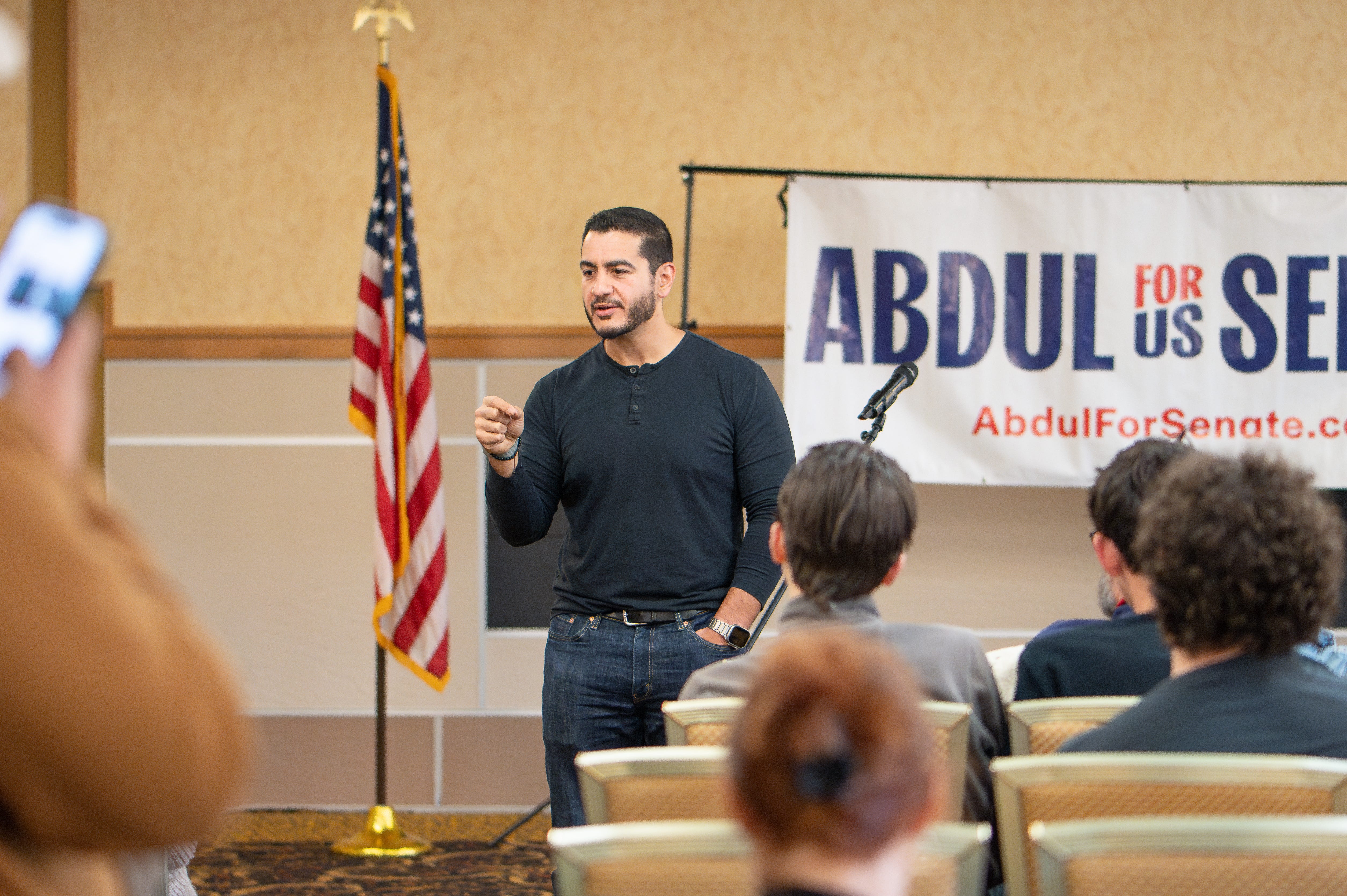
The experience of Michigan Democratic senate candidate Abdul El-Sayed provides a vivid example of the dynamics I want to convey. His race against Representative Haley Stevens was generally viewed within the party and by political commentators as a contest between the left and centrist wings of the Democratic Party. Both moderates and observers predicted that El-Sayed’s leftist policy positions on Israel, healthcare, and other issues would harm him in the general election against the GOP candidate, Representative Mike Rogers. Yet in the last few weeks, we have seen Republicans settle on a line of attack that targets not his economic beliefs and other DSA-adjacent policy positions, but his personal religion and ethnicity. Republicans immediately began emphasizing his full Arabic name, portraying him as un-American and threatening (Alabama Senator Tommy Tuberville labeled him a “TERRORIST” and “RADICAL ISLAMIST.” Vice President JD Vance accused El-Sayed of wanting Sharia law in the United States (a long-running right-wing attack line against American Muslims). And no less a figure than Donald Trump posted a photo comparing El-Sayed and his hijab-wearing wife to the president and Melania, with the appalling caption “two VERY DIFFERENT America’s [sic].”
In attempting to enforce a rigid and self-interested view of what is politically viable or acceptable for the Democratic Party, Third Way and other avowed enemies of the left ultimately betray a basic misunderstanding of how meaningful progress is accomplished in the United States. All manner of policies now considered mainstream, from the necessity of abolishing slavery to the 40-hour work week, a minimum wage, and child labor laws, were once widely condemned as outlandish impositions on the free market and illegitimate exercises of government regulation. There is also the basic political reality that the existence of maximalist policy proposals can expand our political imaginations in positive ways, and create the space for compromise steps that are both beneficial in their own right and lay the ground for bolder changes to come. At a time when the ruling GOP is trying to cripple Americans’ sense of possibility across a staggering range of life, from politics and science, to racial and gender equality, to health care and an economy that brings true security to all, it is nauseating to see a political faction urging the Democrats to rein in their imaginations, and our hope for what we can collectively accomplish for the country.