


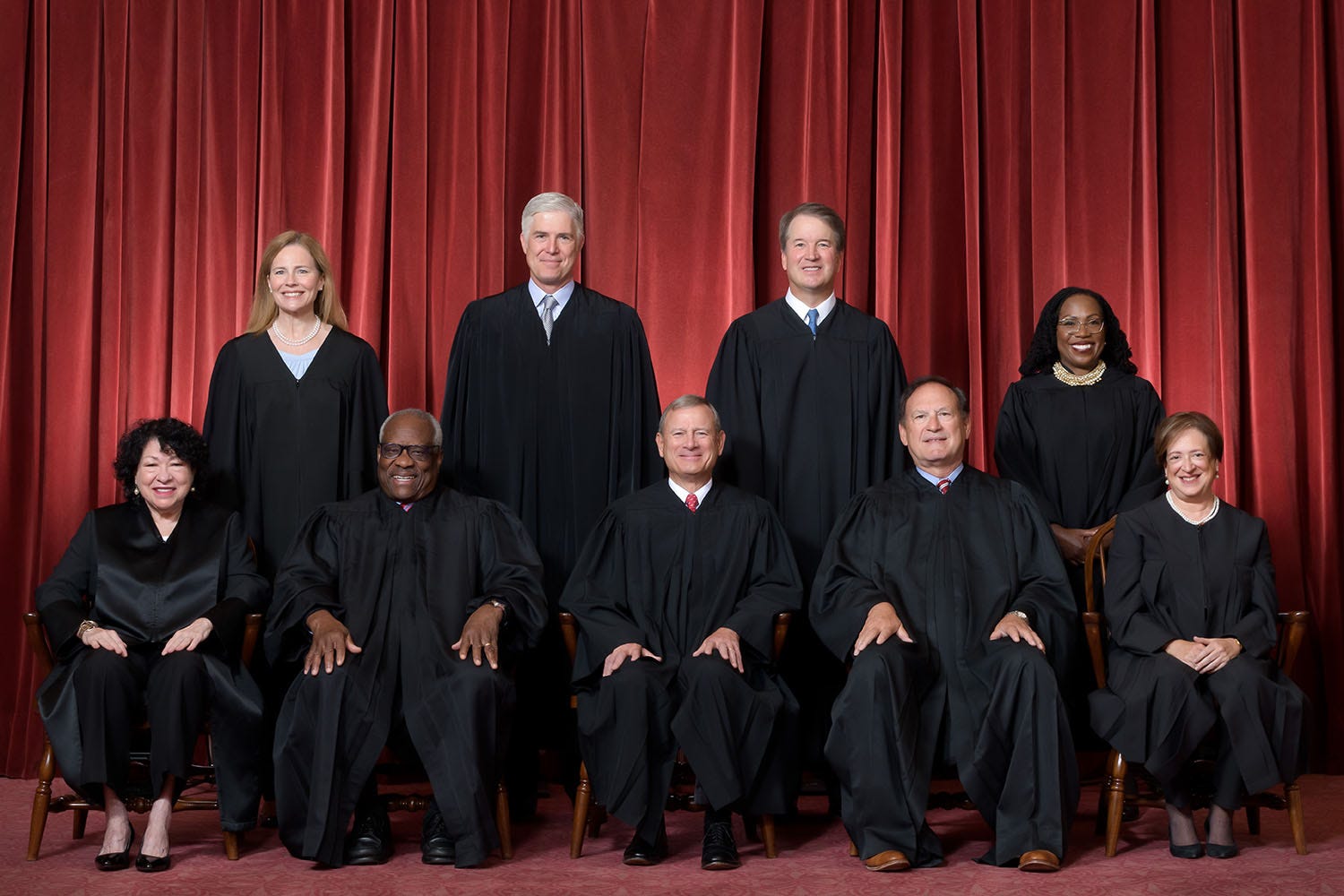
As is so often the case in trying to understand U.S. politics, grasping the full import of the Supreme Court’s catastrophic Louisiana v. Callais decision requires cutting through obfuscatory language and propagandistic spin by the far right and its enablers. The challenge begins with the ruling itself, which mocks and inverts the plain meaning of the Voting Rights Act and legislation that has subsequently renewed and clarified it over the last half century. In essence, the far-right Court majority has advanced the view that, as Adam Serwer puts it in his essential analysis of the decision, “Trying to disenfranchise Black voters isn’t racist; preventing Louisiana from disenfranchising Black voters is racist.” As justification, Justice Samuel Alito (the opinion’s author) asserts that since African Americans overwhelmingly support Democrats, and since it’s permissible to use gerrymanders for partisan advantage, Republicans are within the bounds of the law when they choose to gerrymander African Americans out of political power for the sin of preferring Democrats.
But as Serwer rightly points out, “Congress expressly banned rules and policies that had discriminatory effects, not just those that were explicitly discriminatory in intent.” That is, even if Louisiana Republicans claimed that they were merely trying to discriminate against Democrats, the actual real-world effect of discriminating against African Americans should be impermissible under the actual language of the VRA. In the Court’s judgment, though, the reverse has now been allowed under the fig leaf of partisan gerrymandering: white Americans are free to disempower African Americans (and other minority groups) so long as they claim to be doing so for other reasons.
While the Supreme Court majority hopes that Americans accept their smoke-and-mirrors display, the truth of the decision is brutally straightforward: the Supreme Court has wiped out the VRA — which some call the “crown jewel” of the civil rights movement — and in doing so has cleared the way for white supremacist governments to re-gain political dominance not just in Dixie, but across the land wherever the GOP holds political power.
A main challenge for Democrats and other pro-equality forces, as they seek to reverse this decision and its baleful effects, is to keep front and center the sordid, racist core of what has been unleashed on the country, and to reject efforts to reduce the case and its consequences to simply an expression of partisanship or “polarization.” A corrupt far-right Supreme Court has overturned, on flimsy grounds, a democratically-passed piece of legislation that advanced the American majority’s view that the systematic political disempowering of African-Americans (and other minorities) will not be allowed in the United States. Moreover, the current Court has done so in the context of, and in support of, a broader reactionary movement that is in general rebellion against modern America itself; in this, the Callais decision is of a piece with other recent rulings, such as the immunity decision that essentially set up the president as a de facto king, and the overturning of the right to an abortion. But arguably first and foremost, this movement despises racial equality and the emergence of an egalitarian, pluralist democracy (as historian Thomas Zimmer concisely describes it). In state after state, this movement has empowered a radical, increasingly authoritarian Republican Party to serve its interests and put a halt to our free and modern society, starting with racial equality and diversity (e.g., the war on immigrants) but also extending to state advocacy of misogyny, homophobia, and Christian supremacism.
The shocking white supremacism barely hidden in the Supreme Court decision is both the basic justification for reversing the Callais decision, and the moral basis for energizing the American majority into passionate opposition to the retrograde vision of America that the Court and GOP are intent on shoving down our throats. This white supremacism must be exposed to the full light of public scrutiny; no Democrat should be afraid to utter these two words as a description of the GOP’s vision for American government and society. After all, this is a movement that doesn’t think non-whites should be full citizens; that believes, in fact, that non-whites should be politically disempowered to the greatest extent possible. And we should be keenly focused on the fact that political disempowerment is the necessary precursor to a broader diminishment of the lives of non-whites socially and economically. Shut out from the halls of power by the Callais decision and other racist government policies, non-whites would be increasingly shut out from the life of the nation. It is the prelude to greater police violence against minority populations, to greater economic exploitation, to the denial of the benefits of belonging to a society (such as public education and health care).
The GOP political initiatives underway in the scant days since the Callais decision only add to the case that the threat to millions of Americans is real and that the Democratic response should be unsparing. In states across the former Confederacy — in Louisiana, in Alabama, in Tennessee, in South Carolina — emboldened legislators are pressing forward to eliminate majority-minority House seats representing African Americans. The message of the GOP across the South and elsewhere is unapologetic, if wrapped in the plausible deniability gifted them by the Supreme Court: it’s high time to get the Blacks out of office and out of power. Maps like those highlighted by historian Don Moynihan and others show the enactment of a racist time warp: the states of Dixie returning to their whites-only representation of the Jim Crow era. The shamelessness (as Talking Point Memo’s David Kurtz observes) shouldn’t for a second blind us to the moral grotesquerie — these politicos may feel emboldened by the Supreme Court, but they are acting against any reasonable conception of majority interests and American ideals.
In this way, the GOP has made the essential racism of its political project inescapable; in plain view, they are driving black politicians out of the halls of power, practically in real time, in the very states over which the Confederate flag once flew. In turn, publicly acknowledging, denouncing, and attacking this onslaught has become more pressing than ever for a Democratic Party that has been all too slow to strategize against the gathering threat to the civil rights advances of the past half century and longer. The GOP is practically rubbing its triumphant racism in everyone’s faces; to not name, condemn, and attack the white supremacism on such explicit display would betray the millions who fought for civil rights, not to mention the millions of Americans today who are right to expect Democrats to defend those civil rights now.
The GOP has of course also made the centrality of white supremacism unavoidable through its decade-long embrace of Donald Trump, a man who clearly sees African Americans, Latinos, and other non-whites as genetically inferior, unintelligent, and unworthy of full citizenship. From his demonization of the innocent Central Park Five, to his infamous claims that Mexicans are “rapists,” to his use of anti-DEI initiatives to attempt a re-segregation of the federal government and even American society, to his attacks on Somali-Americans as criminals who shouldn’t be in the country, he is a walking advertisement for the hatreds that thrill and motivate too many in the GOP. Yet we are at an even more incendiary phase of things post-Callais, as Trump’s blatant racism has fused with GOP efforts to reinstate white power in state after state, driven at least in part by the president’s demands that they gerrymander their states sufficiently so that the Democrats can’t re-take Congress and threaten the president’s remaining years in office. Trump has made white supremacism legible in a way that it wasn’t before he arrived on the scene; so have the GOP state legislators rushing to scrub away the presence of blacks in the corridors of government.
To decline to call out the centrality of white supremacism to the GOP’s war on modern America would be to accept the whitewashing that the Supreme Court majority has attempted in its Callais decision, where a hatred of minorities is disguised as simply a wish to disempower Democrats rather than what it is: an anti-democratic attempt to lay the basis for a white supremacist state. While too much media coverage has already focused on the decision as having “partisan” rather than white supremacist implications, there is no need for the Democrats to participate in this charade.
Conveying the moral horror of one of America’s two political parties acting in an unadulteratedly racist fashion should be paired with discussing the larger threat to U.S. democracy; attacking African-American voting rights is indistinguishable from attacking American democracy as a whole. Though the attack on African-Americans is direct and immediate, this is also an assault on other minority voters. Most clearly, it is a grave threat to America’s Latino population, which has already been subjected to extreme gerrymandering in states like Texas in order to dilute its power (a GOP exercise all the more grotesque for how much the party has claimed to have formed an enduring Trumpist majority by attracting Latino voters to the Republican Party). But it is also indirectly an attack on any white voters whose interests align with like-minded minorities, and who with them are able to form majority political coalitions. The most obviously threatened coalition is the enormous multiracial one that stands poised to put a Democratic majority back in control of the House of Representatives in November. The white supremacist gerrymandering allowed by Callais makes it likelier that the Republican Party might win a majority of House seats with less votes than the Democrats receive across the country — already a threat under extreme GOP gerrymandering before, but one which the destruction of the VRA has amplified.
Another immense area of vulnerability for the racist GOP is the fundamentally anti-democratic nature of this ruling itself. It’s simply not the case that a majority of Americans has arisen to repudiate the gains of the civil rights movement. Rather, a sizable minority coalition has gathered to roll back gains in equality by anti-democratic means: via voter suppression, via the incitement of hatred against both outsiders (the war on immigrants) and fellow Americans (minorities, trans people, women who refuse to accept their proper place), and now, via a Supreme Court decision that purports to eliminate the civil rights movement and its arguably single greatest achievement.
Alongside the depressing persistence of white supremacist malice among a significant block of our fellow citizens, we should also recognize the baseline desperation not only in the Callais decision, but in a Republican Party that sees no future for its “traditional” values without the wholesale wrecking of American democracy and the imposition of some measure of authoritarian repression to drag our society back to the 19th century. The audacious attempt to re-impose a white supremacist order on the United States should rightly rouse a majority to enraged resistance.
This decision is not just a blow against African-Americans and Latinos; it is a decision in favor of eternal white supremacist rule in the United States. Recognition of the first provokes outrage, at the injustice; recognition of the second provokes necessary rage, at the grotesque empowerment of modern-day evil.
In his assessment of the Callais decision, Thomas Zimmer contextualizes the ruling within the broader arc of a decades-long right-wing counter-revolution against the gains of the civil rights era. Given the supreme importance of the Voting Rights Act to the shaping of modern America — substantiating the promises of the Reconstruction amendments giving citizenship and voting protections to African-Americans and other minority populations — he and others suggest that this ruling brings to a close the “Second Reconstruction,” in which the modern civil rights movement led to laws like the VRA, which in turn helped push American politics into an imperfect but actual multiracial democracy, and transformed American society in a far more egalitarian direction than ever before in its history. With African-American representation in the federal government potentially wiped out across the South (along with the destruction of their capacity to win office in substantial numbers at the local and state level), and with the real potential of a proudly white supremacist GOP poised to lock in generational power at the state and national level via race-based gerrymandering, this case is persuasive.
But as Zimmer goes on to suggest, understanding the enormity of what has happened does not mean accepting the inevitability of another decades-long epoch of racist repression, like the one that followed the post-Civil War Reconstruction era. While a substantial (but declining) number of conservative white Americans might object to the modern nation that the rise of African-Americans and other minorities has made possible, I am convinced that both a majority of Americans, and a critical mass of white Americans, will not accept the loss of the country that most of us have spent so many decades building together.
But to be effective, this resistance needs to be cultivated and given direction. The reactionary affront to America, and the danger it presents, requires Democrats and others who believe in a diverse, egalitarian future to act decisively to counter the Callais decision; this requires unvarnished descriptions of where the right wants to take the country, a positive vision of the future that lifts all Americans, and a concrete road map for getting there. The intellectual con job of the Court’s decision, and the open depravity of former slave states moving to eliminate the fruits of the civil rights movement, may sooner rather than later prove to be Pyrrhic victories for the white supremacist GOP.
Re-establishing enforcement of the VRA is hardly the only battle that must be fought in order to re-establish a more democratic and equitable modern America, but it is most definitely a cause that illuminates the larger stakes of our moment even as it’s deeply critical on its own terms. The way the Court has acted as a battering ram against the gates of democracy requires that court reform be central to future pro-democracy advocacy. As Jamelle Bouie remarks, “If the Supreme Court is going to act as a partisan institution — as a super-legislature whose judgments override the decisions of voters on the thin basis of ideology — then the only path worth taking is to discipline and transform the court with all the tools Congress has at its disposal under the Constitution.” Here, we should again note again the continuity between the Callais decision and other absurd recent Supreme Court rulings, such as the presidential immunity ruling.
But court reform, as important as it is, constitutes just one front in a far larger battle. Democrats need to think in terms of a democratic transformation that decisively moves the country forward — not just politically, but economically and socially as well. This is not the first time the U.S. has stood at the brink of necessary, dramatic change. As Zimmer puts it, “democratic progress – any attempt at leveling existing hierarchies of race, gender, religion, and wealth – will inevitably lead to a massive countermobilization orchestrated by the forces of reaction. The framers of the Reconstruction Amendments understood this precisely. They sought revolutionary change. Their goal was not merely to restore a status quo ante, or to reform a system that wasn’t worth preserving; they aspired to transform the nation [. . .] as an exercise of practical realism.”
The Callais decision, with its barely-disguised goal of making America white supremacist again, may be the most powerful argument to date that defenders of U.S. democracy have no choice but to think bigger and bolder than ever. And as daunting or even impossible as it sounds, such audacious thinking will necessarily include confronting and discrediting the ideology of white supremacism itself, without which any future pro-democracy reforms must be deemed to be incomplete, and ever vulnerable to renewed waves of reactionary hatred.