
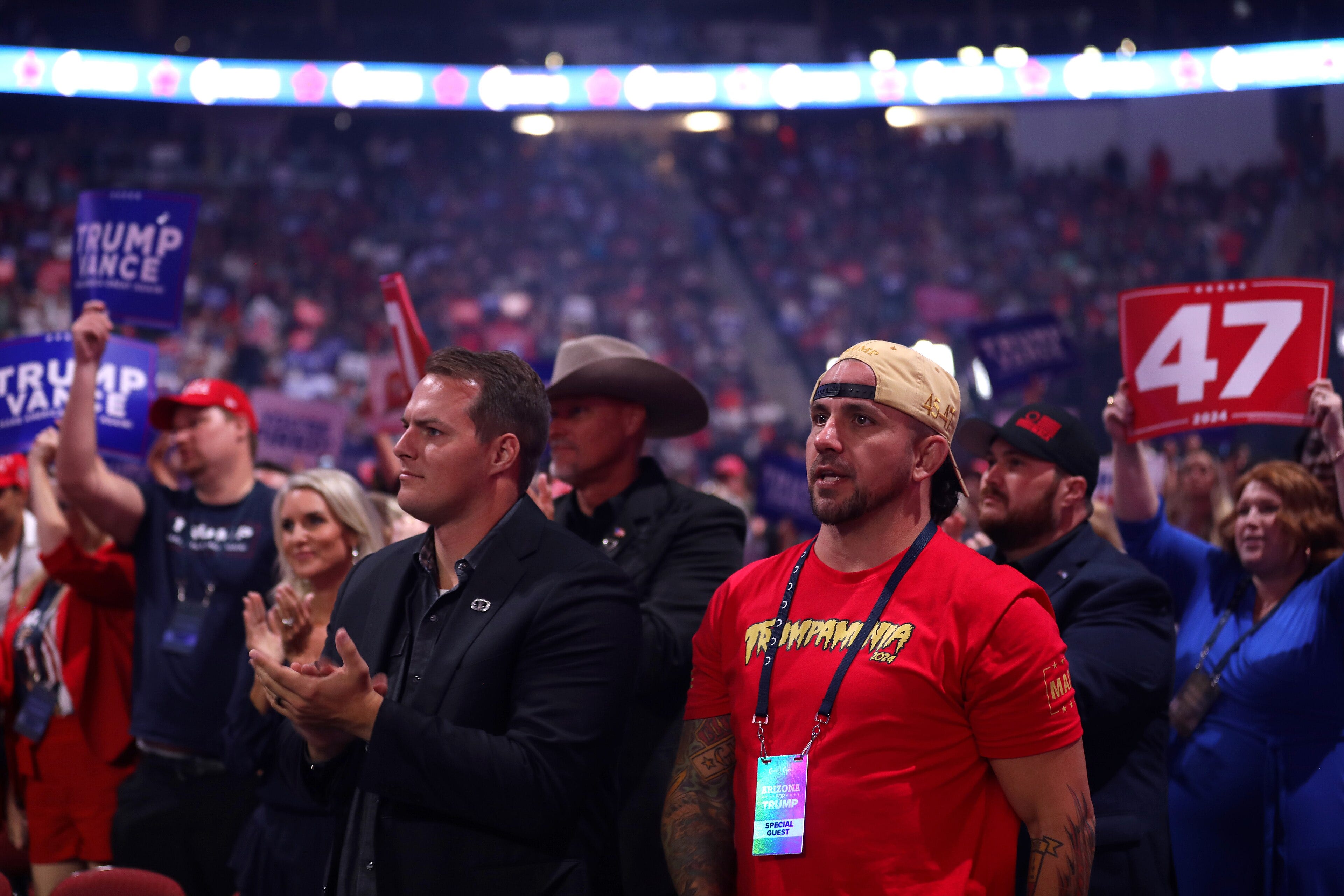
One of the biggest myths in politics today is that Donald Trump’s supporters are just a gigantic monolith, a group of people who will say whatever he says and believe whatever he tells them to believe.
While there are many Americans who will change their opinions to suit Trump’s, it’s also true many people support Trump for their own reasons and reasons, which may not be compatible with his form of governance and the agenda that he has been imposing since he became president for the second time.
It is certainly the case that a lot of Trump voters are super fans of his and really do view him as some sort of blunt instrument to attack a culture gone awry in their opinion.
But there are plenty of people also who don’t pay attention to news and who may not be religious at all who supported Trump in 2024. That matters because these people are, in many cases, up for grabs this year and in years to come.
So why did they vote for Trump? Joining me in this episode to discuss is Stephen Hawkins. He is the global director of research at More In Common, which is a research organization that does political polling and psychological analysis of voters to analyze why it is that they have certain opinions, and what opinions they might have in common with other people who vote differently. They released an extremely large survey earlier this year called “Beyond MAGA” that’s very much worth your time.
This is an audio-only episode. Access the episode page to get the full transcript. You can subscribe to Theory of Change and other Flux podcasts on Apple Podcasts, Spotify, Amazon Podcasts, YouTube, Patreon, Substack, and elsewhere.
Related Content
Latino evangelicals are reshaping American politics, politicians and parties should take notice
How much do political party leaders know about the Americans who vote form them?
In 2024, Trump was betting bigly on ‘unlikely voters’
Charlie Kirk built a powerhouse organization based on finding needy young people 🔒
What does it mean for Democrats’ future that many black Americans don’t like them?
Why attacking Trump will not be enough to stop his movement
Mentioned paper: “Belief in a Dangerous World Does Not Explain Substantial Variance in Political Attitudes, But Other World Beliefs Do”
Audio Chapters
00:00 — Introduction
10:11 — ‘MAGA hardliners,’ the hardcore Christian nationalists who see Trump as divinely destined
15:51 — ‘Mainline Republicans,’ party loyalists who don’t follow news much
17:47 — Politics as a cognitive style and deeper antagonistic divisions
22:50 — ‘Anti-woke conservatives,’ a more secular group that is oppositional more than affirmative
32:27 — The ‘reluctant right,’ a younger group that knew little about politics
36:51 — Did Elon Musk’s ads in Pennsylvania win the state for Trump?
42:43 — ‘New traditionalists,’ young men with very strongly misogynist viewpoints
53:48 — Younger Trump supporters favor more extremist media figures
58:03 — Reactionary religious identity as an act of youthful rebellion
Audio Transcript
The following is a machine-generated transcript of the audio that has not been proofed. It is provided for convenience purposes only.
MATTHEW SHEFFIELD: So, before we get into the findings that that you guys have been compiling over the past several months on this report, tell us about your organization. Where’s the name come from and like what, are you guys doing?
STEPHEN HAWKINS: There’s a member of Parliament in the UK named Jo Cox, who was serving a district in the central north part of the United Kingdom, and she was a vocal proponent of the country accepting Syrian refugees and other Middle Eastern, North African refugees at that point. This is in 2016, and as a result of that support, she was publicly attacked and ultimately murdered by a white nationalist, effectively a neo-Nazi.
And as he was killing her, he was saying Britain first. Britain first. And so there was an outpouring of support across the UK. It was a historic moment, somewhat similar to the Gabby Giffords moment in the United States, but obviously with a sadder outcome. And the phrase more in common was taken from Jo Cox’s maiden speech in Parliament, her first time taking the floor of House of Commons, where she talked about her constituents having more in common despite their religious and ethnic and other differences.
And [00:04:00] so since 2016, since her passing More in Common has been working in the United Kingdom, France, Germany, Poland, Spain, the United States, and now in Brazil on understanding these forces of division. Why are we so divided relative to. Relatively quieter periods in her past? How do those differences relate to views on subjects like identity?
How do they relate to our beliefs, and especially to our psychology? And we work with social psychologists and political scientists to bring the language of those domains into polling. And then we conduct national studies. We do a lot of focus groups, and we try to help make sense of our time so that government leaders, business leaders, civil society, can better communicate with the public and better understand what’s happening during very confusing and concerning times.
SHEFFIELD: Well, and, yeah studies in cognitive psychology have pretty conclusively demonstrated that political ideologies and attitudes and partisanship they are manifestations of deeper values and even cognitive styles themselves. So in other words, the, epistemology of someone, in many ways, epistemologies, they are really what most prolonged controversies, social controversies are about.
And that’s not something that I think conventional political analysis has realized yet. People tend to think that, oh no, it’s just about the issues or just about the candidates, but that’s not what the, that’s not what the data suggests, right.
HAWKINS: Well, actually, it’s a really interesting point that you raised because I don’t think that there’s a static answer to that question. I think that, and this is my hypothesis that we’re gonna be exploring over the coming year with a revisiting of. Questions that we posed for our foundational study in the United States, which was [00:06:00] called Hidden Tribes.
We released that in 2018. And I think that the hypothesis that I’m curious to explore is, it the case that in an earlier period in the United States, in the earlier 20th century, we had common picture of the country, or similar pictures of the country, but different values. For instance, some people had a strong value towards authority and loyalty and wanted to see a harsher, more draconian, more orderly immigration system.
And others want to see a more empathetic, more universalist approach, more forgiving approach to immigration. But both are kind of seeing the same image. And now we might have seen that as the conflict has become more hostile. And we do know also from the political science that affect polarization has risen in the United States, meaning that the.
The emotional register of the conflict has gotten much worse between Republicans and Democrats in recent years. Do the underlying values matter as much anymore or has the conflict taken on a more tribal nature where it’s just that group is one I dislike, I know my team and I prefer it. And the underlying psychology of values takes on a secondary role when the conflict becomes about the group hostility as opposed to the underlying things that maybe brought the conflict into being.
SHEFFIELD: Well that is, I mean, it’s definitely worth exploring. And there are some pieces in, in, in the, report that we’ll discuss today that I think I have some, relevance to, what you’re saying.
So, okay, so the report though, that we’re gonna be talking about today though, is one that your organization released a couple months ago that is exploring the idea of that people who supported Donald Trump in 2024 that they did so for, differing [00:08:00] reasons. And that while people might want to, label all Trump supporters as sharing the same beliefs or sharing his beliefs what your findings suggest is that there’s a lot of people who may not even know fully what Trump believes or, wanted to do. And that they voted for him, just because they didn’t like Joe Biden or for, a variety of other reasons.
So let’s if you could talk about the four groups generally, but before that talk about how it is that you guys ascertained that there were four groups and how many people you were, pulling in the survey here.
HAWKINS: Great. So this Beyond MAGA project was very extensive and did a lot of repeated polling. So all in, we had 18,000 survey participants, including almost 11,000 Trump voters. We conducted, we’ve now conducted eight waves of polling within this framework. The original poll where we did the classification was among 2,500 or so Trump voters.
We included questions in what’s called a cluster analysis, so the input variables that went into cluster analysis related to attitudes towards constitutional questions, orientations towards President Trump and descriptions of him questions of loyalties between President Trump and the Republican Party and other questions of sort of that vein.
And then what we used is a method called K-means Cluster Analysis, which allows you to identify similarities in the responses across your sample, and then group people together on the basis of that similarity. And so there’s an observed homogeneity across the subgroups that we identified here.
And so we identified four: MAGA hard liners at 29% [00:10:00] anti woke conservatives at 21%, 30% that we refer to as mainline Republicans. And then the final 20% who fit into a group we call the reluctant, right?
‘MAGA hardliners,’ the hardcore Christian nationalists who see Trump as divinely destined
SHEFFIELD: L et’s talk about these, the four groups here. So I think the, group that is probably most famous and most devoted to Donald Trump is the MAGA hardliners as, you call them which is obviously a very apt name. So this group is, tends to be more evangelical than the other groups.
It tends to be older. And it tends to have a very, what scholars now pretty much call a Christian nationalist viewpoint about politics. So tell us a bit more about the findings with this group please.
HAWKINS: So the MAGA hardliners, that’s a good introduction, are distinct relative to the anti woke conservatives in that they are not as likely to have a college degree. They’re less likely to live in suburban or urban areas, and they are three quarters, gen X or baby boomers. So they skew older. About nine and 10 are white.
And this is a group for whom MAGA is not just their political preference, it’s not a transactional thing, it’s part of their identity. They say that being MAGA is an important part of their identity. A majority of them say that. And as you alluded to with the Christian nationalist point, they’re also likely to say that supporting President Trump for them as part of living out their faith.
They believe that God intervened to save President Trump’s life in Butler, Pennsylvania when assassination attempt happened. And they trust President Trump more than any other messenger or commentator in general when it comes to understanding American politics, what’s happening in the country. They have a strong antipathy towards progressives, Democrats undocumented or illegal immigrants protestors, the L-G-B-T-Q movement.
And so President Trump plays a very interesting and important, arguably central role in the lives of [00:12:00] many MAGA hard lidars because he is defining the moment for them, we refer to him as playing a kind of grand narrator role in their lives.
The MAGA hardliners are a group that would’ve been derided, perceived to be derided by the coastal elites, whether it’s the Hollywood class, whether it’s the Ivy League professors in academia.
And this is a group that Hillary Clinton referred to as a basket of deplorables. And they’re aware of that. Evangelical white Christians not feeling like they’re respected by progressive left at all. And so President Trump also plays this kind of redemptive role in the sense that he is powerful, he’s wealthy, he’s part of the elite, and he says, I respect you. And they feel that way.
They very much feel that they’re respected by President Trump and not by Democrats. And they transgression that President Trump plays in opposing progressives and defying their social norms is very much part of the appeal for them too. We had a great quote from one of our participants in this survey who said, President Trump is like a giant flashing orange middle finger, and I love that.
SHEFFIELD: Yeah, I literally have that in my notes as quote. And that role as you guys characterize it, is that, that Donald Trump is a blasphemer for them. And and, it’s because, they do see, non traditionalist Christianity as-- they see it as a religion.
Even if the people, who are not religious, they don’t see it as such. and so that’s, I think that’s a, huge part of, what they’re doing.
They also, as you mentioned, with regard to his the assassination attempt on him in Butler, Pennsylvania that was, I mean, the, number is striking. It’s 94% said that God had saved him for that moment. And it was much lower for everybody else. So 56% of mainline Republicans are only 44%. [00:14:00] Anti and then 9% the reluctant right. So these are the people that are, the floor in his support base is, what it looks like because they see him as their instrument against modernity in a lot of ways it seems like.
HAWKINS: I think it’s a bit harsh to say an instrument against modernity in the sense that modernity encompasses technological advancement and a broader set of social changes. And I don’t think that they’re opposed to the wholesale arrival of modernity, but I do think that they’re frustrated with the cultural direction, especially that the progressive left has defined.
I think this is a group that would be very compelled, for instance, by the critique that Curtis Yarvin has made in referring to the Cathedral which he refers to in his writings, which are, which is effectively the idea that Silicon Valley, Hollywood and academic worlds and the publishing worlds-- basically our cultural sense-making institutions and the information, infor, the information economy as well as our moral direction-- has all been defined by a kind of common agenda of secular liberals, and that’s been the case effectively for about 60 years in this country. I think that is the critique that would be maybe not formulated in those terms, but that’s the frustration, maybe more narrowly than modernity wholesale for the MAGA hard liners.
SHEFFIELD: Yeah. Well, I think that’s perhaps what they might say, but you know, it’s also manifesting in terms of what they think about vaccines and other topics like that. So, yeah, broadly speaking though, it’s, yeah, it’s this idea that ‘the world has gone mad and that departed from the, righteous beliefs that we have,’ generally is what it seems like.
‘Mainline Republicans,’ party loyalists who don’t follow news much
SHEFFIELD: Okay. So then the other group which is the largest group the mainline Republicans, so, talk about those. I think to some extent [00:16:00] people might think that people who oppose Republicans might think that this group doesn’t really exist anymore, but in fact, they do.
HAWKINS: That’s right. They do. And they’re among the largest groups at 30% mainland Republicans. I also think of them as default Republicans in the sense that I think they would’ve supported Romney in 2020 or 2024 or 2016. I think that they would have supported Nikki Haley had she gotten the nomination.
These are people who just lean conservative. They are more, they’re religious on average. They transcend generations and racial groups. This is the most racially diverse of the four segments. They’re not especially politically engaged. And so when they express support for President Trump, unlike with the MAGA hardliners, where they would be able to say, here’s the reason, and this is, Trump said this, and this is the issue.
And I heard Trump say this is a rally. But the mainline Republicans, it’s more that they trust the president, they like him, they’ll speak in briefer terms. They have a general attitude towards things. They dislike Democrats. And it’s, kind of, it’s less informed because politics just isn’t a part of their day-to-day.
And so they make up a really crucial constituency though because they’re numerous, right? They’re three in 10 of his voters, and they are going to be slow to break from the president, not because they agree with everything that he’s doing, but because they’re not paying attention to everything that he’s doing.
And they’re, orientation towards conservatism and towards being a Republican is in their minds, likely something that they will always embody. And so they’ve kind of made up their mind about the basic question of who they’re gonna support, and they’re gonna be slow to move away from that.
Politics as a cognitive style and deeper antagonistic divisions
SHEFFIELD: Yeah, that it, their conservatism is, a cognitive style more than it is a, an affirmative political ideology. It’s just, there, these people are not out there reading Breitbart or, [00:18:00] watching Newsmax or something. These are people, if they would look at news at all, they’re, what, reading the New York Times if that,
HAWKINS: can you say more about cognitive style? What? What do you mean by that?
SHEFFIELD: Well, I mean in the sense that so there, there was a study that came out a, couple of years ago, I think it was 2024, I believe, and that was talking about the importance of authority. that’s, so it was a meta study looking at cognitive modes and it, was comparing it to value based ideas.
So, they were, it was saying that, well, actually, it’s just simply the idea that there’s a natural ranking to the world and that’s the way it is. And, so therefore, anything that kind of departs from that is going to be inherently wrong and also ultimately unjust. And so that, that’s manifest in, in, in with, in political ways, but it also manifests in a number of other ways in terms of, like people who were like, organizational members in some other capacity that they resist change or resist new members or new ideas just because they think that it’s risky.
HAWKINS: Very interesting. We’ve, been exploring this idea of natural hierarchy as well. And we’ll be writing about it in the coming year.
SHEFFIELD: Okay. Yeah. Well, and I’ll, put the link to the study in the show notes, but I’ll send it to you separately as well. I think that’s probably the, it seems to be the most data-driven of the research because, like there’s, there, there are a lot of. People that have, argued, for things like right wing authoritarianism or moral foundations and, generally speaking, these frameworks tend to be externally imposed from the top down rather than based on the bottom up through data aggregation, I would say.
HAWKINS: And so top down in this case, meaning from by the scientists.
SHEFFIELD: Yeah. [00:20:00] So it’s using the, it’s, these are operating within degrees of freedom of the analysts rather than emerging from the data set organically, is what I would say. So this, idea of hierarchy is, it is an emergent belief in the meta study that, that I’m thinking about here. But if you haven’t read it, then I, it’s hard to have a, substantive discussion about it.
But maybe we’ll we’ll have to do another one once you
HAWKINS: We will do another one. Yeah, I’d love to opine on that. We’re with Hidden Tribes. We’re, doing a systematic analysis of different theories, including Moral Foundations theory, including work by Karen Stenner on authoritarianism. We also included some questions that relate to hierarchy. We’re looking at questions that measure in group identity, strength, things like this as predictors of where people land on questions that are very salient to our political division today. Whether that’s support for Trump, that’s views on immigration, views on trans issues, et cetera.
Because we’re, trying to figure out what is, what are the strongest psychometric variable relationships to the questions that are most divisive now? And it’s, not obvious that the questions about values are the ones that are most predictive, as you’re suggesting here on, with the critique of Moral Foundation’s theory.
We have used Moral Foundations theory historically, and in our 2018 report, found that it was correlated very well with our seven tribes. Particularly the foundations of authority, loyalty, and purity, which are the ones which define conservatives, relatives to relative to liberals.
But what seems most alive in the data to us now are these intergroup hostility measures, which are really showing the strongest relationship to where people land on political questions today, which is, it’s an alarming signal. And I’ll just share one other data point that we just, we haven’t published this, [00:22:00] is just data that we collected in the last six weeks or so.
But we asked a question about whether Americans think that the other side of the political side is a cancer and whether it needs to be extricated from society. And 52% of Americans roughly identical levels across Republicans, Democrats and Independences opted to describe their political opponents as a cancer.
And we see high levels of people expressing support even for reeducation camps. We’re gonna do some work to make sure we know what people believe Regie reeducation camps are before we publish that. But the. The emotional hostility is what seems to be in the foreground right now, much more so than values differences based on our preliminary analysis.
‘Anti-woke conservatives,’ a more secular group that is oppositional more than affirmative
SHEFFIELD: Yeah. Well, and, that’s definitely the case with the third group that we are, we can talk about here, which is the anti woke conservatives. That this is a group that is extremely negatively polarized like that’s seems to be their primary motivation. They, don’t necessarily know, many of them don’t know what Trump’s agenda is, or they don’t really care about it, except as a way of, stopping the Democrats who they see as evil.
I mean, literally let you guys poll on that question. And, they’re the ones that were the most likely to agree on it. And, the concept of wokeness is, I think. Has been really effective for for Trump and his supporters. and it’s interesting though, because this, label, it, is, I mean, it is just a relabeling of previous belief systems that have, that they, it is like every few years re Republicans will come up with a new label and say that this is this new type of, liberalism and it’s different from the ones before in a [00:24:00] uniquely terrible way.
And it’s a threat to America, so before it was political correctness. And then before that it was multiculturalism. And then before that it was, hippies just generally speaking. So it’s like there, this, but, it always gets, just slightly tweaked a little bit differently so that it can be put forward as a, unique different threat. And, I think that’s seems to be, really effective for these, anti-woke conservatives in terms of their motivations.
HAWKINS: I think I view this question a little differently than the way you framed it there. I, think that with our hidden tribe study in 2018, we differentiated between traditional liberals and progressive activists and traditional liberals, I think could be fairly described. As the inheritors of the hippie worldview, and many of them themselves may have been hippies, traditional liberal skew older, and it’s a universalist worldview.
Everybody should have peace. Everybody should have their rights. Everybody should be respected. It’s a multiculturalist worldview. They don’t differentiate, well, differentiate meaningfully between religions or racial groups. They, they, believe in humanity and they’re the sort of people who would have the coexist stickers on their bumpers.
And they believe in the scientific process and they believe in the large role of government to try and bring about better conditions for everybody. Progressive activists, I think are a different variety of it’s a different variety of worldview in that it looks very much at group identity and power as the primary lens through which to understand society and the primary lens through which to intervene to make society better.
And so the, primacy of racial identity, of gender identity of sexual orientation is more reminiscent of a kind of Marxist way of thinking where you’re policing people into a hierarchy of lower power, higher power, oppressed, [00:26:00] marginalized, and then doing the sociological thinking and the policy thinking in those terms than it is simply a continuation of the traditional liberal perspective.
And so I, think that it’s, and I say this as somebody who worked on the progressive left professionally for several years, having sort of converted. I grew up in the conservative worldview. I grew up in a Republican home and then I was an active Republican in into my college years here in Washington dc And then I.
In the Obama years, became a Democrat and a liberal, and then went to work in progressive activism. And something happened between the, in early Obama years and the activists activism of 2016 through early 2020s. That felt like an inflection point, not just the continuation of previous trends. So I, think that there’s more to it than simply a rebranding exercise by Christopher Ruffo and others to make everything be about wokeness.
And I think it’s, been challenging to define wokeness because of how. Well, I just tried to do it and it took, it’s taken me about 10 years to get a good definition going. And so I think a lot of Americans, a lot of conservatives couldn’t precisely define it. But I think the anti woke conservatives probably could, and their frustration would be at a sense that there’s too much emphasis on group identities and that’s counterproductive.
SHEFFIELD: Although, they have that sense about people on the left, that they believe that’s a, their viewpoint, but they also don’t feel like that’s bad, that Christian identity politics is wrong or that they can’t even see it. It seems like. And so, yeah, I, so I’m not saying, so when I say that it, this is a rebranding of previous labels.
I’m not saying that it’s that there’s not nothing that there’s not anything there. I’m saying that these are just labels that were used. So if you go back and look at.[00:28:00]
HAWKINS: Mm-hmm.
SHEFFIELD: Russia Limbaugh transcripts, where you look at, 1970s or eighties books by Alan Bloom. He had a Closing of American Mind book.
It was basically this same critique. So it’s, like, yeah, there it is. Like they’ve discovered that there are people on the left who do have a different viewpoint of what liberalism should look like, and that they see that as uniquely threatening. And not incorrectly necessarily as tied somewhat to, some post post Marxist viewpoints or epistemologies.
HAWKINS: Mm-hmm. Mm-hmm. Yeah, I think that’s right. I mean, when we ask, we have a chapter on wokeness in the report, and we ask about whether people think that our, culture broadly including our media, has been ruined by the progressive left. And the numbers are very high among anti woke conservatives and my hardliners.
But almost regardless of how you formulate questions around wokeness, whether it’s about cancel culture, whether it’s about transgender issues, you see a big drop off with the mainline Republicans in the reluctant right, who just, they’re not as engaged on the culture war issues. They’re not listening to Ben Shapiro, or reading Breitbart, or Dan Bongino, or any of the other Daily Wire guys, for instance. And so they’re not versed in this. And if you talk to ‘em about wokeness, these less politically engaged Republicans, they have a story to tell you about something that happened at their daughter’s school, or they’re not sure why this Marvel character has been cast by someone from an ethnic minority, or it seems like you can’t say this word anymore, but they haven’t stitched it together into a philosophy and defined that and then said that they’re against it.
But for the anti-woke conservatives and the MAGA hardliners that’s been done, they have an opponent and it’s been defined.
SHEFFIELD: Yeah. [00:30:00] Well, and suggest also that in terms of the change that you were talking about that, it seemed to happen during the Obama years on the left in your observation. I think it, it, it might be that, that the activists of, these groups, they, they overestimated the public support and familiarity with their epistemologies, and with their political issues.
And so they thought, okay, well now, like, and the best example would be about trying to move immediately into transgender rights without having had this explanatory movement that existed before that laid the groundwork for same-sex marriage rights. So in other words that, a lot of people were, in the closet who were lesbian or gay. And so people didn’t know that they knew people who were that. A lot of heterosexual people.
And so, it, it took a while for them to become comfortable, people who might have had these mainline Republican viewpoints to realize, oh, well, if this person, my colleague, is not trying to convert me to homosexuality like that’s, that is a, like, I, I know a number of, elderly people who had that viewpoint for, a number of years that they thought that it was something that could happen.
And and you see that also with this belief that, being trans is contagious somehow. And like it’s literally just a re recapitulation of it. and so many of the arguments that are used against trans rights, I mean, they are literally the same arguments that were used against people who were gay or lesbian.
HAWKINS: Right. I mean, I do think that the, age component really does matter here. I mean, we’re our most recent analysis. On, I mean this has changed the subject a bit, but on Iran and Israel and inflation, like all of those issues correlate well with [00:32:00] generation and across the four types. Just something I want to emphasize is that the MAGA hardliners and anti-war conservatives, their median age would be somewhere in the sixties likely.
And then as you move to the mainline Republicans and reluctant right. It drops down considerably. And so yeah, generation is really important here. And I do think for these questions around gays and lesbians and transgender people, the generally racial differences are really important to, to underscore.
The ‘reluctant right,’ a younger group that knew little about politics
HAWKINS: I think that just leaves us with a reluctant right. To define, right?
SHEFFIELD: Yeah, that’s right.
HAWKINS: So the reluctant right. Is did you wanna say something about that?
SHEFFIELD: Oh no, you can go into it to go.
HAWKINS: Okay. Sorry. Didn’t wanna pre up you. One fifth of the Trump 2024 Coalition. They’re the ones that are in discussion right now because it’s a dynamic group. We did some polling at the end of 2024, right after the midterm elections actually, that showed that among across the whole population actually there was a significant misperception of the priorities of the Democrats, where significant numbers or actually on average, Americans thought that the priorities for Democrats were in this order, abortion L-G-B-T-Q issues, and climate change, and they thought Republicans priorities were immigration, inflation, and the economy.
And of course, most Americans top concern in 2024. And indeed their top concern today is economy inflation. And so that mismatch between seeing Republicans is focused on the right big picture questions. And Democrats being focused on activist issues was something that for the reluctant right, helped them see President Trump as the right answer to their concerns in 2024.
And so the reluctant right, is disproportionately represents those younger voters, young men, of color, who decided who to vote for in [00:34:00] 20, 24 weeks, or even days before the election, and did so in a pretty transactional way. They thought Donald Trump would bring back a better economy, lower unemployment, lower prices, and that Harris had some kind of progressive agenda, or at least wouldn’t be as competent on the economy.
And so now 18 months later, the question is whether those voters are happy with the economic performance that Trump has provided, and they’re increasingly disillusioned with the war in Iran and what that has done on questions of inflation. And so we’re seeing that now over a third of the reluctant right, are expressing some regret about supporting President Trump.
And they describe him in critical terms when we ask them to grade President Trump’s performance across issues. And overall he gets grades in the fifties or the low sixties. So he’s getting Fs on average from the reluctant right now, who are underwhelmed by his performance, and see him as increasingly as an irresponsible decision maker.
I’m happy to get into the Iran questions more, but I think that might be further afield in the conversation.
SHEFFIELD: Well, yeah, we can get into that, but I did, yeah, want to just touch about their, inclination a bit further though. So like, last year the Pew Research Center came out with a study looking at how Americans consume news. And one of the findings that they had was that younger Americans, they don’t look for news that they’ve happened upon it essentially because they’re not, it’s not something that’s an, interest to them.
They say that they don’t have time for it. And, that matches what you guys are talking about here with the reluctant right, that these are not people who are, as you said, are, consuming right wing media and they have no idea, might not have any idea who Dan Mino is.
Probably not. And, I’ve never heard of Laura Ingraham or, so, but they like, watching comedy. And so [00:36:00] they they, might happen to, like Joe Rogan or one of these other people, like the Theo Von and, those people, they were pro-Trump in 2024, and it was so it was, a, vibes based viewpoint of, rather than an issues based viewpoint, except, in terms of like the broader, more specific things.
Well, who, what’s your plan on, social security or taxes or whatever, it was just more, and maybe not vibes entirely, but some of it was, well, I think Kamala Harris is, an airhead or I think, Donald Trump is a good businessman. And he says he’s going to, I mean, he had a sign literally that said Trump low prices, Kamala high prices. Like that’s, it is as easy as you can get to explain what the message that he was trying to push.
Did Elon Musk’s ads in Pennsylvania win the state for Trump?
HAWKINS: Yeah. and the big, message that he was pushing in the final stretch before the election was the $450 million that he and Elon Musk put into the, he’s for you. She’s for they, them. Ad campaign, which you know, very successfully in my interpretation, painted her as someone who was ideological to the point of surrendering her critical thinking and supporting something like incarcerated illegal immigrants, having access to gender reassignment surgeries that were publicly funded.
And it was an effective putting of the finger on the scales against her that I think helped tip the election in his favor. And that was, I don’t know this for certain, but it been the most well-funded presidential campaign ad in history.
SHEFFIELD: Yeah. Well, I’m not sure that particular ad was that effective, just because television ads are not effective in the scholarship. Like they generally are not. But on the other hand, I, [00:38:00] that’s a, larger, it’s part of a larger overall message which I do think was effective. Just simply because like that was a thing, a message that the, the, anecdotal political people, like the guys that talk about guns on YouTube, or driving around in the mud, like hiking or whatever, weightlifting, like the, that was a simple message that they could use. And then push to their audience.
Because I just don’t, I think, people have ad blockers now, like they love ‘em. I love them. And the internet’s a lot nicer when you have an ad blocker. And so, but not to say there weren’t any effects on it, but generally speaking, the scholarship is pretty clear that in presidential elections, they don’t have much of an effect.
HAWKINS: I think I’ve just seen that the, testing of that ad somehow got released and showed that it swung certain swing voters towards him in a meaningful way. But then, the question is whether the at a sufficient scale, people saw the ad and, then whether those are the people who changed their mind or not.
SHEFFIELD: Yeah. Well, and I guess the other thing that that I say on it, on ads is that when you test an ad, you are automatically altering the perception state. So you, in other words, you are getting people who are volunteering to watch an ad. Like most people hate ads. So like, to the extent that it does anything on them in a controlled setting, in a lab environment, if you will, that’s an altered state and it’s not a field appropriate.
But it, but of course all pulling is that way. So like, I mean, it’s, you can’t, it’s hard to say. I like, that’s when, when you look at in the polling industry, it is a common topic and I think that journalists who talk about polls tend to overstate the degree to which the certitude can be ascertained especially if it is [00:40:00] involving self-assessment.
Because opinions change rapidly, on a given day, especially for people who have inco beliefs. That, so it might be effective in that moment, but on the other hand, if they don’t remember it, did it have an effect? And how could you measure it if it had an effect? It’s hard to say, like, and so that’s why I, would say that, like these, more advocacy type media, so like if you look at, this point now, video, political video is now dominated by the right.
So you’ve got, Ms. Now, which, and then, which is, a full service channel. And then I think you’ve got a democracy now, which is a further left channel, but they’re not full service. And that’s pretty much it. Like there is no alternative really to Ms. NBC or sorry, Ms. Now. Got it. That right. Whereas on the right, you’ve got a bunch of alternatives to Fox and that, collectively they, they produce a volume of output and then you got talk radio and, YouTube hosts and whatnot. So it’s just, there’s just this massive flood of content into YouTube and other social media sites that the broader left just doesn’t, seem to be interested in it. In doing this kind of advocacy media, from what I’ve seen.
HAWKINS: Mm-hmm. Yeah. Yeah. Well, I think establishing causality and interventions is really challenging for the reasons you mentioned. And of course, we know there are decay effects of things that are reported seconds after watching a video aren’t sustained a week later. But in any event, the, three data points I’m just tethering together are one.
An awareness that in, those lab environments, flawed but best available data we have, that showed meaningful relative to other types of interventions and other types of a high degrees of efficacy and persuading people towards Trump to the overwhelming scale of the intervention in the final weeks of the [00:42:00] campaign, as I said, half a billion dollars.
And then three is just the data point that we know that there was a strong association with between Democrats and trans issues that carried through the election there. So we’ll never know entirely whether it was the causal factor, but when you, when, Trump won by such a narrow margin, like 1.3, 1.5% of the popular vote the right way to think about that is that anything that had any appreciable effect had a decisive effect because any of the 50 things that mattered, down the final stretch, it likely was, enough to make the difference between him winning and losing.
SHEFFIELD: Well, there’s just any number of things that could have done something and, they’re all worth considering.
‘New traditionalists,’ young men with very strongly misogynist viewpoints
SHEFFIELD: All right, so one of the other big findings in the report beyond MAGA that you guys did what we’re talking about here is you did a, focus on younger Trump supporters.
And we’ve talked about that many of them are kind of reluctant right people, so they’re not very engaged and not particularly aware of, of what he’s doing or, what he wants. But there is another subset of people that that you guys are calling the new traditionalist. And that these are people who, especially younger men who have much more negative attitudes toward feminism, toward women in some cases and to, or women’s independence.
And this is research that, a research topic that a number of organizations have been trying to delve into. But it is difficult to do this type of research. So tell us a little bit about that, if you would.
HAWKINS: I would sure. Yeah. So we’re, we refer to it as an emergent new traditionalism. And the distinction might seem superficial, but the reason we decided to call it emergent new traditionalism rather than new traditional lists. So rather than a group of people, but it’s a broader trend, is that it’s not, [00:44:00] there aren’t clear boundaries around this phenomenon.
And we found it hard to identify people who matched a lot of criteria at the same time. So for instance, gen Z Americans show a kind of frustration and fatigue and underwhelm with American democracy, and that’s a pretty general trend. There is a very low level of active hostile feeling towards Jewish Americans and Jews more generally in the American population, but it’s there at choice levels three, four or 5%.
But that’s much smaller than, for instance, the level of support for a strong president who, challenges the limits of his power and does things that that might take away power from Congress or that might ignore a Supreme Court decision. and then, so there’s, a lot of converging threads here.
I’m mentioning too, anti-Semitism and a kind of loose level of commitment to the Constitution. And then you’ve mentioned a third, which is this thread of a reconsideration of gender norms. And it’s been hard to get the right language on this because part of what we’re seeing is people saying that they think that the man should lead and the woman should follow.
And that just feels like a reversion to traditional gender norms, but we also see it pretty high levels. An affirmation of the idea that women should have the freedom to choose whether they go into a career direction or into a home and family direction. And so it’s getting the right language around the gender questions has been challenging.
And then the fourth thread I’ll just put in here as well is this belief in religion and a return to religiosity, which is something which there’s been a lot of discussion about and it’s been very hard to measure as well. And I think I just wanna mention [00:46:00] from a methodological point and data collection point, part of the challenge here is that the way that polling is working now is primarily through convenience sampling, data collection processes where you’re paying somebody some amount of money to, on their phone or on their browser, take a 10 or 20 minute survey.
And across panels across not just the United States, but across the world really, there’s been a challenge of getting younger men to participate in these surveys. And countries might only have 1% of their population on these survey panels, and so you use demographic controls to try and get good representation, but it’s challenging to one, get survey participants who are younger men to join onto panels.
And then two, it’s challenging to ask younger people to have sustained attention towards an activity for 15 minutes that’s not that interesting to them, which could be like a long political survey. So I think in general, the data collection effort to understand the precise levels at which we are seeing things like.
A reconsideration of constitutionality, a return to gender norms that are more traditional antisemitism. All of these questions have some error bars around them. I think because of the challenges with the data collection effort.
SHEFFIELD: Yeah. Well, and a, some of those challenges probably are relating to the idea that younger people have less of a sense of community especially if they’re not in school. So like that’s, was the, is obvious ready source of community right? And you have to go to it. But once you’re out as a young adult and you’re not in school for, whatever way the, there.
So there is a pretty strong sense of that, that there isn’t community where, I am in the sample. So, 28% of the younger Trump voters in the [00:48:00] sample said that they agreed with that, that they didn’t feel community where they live, but also the non-Trump voters, that 27% said the same thing.
HAWKINS: Yeah.
SHEFFIELD: and this was a, notable difference between older Americans who, who did seem to have more of a connection with their community.
HAWKINS: That’s right.
SHEFFIELD: And so this, and then the isolation is even higher with young men. There were, it was 30% as, I noticed. And then there also is the, a profound sense of precarity among a lot of younger Americans.
this is also an in income based scenario here that we’re talking about. That, people who have lower income obviously have a more precarious existence. Some people have said, oh, well, there’s no truth to the idea that the Trump supporters are motivated by economic anxiety. That is true that many of them are economically comfortable, like the, anti woke conservatives in particular.
But you know, they’re absolutely is the case that, the younger Trump supporters. Do seem to, feel at risk. And now it is. And we should say also that, I mean, the, for the non-Trump voters, feeling anxiety was even higher. So 43% of them said that they felt anxiety whereas only 29% of the Trump younger people said that.
HAWKINS: Right. And that anxiety doesn’t only relate to economic wellbeing. I think you’re, right on when you say that lack of community is, generates a sense of anxiety too, because there’s just less affirmation, community, less of a sense of companionship throughout daily life and the challenges that it brings forward and more time on social media, which I think the evidence will bear out, has generally been harmful to people’s cognition and psychology and emotional wellbeing.
But I think that this is among the most important [00:50:00] overall trends for the country to be watching is, Gen Z in general is not a continuation of millennials. I mean, there’s some arbitrariness about where you define a generation as beginning and ending. So we’re using Gen Z and millennials and baby boomers as because they, tend to be used by pollsters and by other demographic researchers and so on as shorthand for different categories of people.
But those Americans who grew up in the 21st century have not known military success, have not known a functional American politics that was not defined by division and polarization, and ideological conflict, have not known an economy that seemed fair to them, and have less confidence in general in our institutions.
Because whereas millennials were raised by baby boomers who believed in our institutions on average, especially in the fifties and sixties and into the seventies, for Gen Z, they’re growing up in an era where Americans broadly have lost a lot of trust in our institutions, including in our news media, but also in Congress.
And that trust in our institutions, broadly across three branches of government, across the private sector, across the military, is on the decline. And so they’re the inheritors of the disillusionment that has been on the sort of this characterized the last 50 or 60 years in this country. And while some of the data suggests a kind of revolutionary energy in the air, for instance, sympathy with the murder of the United Healthcare CEO by Luigi Mangione. And 20% of younger voters, millennials and Gen Z saying that there could be [00:52:00] cause for political violence.
Something we found in this study we, in qualitative research, when we do focus groups with folks, we don’t find them actively trying to advance or supporting a kind of revolutionary energy. But the dissatisfaction is a dangerous condition, and the, potential for it to be harnessed in negative directions is concerning.
But it’s concerning for its own sake that we have an emerging generation that does not feel that its institutions are serving them and is reconsidering everything from the constitution to how men and women work to work together, because of a lack of confidence in what they’ve been raised into.
SHEFFIELD: I think that’s that sense of institutional failure, it’s something that people who are in charge of social institutions don’t seem to be aware of, I think.
Because institutions worked well for them so well, that in fact that they’re in charge of them that it’s hard for them to put themselves into the mindset that, well, actually tens of millions of people think you have failed. And it’s an uncomfortable viewpoint. And so I can see why they might resist it.
any in-depth polling or focus group study or, other method that looks at Trump supporters in a very significant detail, it always finds this and it always finds this in particular with younger people across ideology. and, it also, this, discontent it does also surface in terms of the media figures that younger Trump supporters tend to admire.
Younger Trump supporters favor more extremist media figures
SHEFFIELD: So you guys asked them about specific individuals and of who, do they agree with? And 10% of them said they agreed with Nick Fuentes, the rate, the [00:54:00] neo-Nazi activist and live streamer, 17% said Candace Owens was somebody that they agreed with, another person who was explicitly antisemitic. But, they were not the number one Joe, Rogan was at 25% as someone who they agreed with.
But Elon Musk actually was their number one person, although in, that’s un unfortunate also because he also has made a number of racist and anti-Semitic statements. Although I think perhaps people may not know that about him as much ‘cause he doesn’t do that as constantly as Fuentes or, Owens.
But, these figures like Owens or, Tucker Carlson, that, that tend to push conspiracy viewpoints, they’re reflecting a suspicion of institution that their audience is feeling and that’s, that is what draws them to them. if that makes sense. That, and then they, absorb the more extreme beliefs after that, or alongside the general discontent.
HAWKINS: Yeah, I mean, when you’re anti-Semitic, I don’t know that’s necessarily a reflection of institutional distrust so much as.
SHEFFIELD: Oh, well, no, I’m saying they get that later. So in other words, they don’t come into it in many cases having any familiarity or, interest in antisemitism. In other words, yeah. So like they just are dissatisfied with, societal institutions and they hear someone saying, oh, life sucks and these people are bastards.
You are right to be angry at them. Then, that then they get the more extreme beliefs handed to them after that because it makes a, a in its own logic, they’re, giving you a progression to say, well, if you believe this, then you should believe me on this one, and you should believe me on that one.
Like that’s the, method of, how it seems to be working. And it’s, and, I think it’s why people [00:56:00] often look at the audience of Nick Fuentes, I mean, his audience is filled with, Hispanic young men and black young men that on its surface, you wouldn’t think that would be possible.
But, it happens because of, I think, because of what I’m saying, that, he gives them narratives that, that are broadly at least arguable and then, pushes other stuff on them later.
HAWKINS: I, yeah, I think in the particular case of Nick Fuentes, what I have heard him say is that he discovered that there was a real taboo around antisemitism and anti-Zionism when he was, I think, in his college years. And that was a kind of moment of revelation for him that there was some transgression and some energy to be had around violating that norm specifically.
So I think it’s pretty deeply entrenched in who he wants to be and what he wants to talk about. And it’s disturbing that he’s cultivated any following at all, and we’re still, that others are willing to. Help raise his profile and validate him or dismiss his viewpoints as merely being naughty and not dangerous.
And the distinction needs to be made. It’s dangerous to be an active celebrant of Adolf Hitler or to say that you celebrate Joseph Stalin’s birthday and it’s disturbing and we should not be trivializing these viewpoints.
SHEFFIELD: Yeah, absolutely. And and not underestimating them either because I think there is some people who, do try to say, oh, well he just has a few thousand people, ‘cause there was a report that came out a couple of I guess a couple weeks ago that, was arguing, well, well he’s only got, a few thousand people who pay for him.
And it’s like, well that’s pretty much how any creator works. That’s how any publication works, the people who read the New York Times are vastly outnumber the people who paid for the New York Times. So [00:58:00] you shouldn’t miss that point. I would say.
Reactionary religious identity as an act of youthful rebellion
SHEFFIELD: So the, other thing though about this, group of the emergent new traditionalists is that they in line with what you were saying about Fuentes, seeing antisemitism as a an act of rebellion, is that this group generally seems to view religion in that way, at least a significant percentage of them.
That the act of, being religious is in their mind an act of rebellion. Compared to what other groups say either older Trump supporters or non-Trump supporters, they. They don’t really agree with that. and I, that’s very significant and I think that’s what drives, there’s there has been a lot of discussion about, whether younger people are becoming more religious, but, I think what your findings, and Gallup and some others have, added some additional precision here, which is to say that no, it’s young Republicans who are becoming more religious.
And it, and for some of them it’s an active oppositional defiance. And just as an example, there was a somebody who was a more of a right-wing atheist, Ayaan Hirsi Ali, who announced she was converting to Christianity because she hated liberals. And that, that seems to be a viewpoint that a lot of people in this demographic that you’ve, that focus on here seem to agree with that in some sense.
HAWKINS: Well, well, I, think that there’s it’s not one storyline only. I spoke to a recent Stanford grad who had converted to Catholicism and is part of this kind of burgeoning, emergent new traditionalism. And for him it was very sincere. And it was, I think, operating in the backdrop of a culture which has been described as lacking meaning.
And I think that for younger Americans, maybe younger people in the West, broadly. There’s a lack of orientation [01:00:00] towards what the good life is, how to have it, what matters in the world, who you are, who you should be. And religion offers answers to those questions. I think that there’s a transgressive element to it in that for people who’ve grown up in the 21st century, multiculturalism, pluralism, secularism have been the waters that they have grown up in, especially if they grew up in coastal areas or elite areas.
And so there is this element of defiance and rebellion in what they’re doing. But I wouldn’t underestimate also the degree to which they’s this sincere desire for a substantive orientation in life that they’re not getting elsewhere. And I think particularly with young men who I think are floundering and failing in a lot of ways, a bit of structure is something which they’re looking for in addition to just the motivation of it being rebellious.
SHEFFIELD: So it wasn’t even the majority, but you know, for a good chunk of ‘em, it is an active rebellion as they see it. But yeah, like, for the, a lot of people are deriving community from it and they’re deriving philosophy from it and, as in, more economically prosperous times, conspicuous consumption might have been the way that a lot of people found meaning in life, if you will, or at least made them stop thinking about whether there should be meaning in life. But that’s not even accessible for a lot of people.
So, people, if you can’t just buy stuff, then you’re gonna start looking elsewhere for meaning. And so these are all things that people who, want, to protect, democracy, need to start thinking about more. I, not just having more economic opportunity, but also offering real coherent worldviews other than just simply well get a job and buy stuff.
Like if that’s doesn’t seem to be working for a lot of people because number one, they can’t get a job. And then number two, if they can, in a lot of cases they can’t afford anything, so. There has to be more than just [01:02:00] simply trying to get, people’s stuff.
HAWKINS: Yeah.
SHEFFIELD: So, all right, so this is I, we’ve, I think hit, this is such a comprehensive report here that we couldn’t possibly have talked about everything that you guys noted in your findings here. So we’ll have the link to the full report. So if anybody wants to keep up with you personally though where, would you direct them?
HAWKINS: Me personally, you can follow me at shawkins on X and you should go to the MoreInCommonUS.com website and sign up for our newsletter.
SHEFFIELD: Okay. Sounds good. All right. Thanks for joining me, Steven.
HAWKINS: Thanks for having me, Matt. It was a pleasure.
SHEFFIELD: All right, so that is the program for today. I appreciate you joining us for the conversation, and you can always get more if you go to theoryofchange.show, where we have the video, audio, and transcript of all the episodes. And if you are a paid subscribing member, thank you very much for your support and you have unlimited access to the archives if you would like to become a free or paid subscriber. You can do so on Patreon at patreon.com/discoverflux. Or you can go to flux.community to subscribe on Substack.