
For decades, people have been telling Democrats that they need to do better in small cities and rural parts of America. And yet, while there are some uniquely successful candidates here and there, there’s no doubt that the party just keeps doing worse in these areas.
The Democratic consultant class keeps trying its familiar strategy of being Republican-lite in these right-leaning parts of the country, but it just isn’t working.
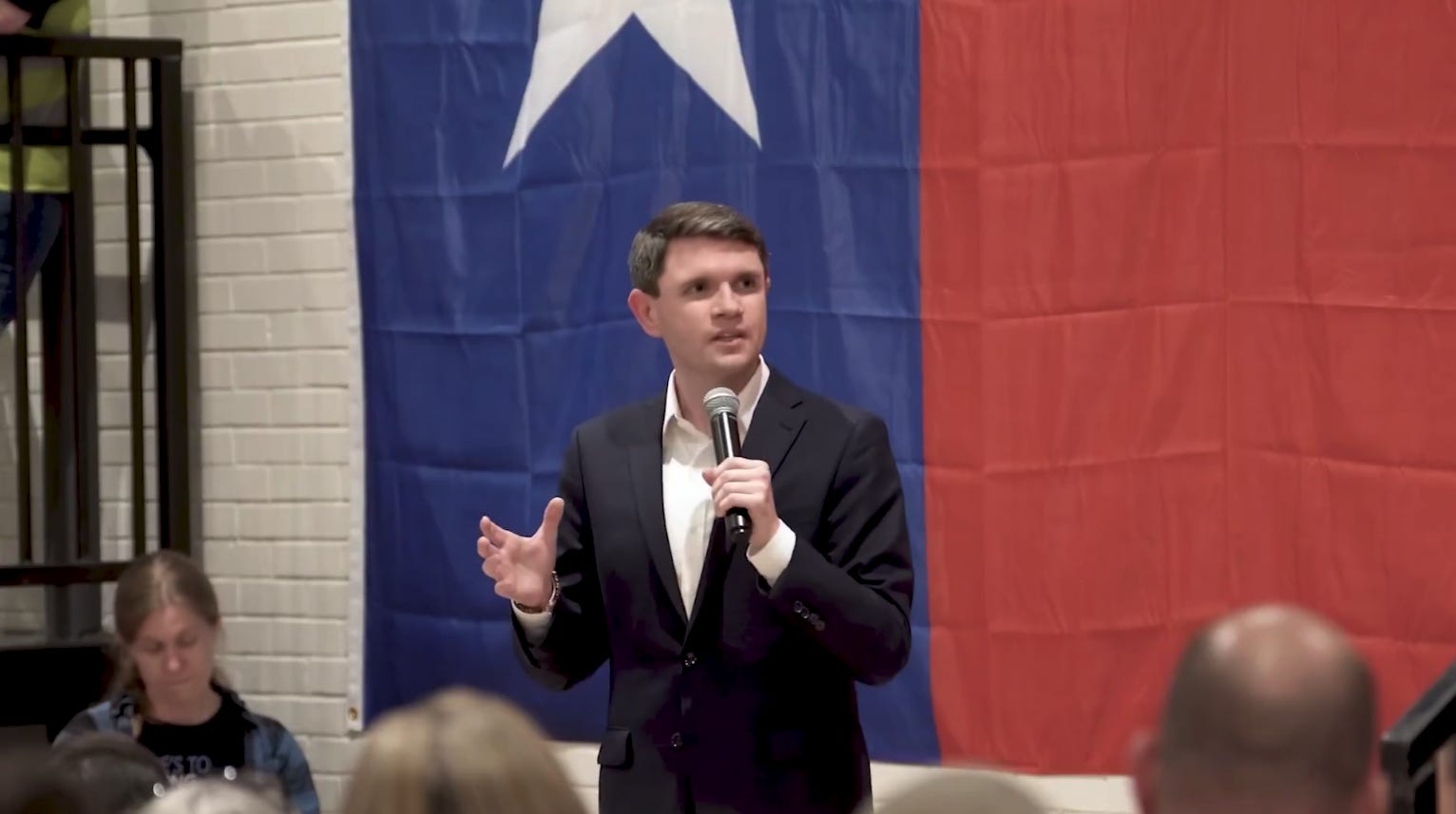
That’s the subject of a recent episode, but for today, we’re going to be talking about a different path, one that’s being boosted by James Talarico, the Democrat running for Senate in Texas this year against Republican Ted Cruz.
There’s no guarantee that Talarico will win such a heavily Republican state, but his approach of unapologetically speaking his liberal Christian values in detail and trying to build community through care is the right approach.
Alan Elrod, my guest on today’s program is fighting the same fight as Talarico. He’s the founder of the Pulaski Institution, a nonprofit based in Arkansas focused on democracy in heartland communities. He’s also a contributing editor at Liberal Currents.
The video of our conversation is available, the transcript is below. Because of its length, some podcast apps and email programs may truncate it. Access the episode page to get the full text. You can subscribe to Theory of Change and other Flux podcasts on Apple Podcasts, Spotify, Amazon Podcasts, YouTube, Patreon, Substack, and elsewhere.
Related Content
Why liberal Christians are standing up for all of their values
How Confederate Christianity took over the Republican Party
To understand the Christian right, learn the history of the Christian left
Elite Republicans are creating a new ‘Satanic Panic’ rather than appeal to moderate voters
Latino evangelicals are reshaping American politics, politicians and parties should take notice
The doctrinal incoherence of today’s extremist Christianity is immense
Right-wing evangelicals have turned politics into Bible fan-fiction
Government subsidizing religion doesn’t make people like it more
Audio Chapters
00:00 — Introduction
06:41 — The internet made it easier to hate strangers
13:25 — Religion and the right-wing political fusion
17:38 — Secular liberals’ allergic reaction to all faith discussions
22:15 — You don’t reach people without relationships
27:05 — Much of Christianity accepted modernity, and this is what upsets the Christian right
35:05 — How the Christian right built its own closed media ecosystem
42:54 — Right-wing elites do not actually care about people in small-town America, but they talk to them
46:54 — Right elites make many opportunities for their advocates, while left elites rarely help new voices get started
Audio Transcript
The following is a machine-generated transcript of the audio that has not been proofed. It is provided for convenience purposes only.
MATTHEW SHEFFIELD: You are joining me from Arkansas today, where you are doing good work with your organization, the Pulaski Institution. So what is that?
ALAN ELROD: So the Pulaski Institution is a nonprofit where we’re focused on democracy, which is a lot of organizations, but our thing is really heartland areas, and the way we think about that is not just like the South or the Midwest, but really anywhere kind of away from the big centers of finance and politics like New York or LA.
So, upstate New York. Places like Buffalo, places like Eastern Oregon, the Inland Empire in California. These are all places we think of as heartland places. Because there are places where the kind of sense of dislocation and, angst towards maybe liberal democratic politics and status anxiety have all gotten heightened in our kind of cracking our commitments to sort of the norms of liberal democracy and we’re worried about that in the US as well as in places like Canada and France and Australia as well.
So that’s our idea. Pretty much everyone at the organization either grew up in a place like that or currently works [00:04:00] in a place like that. And so we like to try to bring people in that have a kind of real life foot rooted in these places and bring that perspective.
So. That’s the general focus we have. A lot of the work we do right now is sort of events oriented. Because we do a lot of things where we try to bring people together in a room and talk. But you know, if we get more money and have more funding, we’re gonna try to put out some research as well, kind of on the quality of democratic life in these places.
But that’s our idea. That’s kind of our premise. This, idea that place matters and that, it’s an important way to consider the dangers that are currently unfolding within liberal democracy right now. And yeah, I’m from Arkansas, so we are based out of right outside of Little Rock.
SHEFFIELD: Okay. Yeah. And definitely the case that a lot of the reason that people in the more rural or smaller cities of America, there are some viewpoints perhaps that are more common that or might be unsavory, but it’s also that people in the broader left kind of stopped talking to them. I’m thinking after people like Rah Emanuel in particular kind of dismantled the National party structure, and discouraged people from presenting candidates in elections and funding them. And I think people in lower populated areas of the country, the only Democrats that, or people, liberals, progressives that they ever saw were people on tv and they were hearing about them from Fox News.
So, of course their viewpoint of what somebody who is on the center to left. Of course they would think that they’re evil and demonic because Fox tells them to think that.
ELROD: Yeah, I mean the flip side of the wonders of modern technology of like television and social media and the internet, are that it’s actually [00:06:00] really easy to develop strong opinions about people who live thousands of miles away from you. Right? And people do that.
And so if you’re on the other end of that, right? If the idea is that people who are sort of liberal or disagree with the kind of politics that may. Be sort of dominant in the area of the country where I’m from. If you just avoid it, well then you are sort of leaving. The only thing to fill that gap are those impressions that are formed right through, through media.
And those are way easier to be negative, right? It’s much easier to hate someone in that kind of context than it is to hate somebody, on your front porch. it’s just I think, a truism of, human nature.
The internet made it easier to hate strangers
SHEFFIELD: it’s, yeah, the easier to be a, nasty troll on the internet when you don’t have to put your name onto your post. And for people that were present on the early days of the internet, it was a lot more civil place in large part because the idea of an anonymous email account almost didn’t exist. And it actually didn’t exist because, well, generally speaking, there were a handful of places that had it.
But like most people’s internet access. It was through, a job or it was through an educational institution or, something like that. Or they didn’t know how to change the default setting on their AOL account . it made it easier to, be civil because, people would know if you were a jerk.
ELROD: Yeah. And I think that’s just a real problem in our politics in general now is as, the way we interact with people increasingly becomes this like, very mediated thing through, it was through television, but now it’s really more through social media than anything. Right. As that happens more and more as we’re interacting less and less in person I think it’s, I think there’s very little question that’s also a real part of the core problem in our politics is like, yes, there are ideological problems at play. Yes, there’s extremism, but there’s also just the more generalized antisocial stuff that [00:08:00] comes with. If the bulk of your interactions with people who aren’t maybe like your spouse, right, are all online and all the impressions you’re getting are from TV and the internet.
Then, then even just like. Your, ability to like conceive of people who you don’t know as sort of like interesting full humans with thoughts and feelings who are also part of this country is just reduced. And I think it’s really bad for us.
SHEFFIELD: Yeah, and it’s, and this isn’t even a political issue either, because this is an example of, something that, that I sometimes talk about on the show here. In philosophy, this is a lived version of the problem of other minds.
ELROD: Mm-hmm.
SHEFFIELD: We don’t have, we can’t know with any, with a hundred percent certitude that anyone else’s mind is real.
ELROD: Yeah.
SHEFFIELD: And so, but it’s easier to, think that they’re real if you can see ‘em physically and be around them. Because the very least, you know that they exist. In one fashion or another.
Whereas, the stuff that people see in right wing media, which, absolutely does blanket-- and I think that’s something that people who are, or live in urban areas who have a, left-leaning politics, they don’t really appreciate that if you are outside of that urban area, you go to a bar, or you go to a coffee shop or something, big, chances are it’s gonna be Fox on the tv or it’s gonna be Newsmax or one of these other, or you’re sitting there waiting for your car, the mechanic, and it’s gonna have Sean Hannity on the radio background. Because they don’t, they’re tired of listening to the same old music on the local radio stations, or they don’t want to pay for Spotify or whatever it is, They, want something more interesting. And so yeah, like this, [00:10:00] it’s just this constant sort of subtle brainwashing of people in large measure because the left didn’t bother to create popular media or they weren’t interested.
ELROD: Yeah. Well I don’t want to get ahead of you, but this is one of the things, right, when I was writing last week at Liberal Current about James Talarico, that I find so interesting and like both exciting and kind of provocative about him as a candidate is, someone in our politics who is just really interested in like the other person as a full person.
Right, because even on you, you mentioned it’s not entirely ideological. Even I think on, the more left side of our politics, there is a tendency for us to just not talk about the people who disagree with us, the kind of broad mass of people we conceive of as sort of our opponents to not talk about them as full people.
And I think, the moment we’re kind of in right now, if, we don’t get better at that, that, that kind of muscle of genuinely thinking about other people, who aren’t like us or who don’t live where we live or just who don’t vote like us as full humans we are going to have a really hard time pulling out of the tailspin we’re in.
SHEFFIELD: Yeah, that’s right. Talarico is very good at that. And, one of the other things that I think he does bring also to that is necessary to the American left is that, so I’m not religious myself, i, I don’t have any particular belief. But I got over the kind of immature atheism, which is, this idea that oh, well if we just get rid of all religion, then humanity will be perfect and everything will be, hunky dory forever. And that’s, I eventually realized that’s not true because you can be extremist atheist, a political extremist atheist. You can be an authoritarian agnostic.
Your [00:12:00] personal stance on why does the universe exist, actually has no necessary bearing on whether you’re a sociopath. And Talarico is really good at, I think, reminding people on the left who are non-religious to be like, look, there’s this huge, massive tradition out, out here of liberal Christianity.
And you should not hate it. And in fact you should like it because a lot of people in your country are not interested in being irreligious, and they never will be.
ELROD: Yeah, the tendency to be dogmatic is there, regardless, right, of whether we’re religious or not. The tendency for wanting kind of easy moral answers and to villainize people who don’t agree with us, that’s all there. it doesn’t really require religious in the sense of like, a kind of belief, a specific belief in like the order of the cosmos or, the ontology of existence.
It just has to do with like human nature. And, people can be quite dogmatic and extremist. And sort of hateful kind of regardless, right? And so religion has been a major vehicle for that because it’s been a key sort of organizing idea of human society. But politics is just as good a, replacement for that.
SHEFFIELD: well, and,
Religion and the right-wing political fusion
SHEFFIELD: But they’re also operating kind of in separate realms, at least from a functional standpoint. So that-- politics is primarily, well, what do we owe each other? Like, and, religion is about that also, but it is also about other broader topics that are not about, are not relevant to politics.
And the right wing in the US did figure that out. During, during the Cold War. That they developed what they call fusionism, this concept of that, that brought together the atheist Ayn Rand acolytes onto the same [00:14:00] team of, the fundamentalist Baptists and the, national security. Obsessives like Lindsey Graham types who are not really either don’t care much about religion one way or the other.
And then basically they said, look, we have a common enemy here. It’s modernity. We need to get rid of it. We need to, give money to rich people. And how can we do that? Like, that’s the one thing we agree on. Let’s go for it.
It’s been a continuously successful fu sion for them. and to this day, it works very well.
They kind of have to shuffle things around the margins a little bit here and there. But overwhelmingly this has been very positive for them. Very bad for America though. And nothing like that really has kind of happened on the left in the US in my view.
ELROD: Yeah, no, I there was a, it was, I grew up in a in the Churches of Christ in a evangelical denomination. Went to a college that was affiliated and my college years kind of overlapped really with the kind of the beginning of the Obama era, so like late aughts into the early 2010s. And that was pretty much what you’re describing was, that was the, sort of accept wisdom of most kind of American conservative Christianity at that point, right?
It was like a blend of sort of. Ayn Rand ish attitudes right on, on economics that were business professors even taught, Ayn Rand in the college. And then a very like, moral majority attitude on social issues. And the idea at that point, like I was a, devout member of my denomination arguing for these more sort of social welfare style politics that I think are very similar, right? To like what you see right now with Talarico.
And it was a, weird time because, on my campus it made me a radical leftist, but for any sort of regular left wing person that I might have interacted with, that would not have been the case, right?
They would’ve perceived me as quite conservative because I insisted on [00:16:00] talking about God and Jesus, and these things as, reasons that I cared about these issues. So I do think that’s an interesting, it’s a tension that really exists, right?
So the right had the right created this, like you said, this sort of fusion between these camps and you had this really sense-- they had a strong sense of identity for, conservative Christians for a long time. And then kind of not really a, strong place, right? The Democrats would talk about God and it was sort of a, I think a box ticking thing for a lot of them. I don’t want to say that there wasn’t devotion because there were very devout Christians on the Democratic side.
But, just by being, by the time we got to, when I was in college, just by being a Christian, I was, I think not really gonna be seen by anybody outside the world of my, like college and church as progressive, but because I didn’t accept right. The kind of compromise with right wing economics and, sort of the Dobson movement of family values, in politics, I was absolutely not accepted. At, on my campus I was seen as like heterodox and radical. So it’s an interesting thing. And I think it’s an opening that still really exists. I myself have much more complicated ideas about faith and identity now than I did then. But, I think the, that window, I think the, even some of the energy around tall Rico speaks to the fact that there’s still ultimately a pretty big deficit of people who are willing to talk this way on the sort of progressive side of things.
Secular liberals’ allergic reaction to all faith discussions
SHEFFIELD: Yeah. Yeah. it’s a real failure of leadership. I think it, it, a lot of it just simply is that for many of the elites, religion is just this irrational, stupid thing.
And so they’re like, well, I don’t understand it. I don’t want to hear about it. I’m not gonna judge you for it. I just. I don’t want to [00:18:00] even think about it, so don’t, talk to me about it. Please.
Or, and then there might be, there are some people, who kind of, because of the way that a lot of Christians can be pushy and bullying with their proselytizing, there’s some people who have a, an allergic reaction because of negative conduct that they experienced.
As well, like, I, want to be fair to say that because there is no question that, a lot of Christians bully people and, gaslight them and lie to them in order to get, them to convert. Like that’s a real thing.
ELROD: Yeah. I think there’s an understandable trepidation that comes when people start talking about their faith that they’re gonna try to convert.
I’ll say this, I, if someone tries to convert you, it depends on how they do it. It, doesn’t have to be an insult, right? Sometimes it can genuinely be just a, an affectionate thing and you can, say, no, it’s not for me.
You can, but I understand the experiences that people may have had. Right? Maybe they’re former evangelicals or, from other churches. Maybe they have that X right attached to them that it is like, they’re working through their own really bad experiences growing up in a churched community, in a church life, or they’re just don’t want to be, evangelized to, and they’re tired of it, which is also fair.
But at the same time, it’s important to speak to people on a sort of values and identity level. And there are a lot of people for whom being able to talk fluently and fluidly. About Christ in the Bible is actually pretty important for reaching them. You’re not gonna reach them if you can’t talk about this stuff.
Like it is something that you have a legitimate handle on and that you’re not faking.
SHEFFIELD: Yeah. Well, yeah, I think that’s true. and one thing that also I, have to say in favor of Talarico is that while he does understand that point, he also does make a point regularly to tell the [00:20:00] Christian supporters of his that look, you don’t have to be a Christian to be a good person. You can have good values from, for a variety of different reasons and from a variety of different traditions or no religious tradition at all. What matters is, what we own each other, not how we get to that point.
ELROD: Yeah, and I, I don’t want to wander too far afield, maybe from, where you want to go in the conversation. But, the evangelical world I grew up in, one of the biggest takeaways I still have in my politics is actually the understanding, and this came from people who, whose mindset was that they were trying to convert people, but the understanding that you don’t actually reach people without having a relationship with them.
And I think that is something that can be sort of universally and generally true. Even outside of a religious context, when I tell people to, when they’re talking about politics, I encourage people, I say, and when they, I’ve gone to events where people have asked me like, what do I do about my, like, super MAGA relatives?
Like, should I cut them off? And my answer is no, because you will not. There’s, no one you will reach in this world when it comes to trying to persuade them to see things the way you do. Right. Or to change their mind about something. There is no one you’re gonna reach in that way who is not someone that you, don’t have some form of foundational relationship with to begin with.
You don’t actually reach strangers. That’s not how human relationships work. You reach people that have a reason to trust you and open up to you and have the conversation to actually produce genuine change. Right? And so that is something that. My evangelical background has taught me and, has stayed with me is that, generally speaking, those little things that you do to build a relationship and cultivate a relationship, those little acts of like service and being willing to sort of stay in someone’s life [00:22:00] and stay connected to them and know what’s going on in their life, those are actually the things that make it possible.
For you to still have like meaningful communication that might even change their mind about something. Without those things, that’s, it’s just not gonna happen.
You don’t reach people without relationships
SHEFFIELD: Yeah. And it’s to borrow the, biblical phrase by their fruits, you shall know them is basically what you’re talking about there. and, but, again, to circle back on the philosophy, this is also the, people can see your mind and they, can see your concerns and your beliefs that there are valid in some sense, even if they, don’t necessarily agree with them. They know that, you’re, not trying to hurt them, you’re not arming them. You often help them. So like, if there’s anyone who could see your mind as real, or your beliefs as valid or your fruits as good, it would be those people, as you’re saying.
ELROD: Yeah. And I think the trick is not to be dishonest. Don’t lie to them about what you think. Right? You can be very, I think, honest and open about the stuff that you think is bad about even the stuff you think is immoral and reprehensible. Like I’ll never pretend with someone about how I feel about Donald Trump, right?
And so those people. Don’t have to, they don’t think I’m lying to them. I’m not pretending that we agree in order to be friends with them. Right. I am maintaining a relationship while also being honest and, that also helps. Right. That’s also an essential part of it. And I think that actually again, comes back to the kind of even juggle thing of like, don’t hide who you are.
Right. Don’t pretend, don’t hide your sort of beliefs. But at the same time, don’t turn them into a wall between you and the other person.
SHEFFIELD: This is really why I, why the Christian w right hates James Talarico so much, because that is kind of, it does seem to be the underlying approach to his politics. And then [00:24:00] also the, so they hate him for that. Because he’s practicing their, ministry perspective better than they do.
And also he’s, he is reminding people that this kind of Confederate Christianity, which is what I call it, that has taken control of the Republican party, that this Confederate Christianity viewpoint has up until only, just now when they’ve kind of colonized and eaten away out a lot of the Protestant denominations like, historically speaking, they’re anti, anti social welfare, anti. dehumanizing rhetoric supporting racism and, hatred for sex workers or other marginalized groups like that.
This is not what Christianity tells them to do. and it isn’t about reading the Bible a certain way or whatever. It’s like the lived practice of Christianity throughout the world does not support the social policies and the exclusionary and hateful, bigoted way that they conduct themselves, and they know that I think.
ELROD: Yeah. What Tallarigo understands is I think, a very powerful truth that is not even limited right to, Christians, but to people of faith and of frankly, of sort of visionary liberation politics over a millennia, which is that living out your values and understanding that the stories we tell about.
The human experience are incredibly powerful things, and that actually you can break through a lot of walls and you can reach a lot of people with those two things, with the, with, living out your actual values, right? With bearing the sort of, like you said, bearing the fruit of your actual beliefs and understanding [00:26:00] the, power of the human experience as a story, right? Understanding that’s a, that’s an incredibly powerful story for people if you focus in on right, the things that actually bring us together, the things that lift us up and, that. That’s something that some of the most effective and meaningful faith leaders have understood is something that some of the most effective and meaningful organizers in human history have understood.
Right. And politicians and tele Rico seems to really grasp that. And of course they hate it because that’s scary. because because it’s effective and it works and it breaks through with people who might otherwise never listen. And it breaks through with people who aren’t supposed to, like someone like James Teleco.
Right. I, it doesn’t, like, I’m not gonna sit here and predict that James Teleco will flip Texas. That’s bold. But it doesn’t shock me that he’s breaking through in polls in ways that we haven’t seen someone do, because he is compelling and it is compelling to see someone be authentic and to have someone see people for, people, and to understand that the human story is a powerful thing and, to deploy it that way.
Much of Christianity accepted modernity, and this is what upsets the Christian right
SHEFFIELD: Yeah. I do want to be fair to people who might have a more negative viewpoint about. Christianity in general that, like it is true. Absolutely. That I guess, maybe what I’m saying, that historic beliefs, we’re talking like. Post liberalism of, christianity, like christianity did have to reconcile itself with liberalism.
And, but that took place quite a while ago to be fair to Christians. And, and, that’s also, this is a dynamic that’s also not just in. Protestantism, but it’s also in Catholicism as well. The, Pope of As, people probably know that, is, often critical of Donald Trump’s policies and locking people up and trying to, impoverish people and give welfare to billionaires, that these are, this is all con consistent through line of Catholic social teaching [00:28:00] and, people like JD Vance.
They know that and it also upsets them as well.
Even like Joe Biden, whatever he is somebody who is a, devout Catholic. And yet the way that he was, he was somebody who kind of didn’t put it forward as much. And so I think a lot of christians had no idea.
That this was a guy who, tried to go to church services every single week. And he was up against a guy who said that he, had never asked for forgiveness for his sins and who had sex with a porn star while his wife was pregnant or had just given birth. And, it, the only Bible verse he can think of is from two Corinthians.
ELROD: Look, I mean, I don’t always get a chance to plug this, but you know, for many reasons my favorite president is Jimmy Carter. And not least is because he was a gen. I don’t think we’ve had that many presidents that you could call sort of moral philosophers. We’ve had some, but Carter’s certainly one of them.
I think he genuinely thought hard and often right about the sort of moral stakes of life and, what we’re asked what’s asked of us right. By being here. And it’s because he was someone who thought about it all the time. His life revolved around these questions.
SHEFFIELD: Yeah.
Well, and, it is why he lost his reelection, but also why? He, was the most beloved ex-president in the modern era as well, because, he, just, and it’s, and it is tragic because he didn’t, his sincerity is actually what did him in as a president, like that, and that sucks. That sucks massively.
ELROD: I always really chafe at criticism of like the malaise speech. Right. I understand the sort of political misstep of that moment. But, I think a president that’s willing to look the American people in the [00:30:00] eye and say, Hey, ha have, we’re actually like, we’re, giving into a lot of the worst aspects of our nature right now and we really need to get it together.
Like, very few presidents have had the, I think the political courage to,
SHEFFIELD: And I’m not, and I’m not going to lie to you and tell you that, everything’s perfect right now. Like that was the other thing.
ELROD: Yeah.
SHEFFIELD: And then of course, you had the, Reagan people secretly working with Iran to not release the hostages. That, perhaps that impacted things for him as well.
Gotta say that. And here we are again with Iran and, Republicans act actually now Trump is subsidizing the Iranians, because he, removed the sanctions on their oil.
ELROD: Yeah.
SHEFFIELD: So he is bombing them and giving them money at the same time.
ELROD: If we ever needed proof that, there’s no actual sort of like moral center to this war, it’s the idea that we’re simultaneously bombing them, including sort of, I guess, sort of outsourcing bombing decisions to potentially like AI bots. And then we’re lifting sanctions at the same time. So, if we ever needed proof that, there’s no clear kind of like.
Purpose to this conflict other than, Trump would really like to blow up some people in the Middle East. There, it’s.
SHEFFIELD: Yeah. And get people not to think about Jeffrey Epstein. So, but we, we, won’t forget that. Yeah. So, you mentioned your, own background in let’s circle back to that though, because, there, after World War II. World War II was a really unique, un unfortunately unique moment in American history because this was, authoritarianism and oligarchy dictatorship, whatever label you want to put on it, it only can win in a democratic system when conservatives feel so scared of social change that they [00:32:00] ally themselves with authoritarians.
And after World War ii, that generation, they had personally learned what happens when you do that if you’re a conservative. And so the conservatives of that era, like Dwight Eisenhower or like Earl Warren, they had learned that lesson that, having a society that supports its own and, spins on its people’s future and invest in the public, that’s a good society.
And that also filtered into American Protestantism as well. Like the, a lot of the biggest institutions, world institution builders, the UN and a lot of other international agencies were built. By liberal Protestants who believed that they were serving God by doing this, and that they were, helping to prepare the earth for Jesus in one way or another, or just making it better because they had that obligation to serve the and the downtrodden.
ELROD: Yeah. I mean, you I think it’s, so important for people to understand this is, and I actually kind of want to, I would honestly even expand what you’re saying and use it as a way to, to talk about American history. At an even wider lens, which is, it’s really important, I think, to push back on this narrative that Christianity can only be, or, has only ever been right.
This kind of conservatizing or even reactionary force in American politics because liberal Christians and progressive Christians have played a crucial role at multiple moments in our history. Right. What you’re describing right there is absolutely true. It’s also, true, you go back to the middle of the 19th century progressive Christians.
Are at the center of the abolition movement, right? Progressive Christians are at the center of the fight to preserve the union. They’re at the center of pushing Lincoln to do emancipation, [00:34:00] right? It, they’re also at the center of, right, the later, reforms that come to protect workers to get rid of, child laborers, right at the end of the 19th century and the turn of the 20th.
I think we do both ourselves and our country and Christianity itself, our politics a, big disservice, right? When we tell a story that doesn’t include the progressive and incredibly important reformist side of Christianity in our politics and how often, really. Catholic and Protestant, really public minded Christians have been crucial to building important institutions to making big change.
Right. It’s also been like we have acknowledged already in this conversation, right? There’s reactionary stuff, right? But, that role, at certain key moments in American history of Christians building liberal. Small L liberal institutions and fighting for, human and civil rights. That’s a really important part of our history that we should emphasize.
How the Christian right built its own closed media ecosystem
SHEFFIELD: And it was such a, powerful and admired tradition that the reactionary Southern Protestants, they realized that they were going to, that they had a policy before of well this is a fallen world. We’re not gonna participate, quoting Jesus, my kingdom is not of this world.
We’re just gonna focus on, taking care of our own and, spreading the gospel in foreign lands. And eventually as so, you had a Brown versus board of education come down, which of course these guys were very much in favor of segregation and they began realizing that liberal Christians are doing so many big things, we have to start mobilizing against them.
And we, have to focus our [00:36:00] evangelism inside of America. And so they began, creating just a ton of organizations, like the Fellowship of Christian athletes and lots of different college ministry focusing on stealing the members of other churches. Like that’s, that was the goal.
Taking people away from mainline Protestantism, taking them away from Catholicism, taking them away from, more progressive or, apolitical evangelical congregations, and setting up publishing houses and setting up, just, I mean they, what they did from an institutional standpoint was incredible. And investing just tight, massive amounts of money in, radio and television.
And because they realize if we don’t advocate for our belief of Christianity. There will be no Christians who agree with us and our viewpoints will be extirpated from politics and from religion. And we cannot allow that to happen. So we will spend all that we can to spread our version of events and our theology and our politics.
And you know what? It’s been incredibly successful. They have basically colonized, the minds of, so many American Christians now. Like, and you see it in the polling, like, and, even colonized Republican minds, like people, Republicans who were not Christian at all.
Like it’s just incredible. And, even beyond, just like the theo the theology or the political viewpoints. Like, like I, I remember, Sean Hannity one time on his radio show, he had said, I’m a guy from Long Island. I didn’t grow up with country music. I hated it. But you know what? These guys have good values, so I think I’m gonna like country music now.
He literally said that. And, you’re seeing that [00:38:00] with Trump also, like people are are identifying as evangelicals. Who never go to church, know nothing about evangelical theology, but they know that other Republicans, a lot of Republicans are evangelicals, so that’s what they’re gonna be too.
ELROD: Yeah, and I mean, that’s a whole other conversation as a southerner who loves a lot of folk and, country, like, sorry, there’s a whole strong tradition in those music genres as well of, anti-establishment and progressive and, provocative. Art, right? No, but I think, I, growing up evangelical, I was someone whose household, like, I got to experience everything.
I had various sort of like open-minded parents and there was a lot of like, I watched like normal media. But, you were saying like the success on the Christian ride of building this kind of world is, it was so, complete, right? That. I mean, there really was, it really was possible.
And I knew people who were like this to, basically live your life in a kind of completely closed ecosystem of Christian media, books, radio, television, everything. Right? I mean, you really could,
SHEFFIELD: From preschool. Eight.
ELROD: From preschool on there was a way you could do it or you basically did not interact with mainstream media or me, or, thought really at all.
And that is. that’s something that’s hard to pull off, but they did. I mean, I would say now with social media, honestly, I think that’s why you actually see a lot of people in my generation who be kind of did a lot of deconstructing and, leaving evangelicalism in their twenties and, thirties is because suddenly that bubble was a lot harder to maintain.
Right. It’s be, it has become harder to maintain. because there’s just so much media now that it’s just really difficult for them to like completely clo seal, seal it off. Right. But I mean, yeah, no, I knew a lot of people who basically went [00:40:00] from like, birth to college and, the only things that they consumed were in that kind of completely closed world.
SHEFFIELD: Yeah. Yeah. And it’s, and, that’s terrible. But from a marketing standpoint, God, like that’s a, that is a marketing agency’s dream.
ELROD: Yeah.
SHEFFIELD: and a political consultant’s dream. I mean, like, that’s the other thing is that, and this was a population that was, really. Mobilized by the republican party, like they, and they understood also the, other thing that that we kind of touched on at the beginning, which is that a lot of people who don’t live in urban areas or, the ELA corridor as it’s often called of Boston to, to dc it’s a fact that the political class doesn’t care about how things are in flyover country as they often derisively refer to it.
ELROD: I think doesn’t care is like almost too generous. And what I mean by that is doesn’t care implies that they think about it and choose not to care. I don’t even know that it enters their minds.
SHEFFIELD: Yeah. Yeah. and it’s, and the other thing is, like me as a Californian, like the only time you ever see California talked about in the national press is if we have a forest fire or an earthquake and, that’s it. Or like some big election.
ELROD: Right.
SHEFFIELD: California does not matter to the Sunday morning news shows or cable news.
They don’t talk about it. and actually, and I, sorry, I have to amend it like the, Fox talks about us a lot actually. Like they lie about us.
Because my Mormon relatives who live in Utah, like they used to go to California all the time when I was, a kid and a teenager.
But now they think that everyone who lives in California, is a drug addict homeless person. And [00:42:00] so, and like they’re worried to come and visit me, because they think they’ll be killed by, some sort of a imaginary, homeless Black Lives Matter trans person.
ELROD: Yeah, well one, and then also like, even that is like, it’s a caricature, right? Because it’s like one, it’s a caricature of the California cities. It’s also a caricature of California. It’s like when my, when I know people around here in the south will talk about California, I’m like. You realize a lot of California is just farms and like rural and like people who are like, it looks, it’s not that different from here, right?
Like the, there’s a whole bunch of California that is,
SHEFFIELD: That’s most of the state.
ELROD: Yeah. It’s, it’s like, it’s not like, it’s just like, I mean, Los Angeles, I’m not like, I have nothing against Los Angeles, but it’s also just like, it’s not true that California is just like one big LA and so yeah, there, there’s a real just misunderstanding of so many of these places.
Right-wing elites do not actually care about people in small-town America, but they talk to them
SHEFFIELD: Yeah. But the other thing also though is that besides not being interested in anything that happens in most of the country. And, this is, I, do plant this firmly on, the Democratic party elites and the, the media elites. Like, they don’t care. But, also they don’t want to, they’re not interested really in they, in telling the stories or listening to them, or even listening to anyone who wants to tell them.
It was interesting to me that, so many self-described liberals were elevating Hillbilly Elegy by JD Vance. Like anybody who had actually read that book, if you looked at the book, you could see that this guy was an asshole who hated the people that he grew up with.
Who hated his, town, who hated the people that he lived with and hated rural America, thought they were a bunch of drug addicted losers in Kentucky.
Like that’s what the point in that book was. Those people are dumb ass fucks. And I got out [00:44:00] because I am so great. That’s that what that book is.
ELROD: Yeah, I think there’s a lot of hunger for that too. Unfortunately. Unfortunately, if we’re gonna talk about the sort of more like center, left side of things, there’s a lot of hunger in those places for people who will come there and tell you, you’re right, everyone there sucks. And what I’ll usually be like, I’m like, well, I mean, look, the politics around here are a lot of, it’s bad.
I’m not gonna forgive that or present or pretend that we don’t have a serious crisis. There’s democratic deficits in the south. Right, and they’re long running. They go all the way back to the Civil War and before, right? There are serious, social, systemic political issues in this part of the country, but there is a certain type of person, and it is in more like liberal media that just wants you to basically go and confirm all their prejudices and say, yeah, everybody’s there is an inbred hillbilly, and they’re dumb, and they’re all on drugs because they’re dumb.
And, that’s just a, that’s just a completely disingenuous, ridiculous portrait of the country Also. it’s a pretty ridiculous, it’s a pretty gross thing. to believe about any portion of American life if you are actually someone who purports to be a liberal, because in theory you don’t think that any sector of American life deserves to just be sort of abandoned to like a sort of dilapidated and, wanting existence.
SHEFFIELD: Yeah. Well, and, to be fair to Joe Biden, it is, and the Democratic leaders, went during the Biden presidency, they did make sure that a lot of the, infrastructure money and other spending that were passed did actually, most of that money went to Republican do dominated districts, house districts.
And so, but where they failed was they didn’t tell people,
ELROD: Absolutely.
SHEFFIELD: Who did this for you. I mean, And it’s such a contrast because Trump, he put his name on the COVID checks that Democrats made him pass.
ELROD: A lot of Republicans just lied, right? They took the money and they spent [00:46:00] the money, but then they turned around and said that Biden ruined everything, right? And so. And I’m not gonna pretend, like I’ve said before in other conversations, that like, I don’t believe economic anxiety is the reason why, we got Trump.
I tend to think it’s status anxiety, which is a much more complicated thing that often has to do with identity and wanting to see your group on top.
But it is just true that these media caricatures are not effective ways to have this conversation.
SHEFFIELD: Yeah. Well, and, also, it’s also fair to say that the media, does enable the Republican security, the blue states as well, like.
ELROD: Oh yeah, absolutely. Absolutely
SHEFFIELD: You don’t see the new, the, national press going on into urban diners and talking to Hillary Clinton voters. So tell me, do you still like Hillary?
Tell me, do you still like Kamala Harris? Like.
ELROD: right.
SHEFFIELD: They don’t, do that.
Right elites make many opportunities for their advocates, while left elites rarely help new voices get started
SHEFFIELD: There is a certain pathology to the way that liberalism conducts itself, I think that they don’t take care of their own. They don’t want to take care of their own.
they have an, a lot of the elites have kind of an abstract sense of, a duty to society, which is good. Like we want that right.
But in terms of helping the actual people who exist and the people who you can see, and the people whose money you can, can help your money, can help.
they’re not good at it. And, and it’s a huge contrast. And, I have personal, direct experience with this that, you know, like when I was, in college I, started a anonymous website with my brother called Rather bias.com, attacking Dan Rather. And the second day that we went live with it, rush Limbaugh quoted it on the air, and he told people, visit this website, it’s great.
We were anonymous. No one, he had no idea who we were, but he knew that we were doing something that agreed with him. And so he wanted to people to see it and he wanted to help [00:48:00] us out and build our audience and. Then, within, I think, at least two months, maybe, one month.
I forget it, it’s a while ago, but, bill O’Reilly invited me onto the O’Reilly Factor. Like, this is the kind of outreach that they love to do.
And by contrast, you turn on to MS NOW, or any of the biggest liberal podcasts and you, they just have a rotating cast of the same people. You already heard them say this thing, yesterday and they say this thing they said yesterday.
and it’s like, yes, we don’t have the oligarchs handing out wing net welfare, but the people who are the media big wigs on the right, they help people build an audience. And it isn’t even just in media too. Like he, like Charlie Kirk’s group, Charlie Kirk was literally a, college dropout who was 19 years old.
They threw tens of millions of dollars at him, and he had not proven anything. He had no brand. He had never done a damn thing in his life. But they knew this guy was smart and he worked hard, and that was enough. And that was enough to help him out.
And then, he took that money and started chapters and put programs and events and, books and, newspapers.
Like every campus in America has a right wing student newspaper.
ELROD: Yeah.
SHEFFIELD: Because they value, and it is that evangelical mentality. They, do it in every single place they do. And then like, and then outside of media, it’s also, when you look at Hispanic Protestants, this is a group that is majority evangelical now.
And it is majority, it’s majority voting Republican because people who are recent immigrants through the United States, they don’t have a network. They don’t have friends, they don’t have family.
But there is a church that is out there that [00:50:00] says, here’s some money and here’s a community. We’re going to, we’re gonna brainwash you
ELROD: Yeah, I think the kind of my sort of like condensed interpretation of that is just that I have a more, as we need a more, as more mentality, right? Like there, it’s, there’s not. A, in a, finite pie or anything like that. Like, more is more, the more voices we can bring out, the more people we can promote, the more we can con, the more we can cultivate the kind of politics we want to see and the conversations we want to be having.
I think it’s just important for us to have that attitude. And I think in terms of getting outta the moment we’re in, we’re gonna have to have that attitude, right? It’s gonna take a lot of people. And I, so I think it’s sort of more, is more view of things is, sort of the way to do it.
SHEFFIELD: Yeah. To, have a, an idea that a rising tide lifts all boats. That it’s, and that the, people on the left rightfully believe in the fiscal multiplier, but there is also a personal multiplier. That when you help others build you political beliefs, you win. Like, that’s how you, that’s how you promote your beliefs is that you help people who believe them you.
That’s really what it comes down to. And it is something that besides just kind of the evangelical urge there is, there are, there is a real economic value that a lot of these right-wing churches are providing to their members.
And, we can rightfully criticize their hateful beliefs and bigotries and terrible voting patterns and whatnot, but. when I was a a, Mormon, they have a, massive food distribution center that any Mormon can go to. If you don’t have a job and you need food, they’ll give it to you and and they’ll make you work in the warehouse to pay it back.
But they don’t tell [00:52:00] you, you, no, we’re not gonna help you out. And, and all of these, and, it’s, and I think a lot of, the right-wing religions are doing that.
And that’s something that is missing for, for the secular left. The government can’t step in, in every single way at least because of how Republicans have cut government to the bone in this country.
Like, we need universal basic income and but we don’t have it. And so, but there also has to be a place where people can learn about positive values.
Right now, I don’t see anything besides liberal religious denominations that is really doing that at all, anywhere.
ELROD: Yeah. I think when we talk about why it is hard for people to leave sort of their communities on the right. This is a big part of it, right? There’s genuine support networks and relationships and, things that make it hard to walk away or scary, right? Even if they want to walk away, sometimes they make it maybe hard to want to walk away in the first place.
And even if you do want to walk away, they make it frightening. So I think we do have to have an understanding of that, and that the only, the kind of broader approach that’s very compassionate and generous, and again, that sort of mores more mentality, I think is essential to, breaking through with people.
Giving them a path out that feels valuable.
SHEFFIELD: Yeah, and, making sure that people are included in America that that the idea that that we are America, not just us, here in this conversation or here on the political left, but everybody. We’re in this together whether we like it or not.
There’s that famous line from the poet WH Auden, and it was LBJ, who put it in his ad, the, famous Daisy ad that we must love each other or we must die.
And Donald Trump and Peter Thiel and all these other right-wing fanatics, they do want us to die.
And [00:54:00] so we can only defeat that hatred with actual love.
ELROD: I mean, I can’t top Auden. I don’t know. I don’t know. I’m, I can’t be, I can’t top W.H. Auden.
SHEFFIELD: Well, all right. Well then how about you, you tell people how to stay in touch with what you’re doing Alan?
ELROD: You can always go to my organization’s website, pulaskiinstitution.org. You can follow me anywhere you want. I’m probably the most active on Bluesky. I’m on LinkedIn and other places as well where I’m posting a lot about the stuff we’re doing.
The next big thing we’re doing is a conference in Charlottesville, Virginia called for Good, which is focused around a lot of things we talked about just now, right? These, this idea of like how liberalism can really engage big questions of sort of ethics and virtue and that is free. You have to register, but it is free.
So come if you want to that and that’s in May. And if you are. Can’t make that, but want to try to stay in touch with us for future things. Like I said, follow me there or go to the website.
SHEFFIELD: All right, sounds good. So a good conversation.
ELROD: Thank you so much.
SHEFFIELD: Alright, so that is the program for today. I appreciate you joining us for the conversation, and you can always get more if you go to Theory of Change show where we have the video, audio, and transcript of all the episodes.
And if you are a paid subscribing member, you have unlimited access to the archives. But we do have free subscriptions as well if you can’t afford that. But if you can’t afford to subscribe right now for whatever reason. If you can help me out still by leaving a positive review on Apple Podcasts or on Spotify, that would be much, much appreciated.
And if you’re watching on YouTube, don’t forget to click the old like and subscribe button so you can get notified whenever there’s a new episode. Thanks a lot. I’ll see you next time. [00:56:00]