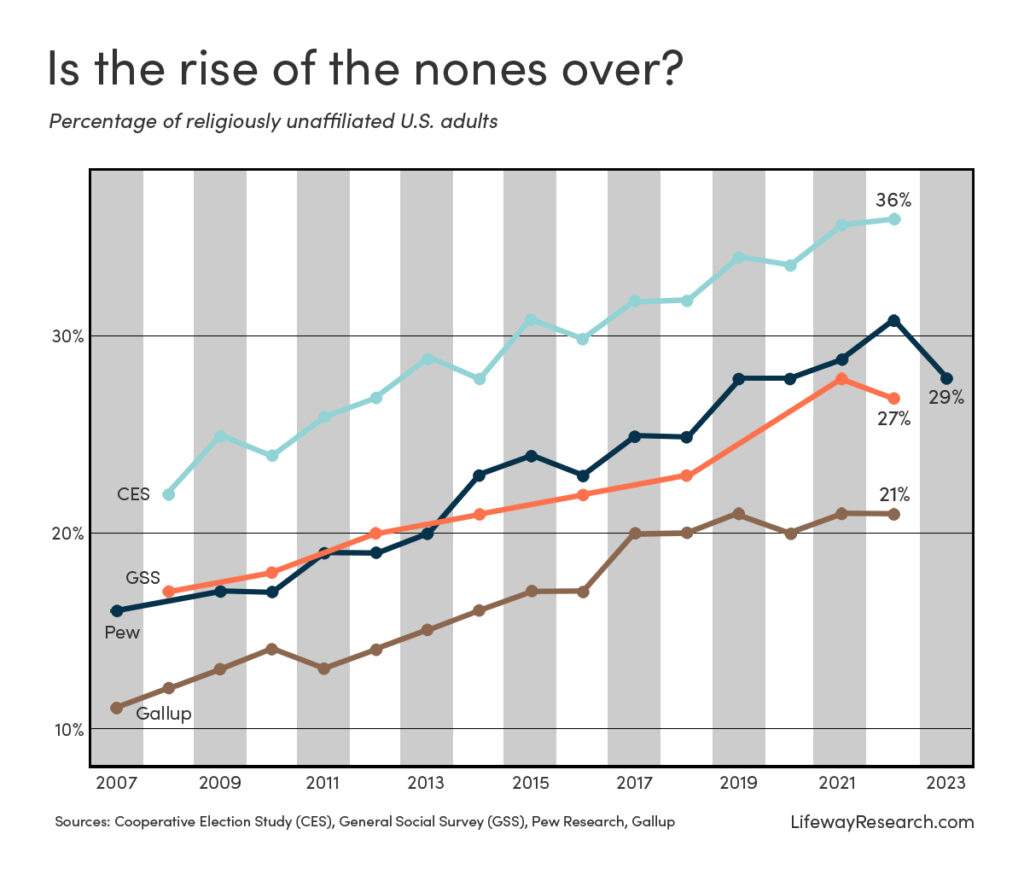


Across multiple surveys, about 30 percent of Americans say they have no religious beliefs, and for the past several years, a majority of people say they “seldom or never” attend religious services.
People are free to think whatever they want to about philosophy and metaphysics, of course, but are they actually doing so? I have my doubts. Whether you agree with religions or not, they at least get people thinking something about minds, selfhood, and ethics.
Daoism, Buddhism and some other Eastern religions figured out centuries ago that you don’t need to believe in gods in order to think deeply about these topics. But here in the West, we never developed non-theistic epistemic traditions to any real degree, and so many non-believers here are philosophically impoverished, and don’t have much to say about minds and ethics.
Luckily for us, however, my guest on this episode, Eric Oliver, has been doing a lot of his thinking in this regard, and he’s written a great new book about it called How to Know Your Self: The Art & Science of Discovering Who You Really Are.
You might recall Eric from his first appearance on Theory of Change and the fact that we also distribute his podcast on the Flux network called Knowing: With Eric Oliver. He’s a professor of political science at the University of Chicago and author of six different books. This one is based on a very popular course he teaches there called The Intelligible Self that’s based on his extensive research in philosophy, psychology, religion, and cognitive science.
If you’re interested in supporting Theory of Change, we are doing a fundraising drive for the show and for Flux on GoFundMe. I’d really appreciate your support. You can also become a paid supporter on Patreon or on Substack. Thank you so much for your help. I cannot do this work without you.
This episode is audio only. The full transcript is available. You can subscribe to Theory of Change and other Flux podcasts on Apple Podcasts, Spotify, Amazon Podcasts, YouTube, Patreon, Substack, and elsewhere.
Audio Chapters
00:00 — Introduction
09:18 — Erich Fromm, love, and the terror of agency
17:44 — Transcendence for non-religious people?
26:04 — Abstract reasoning made humans much more intellectually powerful, but also more vulnerable to delusion
31:04 — AI and why the narrative self depends upon the living self
39:28 — Secular ethics and the meaning of life
43:33 — Energy use and ethics
46:36 — Deriving group ethics from nature
54:18 — Balancing acceptance with making the world better
Edited Transcript
Matthew Sheffield: So I have to say I am glad to see your book out on this subject, and I think it’s an important one, [00:03:00] especially for people who are not traditionally religious. It’s important that we think about things like this more than we do. But before we get to that, why is a political scientist who mostly does sociological research writing this book, Eric? Tell me.
Eric Oliver: So I think the book comes from two sources, one of which is sort of a longstanding interest on my own part in trying to apprehend what’s behind this experience of being. For me, it started in high school when my high school English teacher wrote “Know thyself” on the blackboard. And she assured us that if we wanted to have a meaningful life, we should heed the distillation of the ancient Greeks into these two simple words.
And I thought, “Oh, okay.” And so I spent a lot of my 20s and 30s reading about philosophy, psychology, neuroscience, and Buddhism, going on meditation retreats, studying yoga, going on long hikes in the wilderness, [00:04:00] and talking to priests and gurus of all stripes. And when I got to the University of Chicago, one of the great things about being here is that they let us teach whatever we want.
And so I thought, “Oh, well, it would be kind of interesting to put a class together around these eclectic interests.” And my wife Thea said, “Oh, you should call this class Stuff I’m Interested In.” And I realized, oh, no, this is actually a class on how to know yourself. So I named the class The Intelligible Self, and I’ve been teaching it for more than 20 years, and the class has gotten to be very successful.
And in the time that I’ve been teaching it, I’ve met a lot of adults who were like, “Oh, that sounds like a fascinating class. Do you have a book to recommend?” And the problem was that I had hundreds. And I thought, well, maybe here would be an opportunity to do something that I didn’t see in any other books: put the Eastern contemplative traditions, modern neuroscience, ancient and contemporary philosophy, and psychology all in conversation with each other and see if I could integrate them into [00:05:00] a relatively legible story about what’s behind this experience of being that we’re having.
Matthew Sheffield: Yeah. Well, and I think you certainly do that. But okay, so what is the overall take for people who might be thinking about buying it? What’s your take on it?
Eric Oliver: Sure. And one thing I would say is that there are hundreds of books out there that purport to help us help ourselves, but none of them really describe what the self is that they’re trying to help. And so this is a book ostensibly about what the self is, why it so often malfunctions, and what we can reasonably do to make it work better.
And I think within that is the idea that the self we normally think of as ourselves is not really who we are. Most of our self-understanding is at best sort of shallow or misattributed and doesn’t really get into what’s going on underneath the surface. And I’ll give you just a quick example.
I usually think of myself as a thing. [00:06:00] Things are easy, legible, and discernible for us, so we like to think of the world in terms of things. But there’s nothing about me that is stable at any moment. On a molecular level, I’m constantly swapping atoms and molecules in and out of my body.
At a cellular level, my cells are constantly in metabolic action. At a cognitive level, my consciousness, my thoughts, and my speaking right now are all the result of just the storm of neural firings in my brain. There’s nothing that’s fixed at any moment in time. And this intuition, this strong sense of myself as a singular, stable being, is a projection.
If I identify myself with that projection, I’m going to be missing a lot of what’s going on and probably not getting a full sense of what the potential of my experience could be.
Matthew Sheffield: Yeah. Well, this is a different view of selfhood than the Buddhist view, even though I [00:07:00] think a lot of people might say, “Oh, well, you’re just doing Buddhism there, Eric.” But that’s not what you’re doing. Most Buddhism basically says there is no self, while you are saying there is a self and it’s more than what you think of it as.
Eric Oliver: Right. And I think when we think about the Buddhist claim that there is no self, we have to contextualize that comment, just as we need to contextualize this whole “know thyself” idea. I think we misunderstand both. So when my teacher wrote “Know thyself” on the blackboard, she said, “Oh, this was what Socrates said.”
But the Greeks didn’t have a word that meant self in the way that we think of ourselves as a self. And insofar as they were saying “know thyself,” what it really meant was “know thy place.” And for most of human history, those were the best words you could live by because our ancestors all lived in very tightly bound communities that were largely parochial and highly traditional.
And to get along well, you didn’t really have any freedom, so you just [00:08:00] had to do what everyone told you to do. So you were a hunter or a gatherer. You were a father. You had these social roles. Your familial and love relationships were basically assigned to you. You didn’t really worry about what your meaning or happiness was because that was all from your culture and custom.
And the same thing goes when we think about what’s called Anattā in Buddhism, which is translated as non-self. That’s actually a response to this Vedic and later Hindu notion of Atman: that within us is this eternal, stable, singular soul that wants to find its eventual reunification with Brahman, the greater spiritual essence of the universe.
And when the Buddhists said, “No, there’s no Atman,” that gets translated as “no self.” And so we typically think Buddhism says that means, “I don’t exist.” And that’s not really what Buddhism says once you kind of get into Buddhism. It says that you are this process and this construct.
And yeah, a lot of what I talk about is [00:09:00] very consistent with Buddhism. And I think Buddhism has influenced a lot of my thinking on this, but it’s also remarkably prescient for its time, and it’s remarkably consistent with a lot of what we know now from neuroscience and even from physics and biology to a certain extent.
Erich Fromm, love, and the terror of agency
Matthew Sheffield: Yeah. That’s right. And it is interesting to kind of see those intersections sometimes. One person who has a lot of interesting theories about selfhood and its relation to agency in the modern context, and whom you cite several times in the book, is the psychologist Erich Fromm. He wrote two books that are both really good, and I would encourage people to check them out. The first was called “Escape From Freedom,” and then he had another one, which you cite more in yours, called “The Art of Loving.” But they both really deal with very similar topics.
Eric Oliver: Yeah, I think [00:10:00] one of the most important things to understand about ourselves is that we are not isolated beings. We are thoroughly social all the way through. One way is just to look at your own molecular biology. For example, within our cells are mitochondria, which have entirely different DNA from the DNA that programs us.
And the best explanation of that is that sometime way back in our evolutionary past, two organisms interacted and developed a symbiotic relationship. But what it means is that you and I are not a singular species. We’re a composite of species, and if you add your microbiome, that just adds to this sociability.
And then, of course, as humans, we have language and we’re culturally situated, so that makes our sense of self even more socially bound and determined. And then I think this is where Fromm comes in. At some level, our whole development—the way our psychology works and the way our sense of self works—is a consequence of our prior experiences with other people. [00:11:00]
And we need that consistent updating vis-à-vis other people to kind of keep our system going here. And Fromm does a great job of differentiating between what he calls love and loving. I really discuss this toward the end of the book: we all want love, and we all sort of fantasize about love.
But it’s important to note that love is a noun. It’s the emotional experience that we might be having vis-à-vis someone else at any moment in time. Loving is the act of relating to other people. And when we want to know ourselves, a big part of why we want to know ourselves is, A, what is triggering feelings of love within us?
But, B, how can we sustain better loving relationships with others? And I think knowing yourself is really crucial to that because one of the biggest obstacles for most people to engaging in meaningful, healthy, loving relationships is their own [00:12:00] shit: their own attachment issues, their anxieties, their tendencies toward withdrawal, their inability to hear what other people are trying to tell them and communicate with them, and their own neuroses coming to the fore and presenting themselves as obstacles to actual meaningful connection.
Matthew Sheffield: Yeah, definitely. He does touch on that a lot. And there’s also the political dynamic, which is not as much in “The Art of Loving” as in “Escape From Freedom”: the idea that, historically, human beings existed in deeply hierarchical societies.
You had to know your place, as you said. And you had to know your station, I think maybe is the English phrase for that. And then over time, as you had a proliferation of economic plenty [00:13:00] and specialization and whatnot, more and more of people’s basic survival needs were met in different ways.
And so you were left with yourself in many ways because your worldly or biological needs were kind of met. To bring Maslow in here, once the lower levels of the hierarchy of needs were met, people moved up the hierarchy.
And people were kind of terrified. “Well, what am I supposed to do with myself? What am I supposed to think? What even am I? What are these other people? Are they even as real as I am?” All of these questions are, I think, a huge part of what underlies a lot of the reactionary revolt against modernity that we’re seeing so much around the world now.
Eric Oliver: Yeah. I think in a lot of ways you could think about this project of knowing yourself as an extremely modern phenomenon. In a way, we think of [00:14:00] knowing ourselves in terms of this sort of isolated individual. Much of it comes, for example in my case, from the fact that I abandoned my Catholicism when I was a teenager, and that left a big void for me in terms of purpose and meaning in my life.
And in a lot of ways, I think what those of us who have left behind our parents’ religions and no longer have that ballast to anchor us struggle with is this: how do we find purpose and meaning? How do I know what’s behind my own existence? How do I account for this existence? Luckily, I think this is where science, philosophy, and the Eastern contemplative traditions, if we bring them together, can actually provide us some guidance.
And a big part of it for me is sort of saying, “Okay, well, what is the self here? What’s ultimately behind this experience of being?” And it really goes back to being a life form because what all living things are doing is resisting entropy. At some level, we’re all energy systems, and life forms are energy [00:15:00] systems that push back against this great energy degradation of the cosmos.
And so physicists will tell us that the universe is unfolding, and as it unfolds, it’s degrading in its energy potentials. It has less energy to make stars and galaxies. At some point, it’s going to stop making them altogether. And everything is kind of heading toward this dark, inert state, but life is pushing back against that and keeping itself going by drawing in energy, reproducing itself, and protecting itself from threats.
And I call this the life force, this impetus of living things to keep their life processes going. And we can begin to think of the self, then, as all of those processes that help this life force negotiate with reality. So within us is this impetus to resist entropy, and everything from our DNA and cellular structure to our muscles, bones, animal psychology, and now our culture is part of that self-process.
And I think, most interestingly, when it comes to knowing [00:16:00] ourselves, our sense of egoistic attachment and identity—the sense of me as Eric, a professor, with all my hopes, ambitions, and dreams—is part of this self-process. All of these elements are ultimately just trying to keep this life force going and push back against entropy.
Now, okay, great. That’s there. These processes change historically over time, and we’ve talked a little bit about that. But the problem is also that I think a lot of our cultural and historical circumstances throw these processes out of balance. We end up spending an inordinate amount of emotional energy, psychological time, or cognitive exertion around issues that are ephemeral, don’t matter, or are counterproductive for us.
And ultimately, I think knowing yourself is about getting to a point where you’re not so compressed in a particular mental state or emotional state, [00:17:00] and when you’re less compressed, you can open yourself up to the greater sort of effervescence that’s actually kind of latently there. And this is, I think, where Buddhism comes in because it says there’s a way of being that’s a lot more sparkly and sensitive and open to experience, just below the sort of compressed level of our ordinary consciousness.
And I think that’s ultimately what I would say is the final act of self-knowledge. This goes back to Maslow’s idea of transcendence, and what transcendence, I think, is ultimately doing is realigning these self-processes so that they work more harmoniously and in greater balance between the demands of, say, order and vitality.
Transcendence for non-religious people?
Matthew Sheffield: Well, although that’s not how people who are religious conceive of transcendence. So how do you think religious people would define it?
Eric Oliver: Yeah. I mean, I don’t think they use those terms. When you say religion, the problem is that there are so many different forms and types of religion. They probably don’t use that terminology. But I think a lot of what I would call spiritual practices are really about getting past your own ego and your worldly concerns and putting you more in touch with your own energy experience. [00:18:00]
They may also give you terminology or a way of trying to apprehend that experience. And sure, they might say, “Okay, go say these prayers,” or “Go do these rites,” or engage in this kind of spiritual discipline. But I think ultimately they’re about some sort of realignment of self-processes to create better harmony.
And I think the big challenge for us is that most religious traditions evolved within particular ecological niches, and they’ve mutated and transformed over time, and they’re not [00:19:00] necessarily appropriate now to the same niche. And I think that’s why they can oftentimes be abused and cause us so much trouble.
So take Christianity. It evolved relative to a pastoral culture in the Levant, with a lot of tribes there, in the context of Roman domination. So it was this sort of pastoral religion that ostensibly became a form of political resistance to the Roman Empire and then kind of spread in that regard.
We live in a very different kind of context now, but nevertheless, we still hold onto Christianity. For some people, it serves them well. But I think for a lot of us, there’s just a gross inconsistency between the tenets in both the Hebrew and the Christian Bible and a modern way of understanding the world, and it’s kind of hard to reconcile those.
Matthew Sheffield: Well, I mean, I think so much of that question is about what transcendence [00:20:00] and enlightenment are. To a large degree, I think people who have a scientific worldview hear you say things like that and think, “Oh God, I don’t want to hear this woo-woo bullshit.” But if I may bring it into the scientific context, essentially what we’re talking about is the fact that there are two kinds of selves. Everyone has two selves. There is the biological, processual self, which is the sum total of all your biological processes and how they interact with each other.
And then that generates the conceptual self, or the epistemic token of the self. It’s easier to think this way because you have to think of yourself in terms of doing actions like, “I am going to go do this. I have to do this today. I have to do this tomorrow. I have to pay my bill on Friday,” or whatever it is.
It’s easier to think of yourself as an “I,” but [00:21:00] really that is a generated image of ourselves, not our real self. And that’s really what the traditions you’re talking about here are trying, in varying ways, to make us more aware of: what we really fully are, and that we’re more than ourselves.
And that doesn’t necessarily mean importing any kind of religious or supernatural context.
Eric Oliver: No, it doesn’t have to. And I think the way to think about this is that animals don’t have religions, and I think our hominid ancestors, probably before they had language, didn’t have religions. And so the question is, why did we evolve religion? And we evolved religion, I think, once we started speaking and having abstract concepts for apprehending the world.
And once we had that, we could make laws, we could make morals. And I think one of the primary things religion was doing was [00:22:00] linking everyone together in a set of shared concepts that were bound together primarily by myths and stories. And a lot of this had to do with regulating the reproductive economy.
It was regulating sex. It was also telling us when to plant crops or when to take the herds out, all sorts of instructive things. And what were the codes of the tribe and the group? What differentiated this tribe from the neighboring tribe? Early on, I think that’s kind of what religion was doing, and since then it has morphed, grown, and evolved over time to try to meet other types of needs.
But I think the question we have is: Is there an alternative way to find meaning and purpose in life without having to make reference to some doctrine that invokes a supernatural deity? I think there is. And I mean, you could still use the doctrine of supernatural deities.
Fine, go for it. But for those of us who don’t find that plausible, then okay, what is the alternative? And in a lot of ways, what this [00:23:00] book is trying to do is say, “Okay, this is what an alternative framework might look like.” And at the very least, I think what I’m trying to do in this book is help people expand the vocabulary of their own lived experience.
And I think this goes to your epistemic idea here, because ultimately that’s what books and knowledge do for us. They give us a wider array of concepts and tools to bring to bear on our own experience, to understand what’s going on, and to give us some perspective on it. And I’ll give a simple example of this.
So prior to the advent of writing, the evidence seems to be that most people didn’t often realize that the thoughts in their head, the mental discourse in their own head, were coming from themselves. And so they often attributed them to outside forces, to spirits or gods or demons or whatever. And it was only with the advent of writing, once people actually started writing things down, that we see this shift.
And you can see it, for example, in tales that were [00:24:00] oral tales for long periods of time, like, say, Homer’s Iliad or the early chapters of the Hebrew Bible. The characters in those stories don’t have their own interior lives. To the extent that they’re motivated to do something, they hear the call of God or gods.
Matthew Sheffield: Like with Pharaoh, most famously, God put the thought in his head to resist Moses. It was God that did it.
Eric Oliver: Right. Right. And then once you start getting widespread literacy, as people are writing things down, they’re like, “Wait a minute, I am the author of my own thoughts.” And so this new analytic kind of era begins to emerge, and this is when you see the beginnings of philosophy and more analytic thinking.
And it’s not like the mythology gets displaced. It stays with us. It just gets elaborated and now intermixed with this new analytic framework. And I think this is, in a sense, what we’re doing when we’re trying to expand our self-knowledge. We’re beginning to get a better sense of, oh, all those things that I was attributing to gods [00:25:00] or demons or whatever, maybe that’s actually part of me.
And so I’ll give you a kind of modern example. I might experience a lot of anxiety, and then my mind looks to rationalize that anxious feeling, and I generate some sort of narrative in my head. But if I can sort of stop and say, “Oh, this is just me being neurotic,” or “This is just my anxiety at work,” I’m no longer caught in the vice grip of whatever fear I feel I have to act on.
I can distance myself from it and say, “Oh, okay, that’s just me making an attribution relative to an emotional state.”
Matthew Sheffield: Yeah, that’s right. And it does give us an awareness that we don’t have to do everything that pops into our head and that not everything we think is true. I think that is another big difference between humans and animals: if animals see an optical illusion, they believe it.
They believe everything that they sense until something contradicts it. That’s why they’re so easy to surprise, and [00:26:00] anybody who has a cat knows how easy it is to surprise them.
Abstract reasoning made humans much more intellectually powerful, but also more vulnerable to delusion
Matthew Sheffield: That’s because they believe all their senses, whereas we don’t. But at the same time, that development of abstract reasoning has also made us more vulnerable in a lot of ways because we can know that our senses might not be telling us the truth, or that things can exist even when we don’t perceive them—that object permanence is real.
We can also know that other people may know things, or have first-person experiences, that we don’t. All of these things can also be flipped around in a really negative way, and this ties back to the previous book that you wrote, like the idea of what you called intuitionism.
Essentially, if I haven’t seen vaccines or don’t personally know how they work, then they don’t work. If I wasn’t [00:27:00] there to witness the moon landing, then it was fake.
You know, flat Earth, et cetera, or Trump’s stolen-election claims—these are all paradoxically the result of abstract thinking. But this kind of thinking detaches us from reality rather than attaching us to it.
Eric Oliver: Yes, and I think that’s really one of our central challenges right now is so much of our thinking is detached from reality. I mean, just think about how much of our time and attention is caught up on social media and smartphones. And we get caught up in this kind of mediated cyber existence that has no real bearing on our material experience at any moment.
Yet we are completely held captive by this attention algorithm and this kind of dopamine-centered stimulating process. And you could make that argument about a lot of cultural phenomena too. Think about [00:28:00] Marx’s idea of false consciousness: people would gladly participate in their own self-subjugation thanks to a certain kind of belief system.
Matthew Sheffield: Yeah. And then even he himself, with his march of history idea, like that itself was a delusion as well.
Eric Oliver: Yeah. It’s myths all the way down.
Matthew Sheffield: Yeah. Well, I do think that it is really important for non-religious people to actually get more of a handle on some of these ideas because where I live in Southern California, like there are so many people out here who are “spiritual but not religious.”
And basically that means they believe in tarot and astrology and crystals and anything else that is nonreligious mysticism or supernaturalism. You could argue that this is just as harmful as, or perhaps even more harmful than, a lot of religious delusions. I mean, we’ve got a guy who wants to be the mayor of Los Angeles and says that crystals are magic.
And [00:29:00] so it actually really matters for people to understand: look, okay, it’s fine if you don’t want to believe in religion. Well, then you still have to think about this stuff, because if you don’t, then you’re probably going to fall prey to delusions of one kind or another, I think.
Eric Oliver: Right. And I think that goes back to this theme of why it’s so important to try to know yourself. The way I actually describe this to my students is that I say, “Okay, how much of your life story are you the author of?” And if you think about our life stories—the narratives that we tell about ourselves, such as “this is what success means,” “this is what a good life means,” and “this is what is important for me”—these are stories that we haven’t written for ourselves. They were bequeathed to us by our parents, by our culture, by whatever context we’re in. And sometimes those stories are useful, but a lot of the time they were not necessarily written by people who had our best interests at heart. And a big [00:30:00] part of that is what I would say is this kind of egoistic self.
And it’s interesting: if we go through and look at our self-processes, there are some parts of our self-processes that are very legible to scientific inquiry. So, like you were saying, there’s the biological self. We can observe most of our biology. We can observe ourselves as physical beings. We can actually even observe a lot of our language; it’s all finite and tractable, even if it’s constantly evolving.
What becomes really hard for us to observe—and this goes to the question of consciousness—is our subjective experience of being. And, more importantly, what are those psychological processes that I’m using to understand my position in relation to other people around me?
And this is ostensibly what the ego is. It’s all of those concepts and emotions that we utilize to sort of defend our place in society, to know what our entitlements are, and to motivate us to try to get more, to ensure that we’re not [00:31:00] just kicked down to the bottom of the pecking order in any given context.
AI and why the narrative self depends upon the living self
Eric Oliver: At the same time, these processes get very much intertwined with names, identities, titles, and status markers. And those, in turn, get intertwined with narratives. The problem is that those ego processes are not readily available. We have some clues about where in the brain they might be correlated, but we don’t really know if the ego as such exists.
But how do we understand our egos? Well, most people understand their egos by going to therapy. And what do you do in therapy? You sit on the couch and you tell your stories, and you tell your stories about your parents and your childhood, or you tell your stories about your contemporary circumstances.
And it’s through interpretation of those stories that you begin to understand this aspect of yourself. So I think this goes to your understanding of this sort of epistemic aspect of us, which is going to be fundamentally narrative-driven. We are a narrative species through and through. And so at some point, we have to come to terms [00:32:00] with our own stories.
Matthew Sheffield: We do. And I also think one of the biggest problems in a lot of analytic philosophy and a fair amount of early cognitive psychology is that a lot of it was very language-tied, with this idea that selfhood comes from language.
But that’s not what modern neuroscience and modern cognitive psychology indicate. One of the worst examples of this, and somebody who irks me, was the philosopher Jerry Fodor, who had this idea that there’s a language of thought, and all thoughts take place in a syntactically derived language that exists because there’s a module in our brain, even though I don’t know where it is, I can’t prove it’s there, and no one can prove it’s there. It’s there. And we all think in the same linguistic manner.
And it’s just [00:33:00] not true at all. Sadly, these ideas have persisted contrary to all of the scientific evidence, and now they’re coming back to us in a lot of the large language model discourse, with people saying, “Well, the fact that they can understand what you say means that they are conscious, and it means that we should treat them as moral patients.” Geoffrey Hinton, one of the founders of the field, was just recently saying that he thinks they probably are conscious because they can write about consciousness. And that’s enormously frustrating to me. It’s all coming from this language-centered idea of selfhood and consciousness.
Eric Oliver: Yeah. A player piano is not musical. It’s a player piano. In that sense, it’s not generating its own music. [00:34:00] It’s funny; it even starts with this Cartesian notion of “I think, therefore I am.” Well, if you didn’t have a word for think, then would you not exist?
I mean, that starts with the same linguistic fallacy: that cognition somehow has to be understood only if it’s oriented in some lexicon of words. And that’s one aspect of our type of cognition, but it’s not cognition in its totality.
And I think there’s a lot of misunderstanding in terms of what consciousness is. Our willingness or eagerness to ascribe consciousness to, say, LLMs also reveals what our own brains do with respect to consciousness, because our sense of self is a model that our brains are creating. I’ll maybe situate this in another way. We oftentimes think that the way we perceive the world works like this: I just open my eyes and the world [00:35:00] comes to me through my senses, and then my brain is there processing all this incoming information and kind of creating a scene.
It’s not really what’s happening. What happens is that in the moment before I open my eyes, my mind is already generating a prediction about what it thinks the world is going to be like, and then this information comes in and basically updates and varies that prediction relative to the incoming information.
Matthew Sheffield: Well, and that’s why you can wake up when you’re asleep.
Eric Oliver: Right.
Matthew Sheffield: That’s because if your mind was stopped, you couldn’t wake up if you heard a noise or somebody talking to you.
Eric Oliver: So our whole experience is really this ongoing dialogue, in a sense, between the information coming in and this model that our brain is putting forth of what it thinks is going on in the world. And when there’s a discrepancy between the information coming in and the model that our brain has, that triggers an emotion within us. And it’s not simply the model in our brain in terms of some sort of [00:36:00] cognition; it’s also our body chemistry. So you can think about it like this: my body chemistry now models hunger, and so I need to get food to reestablish my body energy.
And biologists call this homeostasis. It’s sort of the natural balance set point that we’re at. And what our brains ostensibly are doing is projecting these images of ourselves and comparing them to the world. If those comparisons are off in some way, we get an emotional response, and then we get new, deliberative thoughts: “Okay, how can I correct this? Maybe I need to update my model of myself, or maybe I need to go out and change something in the world.”
Until I can sort of rectify that, I’ll still be stuck in this kind of emotional, motivational state.
So I’ll give you an example. I’m walking in the woods. I have a model of these beautiful, peaceful woods, and all of a sudden I hear a rattle, like, ta-ta-ta-ta-ta-ta-ta-ta-ta-ta.
Okay, that’s a new piece of information that’s out of sync with my [00:37:00] model. I get a fear alarm. I look around. I begin to think, “Oh, that’s probably a rattlesnake. It’s probably good to get out of there.” And I motivate myself to move away from it. Once I move away, if I don’t hear the rattle anymore, my model and my external circumstances come back into alignment, and I calm down and go back to a homeostatic set point.
And we are basically doing that constantly. Our brains are constantly doing that in any number of dimensions. And that’s, I think, really what’s at the heart of our experience of being.
Matthew Sheffield: Yeah, it is. And that is, of course, why large language models are not conscious: they do not exist in the world. And they don’t even exist when they’re not being talked to. So there is no independent, continuous experience.
Eric Oliver: Well, and I would say it’s because they don’t have a life force. At this point, they don’t have any incentive to replicate themselves or protect themselves from destruction. We could potentially program a silicon-based life form that drew in energy, reproduced itself, and protected itself from threats, ostensibly giving it the qualities of living. [00:38:00]
At that point, I think it might evolve something akin to consciousness. It probably wouldn’t be the same kind of consciousness we have because it would have a very different set of inputs to draw from. But maybe at that point it would start doing something that might resemble consciousness in living beings, or the way living beings perform consciousness.
And I think another issue is that because we see these LLMs and they seem to replicate us so well, we naturally make the assumption that they are like us. So we anthropomorphize them, just as we anthropomorphize everything that [00:39:00] seems to have any kind of independent movement.
And especially because they’re so adept at mimicking what we’re doing, naturally, of course, we’re going to want to anthropomorphize them. How could we not? But that’s our brains tricking us. We have a model: things that talk have human intentionality; therefore, they’re going to be like me, they’re going to have theory of mind, and I’ll be able to read some sort of consciousness into them.
But that’s not really what’s going on.
Matthew Sheffield: Yeah. No, it isn’t.
Secular ethics and the meaning of life
Matthew Sheffield: Well, and the other reason I think it’s important to think and talk about these ideas in general—selfhood and one’s existence in the world—is that doing so lets us derive ethical paradigms and group motivations.
I think that’s another area where non-theistic cultures have kind of dropped the ball in a lot of ways. Consider the old questions people often ask, such as “What’s the meaning of life?” [00:40:00] or “Why am I here?”
And these are questions that a secular worldview can answer. Unfortunately, I think a lot of the more purely hard-science people just say, “Oh, well, those are dumb questions.” Or there are philosophers like Daniel Dennett who say things like, “Well, there is no self. It’s imaginary. It’s a delusion. It’s a fiction, and it doesn’t mean anything. Felt experience is just a lie you tell yourself.”
And that’s not going to be persuasive to people, I think.
Eric Oliver: Yeah. And this is where I would disagree, and it’s also my refinement of Buddhism. There is a self, and insofar as you think of yourself, it’s not a thing. It’s a very complex set of processes that help this life force—this drive to resist entropy—negotiate with reality.
And it has all different kinds of layers and all kinds of complexities to it, and we do it probably in a way that’s far more [00:41:00] sophisticated and complex than any other living creature. I mean, that’s clear just from our language, culture, technologies, and whatnot. But there is a self there. There are all these processes going on. As long as we’re alive, we’re going to have a self, or we’re going to have these self-processes occurring.
And then I think it’s incumbent on us to try to apprehend what these self-processes are. And I think traditional religions describe these self-processes in terms of intentional gods, deities, and spirits, and then they make laws and attributions from that.
But we too can develop an ethics based on this: here you are as an energy system trying to resist entropy. You have these balancing tendencies. On the one hand, there’s order. You need to structure this way of resisting entropy and have some rules and forms in which to do this.
But then you also have to let the energy itself flow, and I would call these two things [00:42:00] order and vitality. Optimally, what you want to do is balance that order and vitality. You want to have it so that you’re not over-ordered, so that you’re inefficient and stifled, but you don’t want to have too much vitality because then you’re wasteful and incoherent.
And you really want to find, I think, the optimal way, relative to your ecological circumstances, of balancing order and vitality. Our single-celled ancestors did this by altering the pH balance within them. They evolved different cellular structures. As animals became multicellular, they evolved sense organs and muscles and all kinds of ways of doing this.
We have evolved cultures and technologies that purport to do this. I think right now, though, we are way out of whack with respect to this balance, and I think this is where we can start thinking about ethical issues. For example, consider the consumption of energy. How many natural resources do we need to consume just to stabilize [00:43:00] ourselves?
You and I use so much more energy than any of our ancestors ever did, and what do we use this energy for? Well, to go and make AI cat videos. Okay, is that really helping us achieve balance in some way? Or are we just so desperate for something interesting to focus on, to distract us from the living moment, that we expend an enormous amount of energy just to keep ourselves from actually trying to be within our own existence?
Energy use and ethics
Matthew Sheffield: Yeah. Well, okay. But for somebody who would say that this doesn’t really explain the feeling that I’m more than my self-concept—for example, that I feel there are forms in the world or spirits in people’s bodies, and that’s what grounds my [00:44:00] ethics—how would you answer that?
And one could argue that there are some people who do say something in line with this idea of resisting entropy. Take Marc Andreessen, who is an atheist right-wing billionaire and embraces what people are calling effective accelerationism, which basically says the goal of life is to enable entropy, as he puts it.
And we enable it by maximizing energy use. Therefore, we should use as much energy as we can and not restrain capitalism in any way, because restraining it would be immoral.
Eric Oliver: Yeah, I mean, this is perverse. To use energy for the sake of using energy doesn’t really make any sense. We utilize energy toward the end of sustaining the energies of being alive. And I think the other thing I see a lot in this tech orientation is this [00:45:00] prioritization of humans.
I mean, I think once you begin to sort of see yourself as an energy system and as a living energy system, you realize that we humans are just one little leaf on this kind of greater tree of life. All living things, for example, trace their origins back to a common ancestor that lived about 3.7 billion years ago that had 350 genes that you find in all living things.
And what this actually means, though, is that we’re just one little expression of a sort of greater life force. We ourselves are not that distinct. We’re not that important. This is where I think things get kind of humbling and oftentimes very confusing, because we humans could annihilate ourselves next week.
Life will still go on. Most of life is still microbial and would sort of shrug. And it’s not like our particular human incarnation of life is really that much better than any other kind of life [00:46:00] form or is deserving of anything more relative to any other life form. Life is chaotic. It’s self-feeding.
It’s generative. It will continue to go on. But what always constrains life is what energy is available and how it works relative to its ecology. And what we should be thinking about ethically is, okay, what is the ecology that we’re constructing?
How does this actually help life itself thrive, or is this destructive to kind of life on the planet?
Deriving group ethics from nature
Matthew Sheffield: Well, and how does that generate moral duties to each other? How would you answer that?
Eric Oliver: Yeah. I mean, it goes back to this idea that it’s important to remember that our selves don’t exist in isolation, that we are fundamentally socially contingent beings. And so no self is an island. A big part of our [00:47:00] self-processes is caught up in the laws that we make, the rules that we follow, the culture that we share, our patterns of interaction, and the ways we relate to and love other people.
All of these things are essential for thriving. I kind of punted on this in the book because I’m like, “I can’t really describe what the ideal socioeconomic political system is.” I don’t know if anybody can, at least at this point. It varies a lot by circumstance. But nevertheless, knowing yourself and working on yourself doesn’t mean focusing just on the solipsistic individual.
It also means: what am I doing with my community? What am I doing with other people? I mean, to me, the very simple ethical claim is: am I doing something to make the world a better place? Is any action I’m doing making things better for those around me? Or is it harming those around me? Obviously, you can come up with various kinds of situations like [00:48:00], “Oh, if I could go back in time and kill Hitler, should I do that?
Is that making the world a better place even if I had to kill Hitler?” Whatever. We can be pragmatic about these things. But I mean, just as a general rule, I think that’s a pretty simple and easy ethical answer, at least for me.
Avoiding protagonist thinking and living in the moment
Matthew Sheffield: Okay. And then let’s maybe end with Friedrich Nietzsche, who did a lot to get discussions of secular ethics going and was famously atheistic. He often said that once people realized that there were no gods, they would become depressed, become nihilistic, and think, “Well, what’s the point of doing anything?”
And, you know, in a lot of ways, I think your book is trying to answer the question of what the point is, because I’ve had conversations with religious people before when I’ve talked about [00:49:00] the idea of a processual self and the epistemic self, and they’ve said, “Well, that doesn’t mean anything to me. That’s depressing, the idea that I’m just a bunch of molecules.”
And the way that I respond is that you decide the meaning of life for yourself, and that should be empowering and beautiful. Nobody can tell you what the meaning of life is.
You have to decide that. But it is a responsibility, and that’s part of the thesis of Erich Fromm’s “Escape From Freedom”: if everything is up to you, that’s terrifying to a lot of people.
Eric Oliver: It is. And I would even go beyond that. At some level, if you say, “Oh, it’s up to me to determine my life,” I’m still living within this kind of linguistic-cognitive frame. I’m still living within this idea: “Oh, my life needs to be motivated by a story in which I’m the [00:50:00] protagonist.” But what if there’s a way of living where there doesn’t need to be a story? There doesn’t need to be a protagonist.
And that’s hard for us because our brains almost reflexively go back to, “Oh, there is a story. There is a protagonist.” That’s our model of the world. But part of beginning to know yourself, I think, and then engaging in this act of transcendence, which means kind of unlearning these habits of mind, is opening yourself up to an experience of being that’s not so bound and delimited by certain kinds of word concepts, or, as you might say, certain kinds of epistemologies.
And I think the more that we can do that, the more we open ourselves up to an inner effervescence of being that doesn’t require this. And I’ll give an example. I go on these long meditation retreats. They’re a lot of work. They’re very hard. And what I’ve noticed when I encounter people who have very deep contemplative practices is that they’re very [00:51:00] quiet and very present, and they’re just lovely to be with because they’re fully there. You don’t get a sense that there’s any kind of agenda on their part or anything they’re trying to get from you.
They have such an exquisite way of existing that they sort of present to the world. And I think this ultimately is what we can begin to cultivate through self-knowledge, and it’s hard to do. It requires a lot of discipline. You could call it spiritual discipline. You could call it physical discipline.
But this, I think, becomes a goal in and of itself. And now I spend a lot of time thinking, when I observe my own thinking, “Oh, is this thought helping anything?” A large percentage of the time, my thoughts—I’d say a big chunk of my thoughts—are not helpful in any way. They’re just me regurgitating some story or rationalizing some kind of anxiety or resentment or [00:52:00] whatever.
And the more I can then sort of let go of those thoughts and just be in this sensual experience of being, the more at ease I am, and I think the better I live.
Matthew Sheffield: Mm-hmm. Well, and like you talked about toward the end, that experience is always in the present. Really understanding that as a lived concept matters. People always say, “Oh, well, live in the moment.” Well, what does that even mean?
But you actually do get into that.
Eric Oliver: Yeah, it’s a hackneyed cliché, but what living in the moment means is not having your consciousness so compressed by a very narrow storyline or being so dominated by whatever emotion you might be in. Instead, you have some equanimity with your own experience and an ability to just sit and ride with it.
And the more [00:53:00] you can do this, the more vivid that experience becomes. Food tastes better. You hear bird songs that you might not otherwise hear. You can see colors around you that normally are just tuned out. And you offer yourself a much richer existence.
Matthew Sheffield: Yeah. And none of this requires any supernatural beliefs. None of it requires any crystals or anything like that.
Eric Oliver: No.
Eric Oliver: Yeah, I mean, what it requires is a lot of work of retraining your mind, and it requires some intention to say, “Oh, I want to try to live honestly. I want to try to live more completely. I’m not going to try to just continually be distracting myself with my phone, or the fridge, or the liquor cabinet, or whatever.”
Instead of always evading, I try to say, “I’m going to try to meet the moment head on, sit with the discomforts that the moment provides, try to hear what those discomforts are [00:54:00] telling me, and not get so caught up and attached to some high-pleasure experience that my life is simply defined by one peak experience after another.”
I want to allow the subtlety of this moment to become more manifest.
Balancing acceptance with making the world better
Matthew Sheffield: And how does all of that conception reconcile with trying to make the world a better place? I ask because stoicism is famous for kind of saying some of these things, but it is also often criticized as saying, “Well, you should just be content to have nothing and be content to have no power. And if you’re repressed, well, so what? It doesn’t matter.”
But you’re not trying to say that.
Eric Oliver: No. I think it’s about recognizing that we live in a social circumstance. We live in economic and political circumstances. If we see or experience exploitation [00:55:00], abuse, or insecurity, we need to address those things. I mean, it goes back to what you were saying about Maslow’s hierarchy of needs.
It’s going to be very hard to focus on any kind of transcendence if you’re starving to death, or if you see people starving around you and you have that kind of instability. Part of understanding that our self-processes are socially situated is recognizing that if I want to live better, I need to help make the world better too.
It’s not just about my own internal experience; it’s also about trying to figure out how I can help others with their internal experience, making sure they have enough to eat, making sure they have shelter and safety, and making sure they have basic rights that are being observed.
Matthew Sheffield: Yeah, I think that’s a really important point because we are in communities of minds. I think that’s what we are. And if they are harmed, then so are we, and it impacts us in a lot of different ways. So it’s a great point. And I [00:56:00] guess the question is, what’s the final thought of the book here? Let’s get that out.
Eric Oliver: Well, I think the final thought is that there’s a real temptation, either when writing a book like this or encountering a book like this, to want the easy seven-step solution. But there is no easy seven-step solution. Recognize that there’s not a quick and simple way to know yourself. You are a very complicated being.
But the more that you can begin to delve into this, the better your life will become. There’s no one way to do it, and there’s no simple way to do it. It’s about being willing to be curious and open, to try things out, and to basically engage your curiosity about your own experience.
And I think that’s really the first step.
Matthew Sheffield: Okay, very good. All right. And so, yeah, I encourage people to check that out. We’ll have the links to it. And you also have a podcast, which we distribute on the [00:57:00] site, so people can also see that in the Flux podcast feed as well. So keep an eye out for that.
Eric Oliver: Okay, great.
Matthew Sheffield: So, yeah. Thanks for being here. It’s good to have you back.
Eric Oliver: Yeah, it was great to be here. Thanks so much. I loved our conversation.
Matthew Sheffield: All right, so that is the program for today. I appreciate you joining us for the conversation, and you can always get more if you go to theoryofchange.show, where we have the video, audio, and transcript of all the episodes.
And if you are a paid subscribing member, you have unlimited access to the archives, and I thank you very much for your support. If you’d like to become a free or paid subscriber, obviously I would prefer the latter. You can go to patreon.com/discoverflux, or you can go to flux.community to subscribe on Substack.
Thanks a lot. And don’t forget to subscribe if you’re listening to this single episode over on your favorite podcast app as well. I’ll see you next [00:58:00] time.