


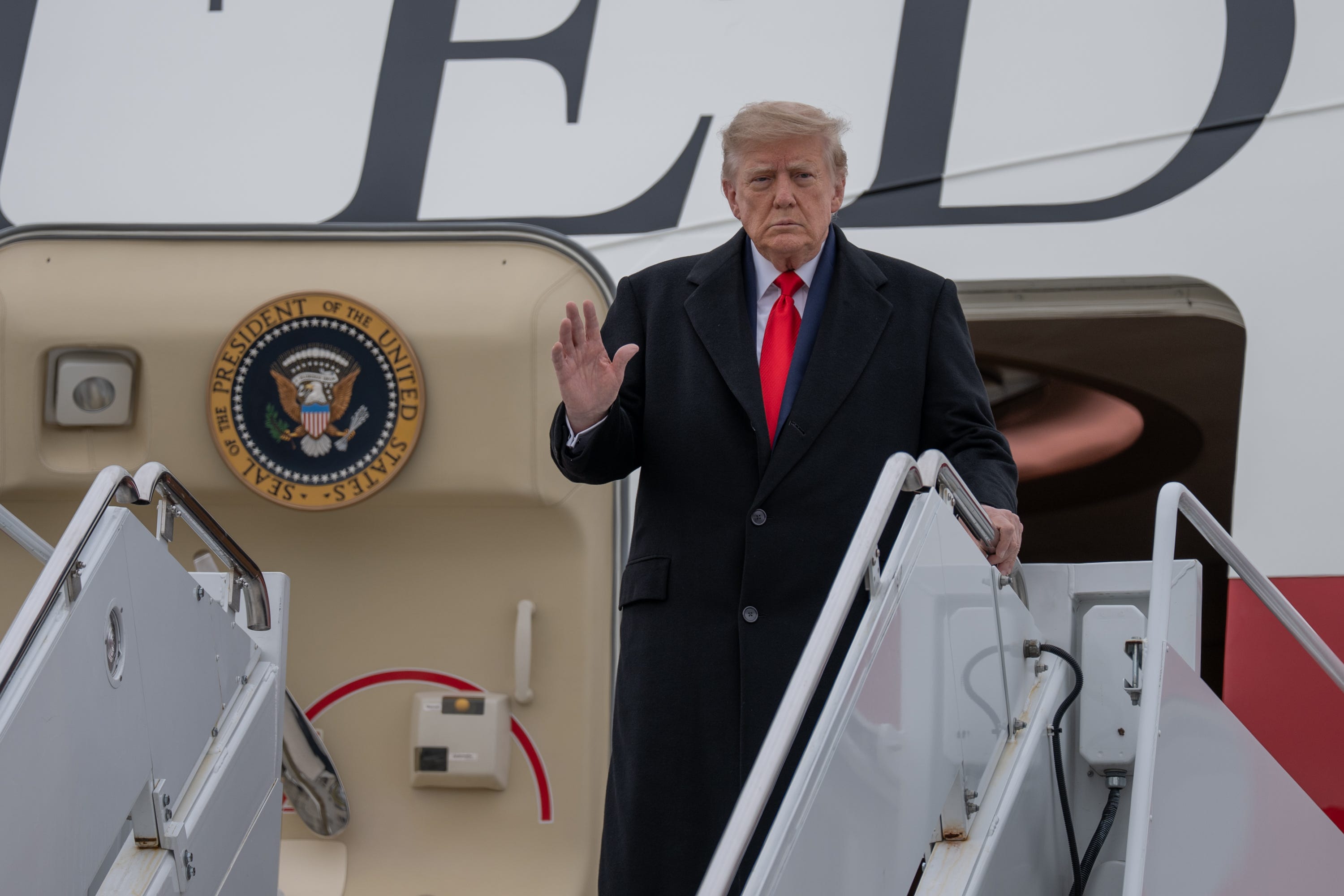
Last time, I talked about the necessity of taking a critical look at the small but increasing number of Republican politicians who are making a show of “distancing” themselves from President Donald Trump. Panicked by a midterm environment that glows gloomier for Republicans by the day, they have correctly intuited that public rejection of the president — both generally and on specific fronts like the economy and immigration — has created not so much headwinds as a proverbial wrecking ball set on a crash course for the GOP’s congressional majorities.
But these maneuvers shouldn’t obscure the underlying reality: on issue after issue, on goal after goal, the contemporary Republican Party seeks to advance a vision of the U.S. that is largely indistinguishable from major initiatives and priorities of the Trump administration. This means that a key challenge for Democrats, not just in the weeks leading up to the midterms but over the next two years before the next presidential election, will be to both maximize the damage that Trump has inflicted on the Republican brand while also not letting his allies, toadies, and even reluctant defenders off the hook for their complicity in outlandish policies and ideologies.
After all, in the person of Donald Trump, the many pathologies of the contemporary GOP are legible for any American to see: he makes explicit what so many in the party would rather downplay or dissimulate. His contempt for women; his incitement of violence against both his fellow citizens and defenseless immigrants; his embrace of white nationalism: on so many fronts, his shameless pronouncements and behavior help make evident what might otherwise feel abstract, or retain a modicum of plausible deniability. Properly described and framed by the opposition, Trump can be a skeleton key to assist in the wholesale discrediting of a political party whose views he so often advances. And when you add in his bottomless greed, his narcissism that seeks to swallow all the attention in the world, a general undermining of the U.S. on the world stage, and his clearly deteriorating mental state, it would be a lost opportunity not to remind American voters that this is the man the Republican Party has chosen to sell their souls to — and to judge the party accordingly.
But Democrats need to bear in mind that at some point, they will be entering a zone of diminishing returns in trying to tie the GOP to the bloated failure of Trump and his administration, rather than hitting Republican politicians for their own policy and ideological failings. To my mind, this means that the pivot to emphasizing GOP complicity in Trump administration depredations needs to start now, and ramp up through the 2028 election. The worst thing that could happen would be for the Democratic Party to stand up a narrative, inadvertently or not, that Donald Trump is the primary source of the GOP’s moral rot and anti-democratic animus, so that the GOP is able to enter the 2028 election cycle with semi-plausible claims that it will be a reformed or more palatable party with Trump no longer in power or on the ballot. For the remaining years of the Trump administration and beyond, the ambition of Democrats should match the country’s political crisis and the danger that the Republican Party presents to the continuation of democracy in America. They have been presented not just with a generational opportunity, but a moral obligation, to discredit the Republican Party as a political force in the United States, and should not hesitate to seize it.
If this sounds extreme or grandiose, then I’d simply ask the reader to consider the project of the Republican Party over the last decade and more, which has constituted nothing less than an escalating insurrection against American democracy — including an explicit goal of permanently keeping Democrats out of power at both the state and national levels. This insurrection has been propelled by a millions-strong reactionary movement of Christian nationalists and white supremacists who wish to turn back the social progress of the last half century and more; augmented by millions of less ideological Americans who nonetheless find themselves unsettled by rapid social change, a sense of economic precarity, and political disempowerment; and bankrolled by a rogue’s gallery of tech oligarchs and assorted billionaires who have seen in the Trump era an opportunity to reshape the American economy even further in favor of the hyper-wealthy.
Looking beyond Trump’s congressional co-conspirators to individual red states and their Republican leaders, there is little reason to think that a post-Trump GOP will somehow be more moderate. It’s always bracing to recall that the GOP’s push for permanent political dominance achieved its first, striking successes at the state level, with the party obtaining, via gerrymandering and voter suppression, a stranglehold or disproportionate power not only over red states, but also purple polities like Wisconsin. Indeed, as Alan Elrod writes at Liberal Currents, the cruelty and extremism displayed by GOP politicos in the ur-MAGA state of Texas make a good case that the party is set to go even further off the democratic rails in the coming years.
Despite all this glaring evidence of a grotesquely revanchist GOP, there is a certain strain of Democratic politico who asks us to ignore the full evidence of our senses; to turn our backs on all the outrages against democracy, dignity, and human life that we have suffered, and to concentrate on “real,” material things like “affordability” and a return to “normalcy.” But in fact the citizenry has been forced by the Trump administration and the radical GOP to realize that there is no “normal” we can get back to without fully confronting and discrediting the forces that have turned our country so very abnormal.
Even the narrow, cautious focus that some in the party counsel — such as on affordability and health care — turns out to be inseparable from larger questions of American identity, equality, and freedom that the GOP has thrust to center stage. We cannot have a meaningful discussion about health care if it is poisoned by the idea that some Americans are less American than others. We cannot have a thoroughgoing discussion of economic justice if the millions of immigrants who contribute so much to our country are to be considered as less than human. And this is to say nothing of the idea that there is small pleasure to be had in full employment and fat paychecks if, at the same time, an autocratic government can abuse you or your family for having the wrong skin color, treat you as less than a full citizen because of your gender or sexual orientation — or render your ability to meaningfully participate in our democracy null and void.
But despite so many Democrats’ refusal to engage fully with the GOP’s advocacy of racism, misogyny, and Christian nationalism, or to highlight these assaults on the nation and its populace, the citizenry has indeed been forced to grapple with such outrages and their larger meaning for the nation’s future. Federal agents’ sadistic abuses of non-white immigrants and the citizens who have attempted to defend them; an unending torrent of racist, homophobic, and misogynistic rhetoric from the White House aimed at diminishing the safety and status of millions upon millions of Americans; a ceaseless unleashing of hate against trans people that aims to deny them their very right to exist: Trump and the Republican Party have made no secret of their desire to corrode not just U.S. politics, but American society itself. The direction they’re trying to push us in is palpable not just intellectually, but at a gut level for so many people: to raise white, straight, Christian men up to positions of high authority and social dominance, and to put everyone else in their proper, degraded place. For millions of Americans, this push is alternately frightening, enraging, and disorienting.
But here’s the crux: having seen this grotesque social and economic experiment run in real time and at national scale, a strong majority of citizens are repulsed, and wish to be freed from this radical re-envisioning of America. Democrats must directly speak to Americans’ ongoing engagement and reaction to a Republican assault on basic notions of equality and national unity, and be unafraid of channeling this disgust and outrage.
So as important as it will be for the Democrats to develop legislative strategies to minimize any further damage Trump tries to inflict on the country over the next two years, they also need to communicate a narrative to the American people of what the president and the GOP have aimed to do to our democracy and our society, the damage already done, and the prospect of further horrors should they continue in power. If and when their party wins back the House (and hopefully the Senate), Democrats have every incentive to amplify their scope of victory by casting it as a public repudiation of this unacceptable GOP vision, both to bolster their fight in the next couple years and over the longer term. The goal should be to strike at the fundamentals of contemporary Republicanism, with Exhibit A being the clear failures and horrors of the last few years, and the antidote being a full-court press to restore American democracy, strengthen our free society, enable an economy that brings prosperity to all, and hold their antagonists to account.