


This is the second of a three-part essay on how Friedrich Nietzsche became the lodestar of reactionary Christianity. Read part one here. Please subscribe to stay in touch!
You would think that given the drastic unpopularity of his war of choice against Iran and the economic devastation it’s causing Americans, that President Donald Trump would be spending his time trying to drum up support for his war efforts. Instead, Trump and his top lieutenants have launched a war of words against Pope Leo XIV, railing against him as “WEAK on crime” and saying that popes should not comment on foreign policy matters. This week, Trump escalated dramatically by posting an AI image depicting himself as a Christ-like figure healing a sick man — an act condemned worldwide, including by many of his own supporters.
The White House’s actions make no conventional sense. There is no good reason for Trump to be declaring war on Catholics and presenting himself as Jesus during a time when his poll numbers are at all-time lows. But all of this makes perfect sense once you realize that Donald Trump hates Pope Leo XIV because he sees Leo as an illegitimate rival. Trump isn’t just more Catholic than the pope, he sees himself as the authentic leader of global Christianity.
That claim would have seemed hyperbolic two weeks ago. It does not seem hyperbolic today. When the Jesus Trump image drew too much backlash even from his own base, he deleted it — and within 24 hours posted a second image of Christ, arms draped around Trump’s shoulders at a podium, American flag behind them. “The Radical Left Lunatics might not like this,” Trump wrote, “but I think it is quite nice!!!”
While it’s easy to think of Trump’s follow-up post as just peevish defensiveness at being shamed into a rare retracted statement, his decade-long record indicates that both of the images from this week indicate a much more consistent record of trying to rebuild American and global Christianity in his own personal image.
Trump as the leader of reactionary Christians’ war on modernity
To understand why Trump believes himself to be the real vicar of Christ, we must go back to the beginning of his political career and review why it was that a self-admitted serial philanderer, swindler, and liar who seldom attended church came to be the avatar of far-right American Christianity. It’s a question that establishment media has been asking non-stop for the past ten years despite its very obvious answer: the Christian right sees Trump as their most powerful weapon in their battle against modernity.
This is an unsettling thing to realize if you have never seen right-wing extremism up close. But it is the reality of the contemporary American far right. Ali Alexander, the lead organizer of the rallies that eventually became the January 6th Capitol riots, summed up the radical vision shortly after the attack:
“The Lord says that vengeance is his, and I pray that I am the tool to stab these motherfuckers,” he said in a video statement. “This begins the rebellion and I will not bow before an illegitimate government, not now, not tomorrow, not if they imprison me, not if they question me, not if they poison me, not if they behead me. They can go to hell, I’m going to heaven.”
While mainstream Protestants and Catholics have long since reconciled with the cultural and political changes of the past century—full political rights for women, the end of racial segregation, and the civic normalization of homosexuality—American Protestant fundamentalism has manifestly stood apart. In a 2024 Pew Research Center survey, just 36 percent of White Evangelicals said that homosexuality should be accepted by society, while large majorities of Black Protestants, Catholics, Mainline Protestants, and non-religious people agreed. Similar trends hold on whether abortion should be legal and whether same-sex marriage should be legal.
Unlike the Catholic Church, which made its accommodation with modernity through the Second Vatican Council, reactionary Protestant Evangelicalism never did. Beginning with the international humiliation of the “Scopes Monkey Trial” of the 1920s, it has instead spent decades in a state of escalating apocalyptic siege mentality, convinced it is fighting against the literal forces of Satan before the Second Coming of Christ — losing cultural ground daily, and knowing it.
Into this vacuum stepped Donald Trump in 2015. The offer was explicit. “Christianity is under tremendous siege,” he told a heavily Evangelical crowd in Iowa that year. “We are getting less and less and less powerful in terms of a religion, and in terms of a force. If I’m there, you’re going to have plenty of power. You don’t need anybody else.” It was a Nietzschean Christian appeal to power rather than a show of humble faith. Together, Trump promised, we will seize control of the kingdoms of this world—an almost perfect recapitulation of Satan’s offer to Jesus in Matthew 4.
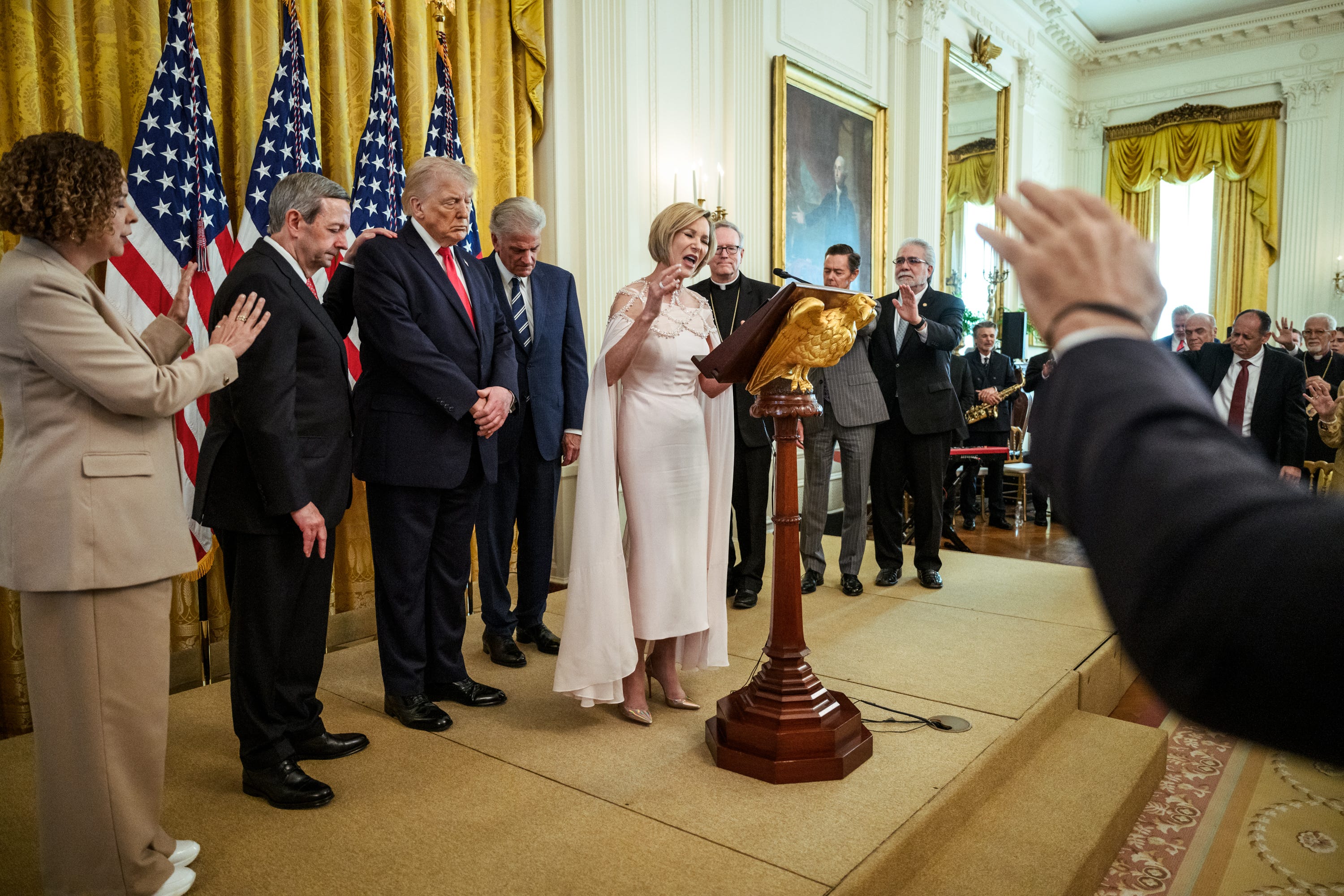
The Evangelical establishment heard this offer and immediately set about building the theological scaffolding to justify accepting it. Leading the effort was Paula White-Cain, a prosperity gospel televangelist who had been Trump’s spiritual adviser for over a decade. In 2017, White declared Trump “authentically raised up by God,” invoking the biblical principle that “it is God who raises up a king. It is God that sets one down. When you fight against the plan of God, you are fighting against the hand of God.” She later described Trump as “the greatest champion of faith” ever seen in a president.
But the most theologically ambitious construction came from Lance Wallnau, a charismatic preacher and key figure in the New Apostolic Reformation — a fast-growing movement that believes God still speaks through modern-day prophets. Wallnau met Trump in 2015 at a prayer session organized by White, and immediately declared him a modern-day King Cyrus — the Persian ruler described in Isaiah 45 as a pagan king anointed by God to liberate the Jewish people from captivity. The analogy was perfectly designed for the situation: it explained why God would choose a vulgar reality television star who couldn’t name a Bible verse, and it framed Evangelical submission to Trump not as a compromise but as an act of prophetic obedience. “There is a Cyrus anointing on this man,” Wallnau wrote, arguing that Jesus had raised up Trump to fight demons.
Wallnau’s book God’s Chaos Candidate predicted Trump’s 2016 victory and made him a central figure in Christian nationalist politics. The theology spread fast. By 2020, nearly half of white Evangelicals who attended church regularly believed God had specifically meant Trump to be president.
Trump absorbed all of this and amplified it. In 2019, he publicly described himself as “the chosen one.” He cast his criminal indictments as martyrdom — “I am being indicted for you,” he told Evangelical broadcasters — and repeatedly claimed after the 2024 assassination attempt that God had personally intervened to spare him. The fiction that Christians had been persecuted and that Trump alone had saved them was the point. The debt had to be established and constantly renewed.
What Wallnau, White, and other elites constructed within the institutional church, the QAnon cult has extended into something far stranger and more sprawling. As researcher Noelle Cook documents in her book The Conspiracists — drawing on years of immersive study of QAnon believers, many of whom she first encountered at the Capitol on January 6th, the cult is not a departure from Evangelical Christianity, it’s a natural ougrowth. The pathway from one to the other, Cook found, was frictionless: the same structure of patient suffering before a great reward, the same apocalyptic framework of a cosmic battle between good and evil, the same absolute certainty that the believer possesses truth that the corrupt world suppresses. Where Evangelical Christians wait for Jesus’s return, QAnon adherents wait to “ascend to 5D.”
While QAnon has more iconography than its parent religion, the fundamental message is the same. What QAnon has added is a personalizing of the divine — a choose your own adventure religion, in which the believer is not merely a member of a flock but an active decoder of divine signals and secret messages from his prophet, Donald Trump.
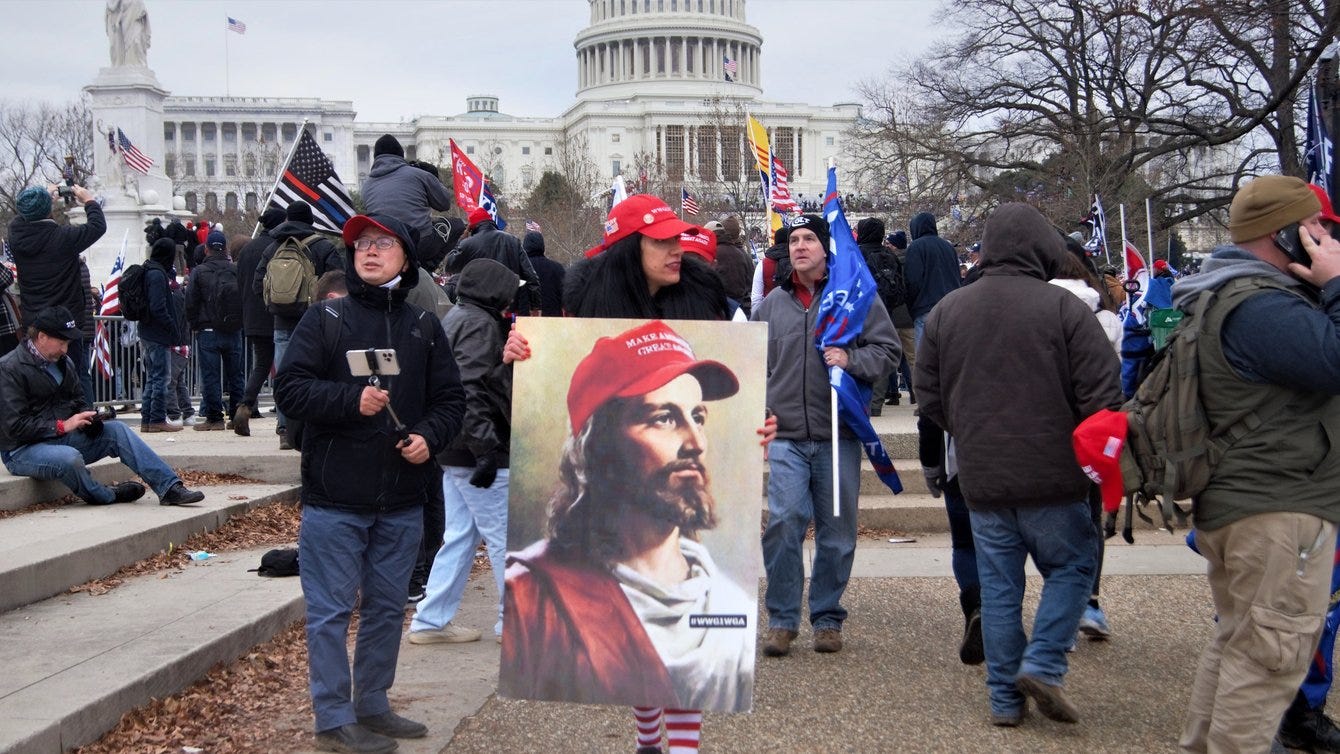
While it might seem like just an internet conspiracy community, the reality inside of America’s Evangelical congregations shows that QAnon is a religion. Since it became a cultural phenomenon, multiple news outlets, including the New York Times, have reported on Evangelical pastors who were forced out of their congregations for refusing to preach the doctrines of Q. For this movement, truth had long since become not a matter of evidence but of power — not that which you can prove, but that which you can compel others to accept. They put this belief into practice on January 6th, as I reported earlier. The Capitol Putsch was filled to the brim with Trump and Jesus imagery, and took place days after far-right Christians re-enacted the Biblical march of Jericho in Washington, DC.

New icons for a new religion
Trump and his staff have repeatedly fanned the flames of his most delusional Christian supporters, incorporating QAnon theme songs into campaign rally speeches, frequently boosting QAnon memes on his social media accounts, and regularly boosting blasphemous imagery portraying himself as God’s anointed.
In October 2023, on the first day of his New York civil fraud trial, Trump reposted a an image showing Jesus sitting beside him, captioned “nobody could have made it this far alone.” In January 2024, he reposted a video entitled “God Made Trump,” in which an AI-cloned Paul Harvey narrating Trump as “a shepherd to mankind” divinely sent to “fight the Marxists” and “wrestle the deep state.”
A few months later in March, Trump partnered with far-right Christian singer Lee Greenwood to sell a “God Bless the USA Bible” for $59.99. (The book was printed in China, according to the Associated Press.)
After surviving the assassination attempt at Butler, Pennsylvania, in July 2024, Trump repeatedly claimed God had “spared him,” and his Evangelical court declared the moment proof of divine anointing. Merchandise appeared: “They called Jesus guilty too.”
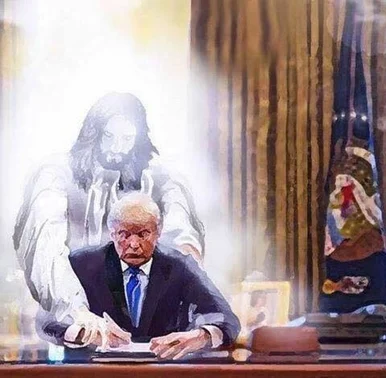
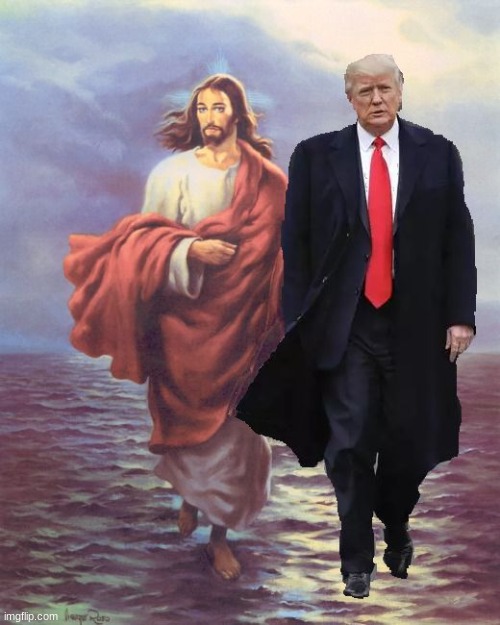
The blasphemous Trump iconography is far larger than you have any idea. There have been images of Christ guiding Trump’s hand as he signs papers, Trump walking on water slightly ahead of Jesus, a painting of guardian angels watching over Trump in the Oval Office, and multiple images of an invisible Christ protecting Trump. Amazon is filled with hundreds of Trump-Jesus products, including a “President’s Bible” series of children’s books featuring a cartoon Trump narrating the birth of Christ and helping Noah build his ark. Fans will soon be able to purchase a David and Goliath story as well. The series is one of hundreds of Trump books for children, including Trump Saves Christmas, and several Plot Against The King books by FBI Director Kash Patel.
Remaking America through Trump Christianity
Safely reinstalled back in the White House, Trump and his top staffers have made it unquestionable that they intend to remake America in the image of their anointed leader. At an Easter lunch event at the White House this year, Paula White stood before the president and prayed over him: “Mr. President, no one has paid the price like you have paid the price. It almost cost you your life. You were betrayed and arrested and falsely accused. It’s a familiar pattern that our Lord and Savior showed us, but it didn’t end there for him, and it didn’t end there for you.” She continued: “Sir, because of his resurrection, you rose up, you were victorious.” She was not speaking metaphorically. She was a senior White House adviser, at an official government event, explicitly mapping Trump’s biography onto the Passion of Christ.
Trump took the idolatry to the next level last month by releasing a rendered video of his proposed presidential library featuring a gigantic golden statue of himself. Besides being an echo of the famous golden calf worshiped by the Israelites in the Exodus story, the president was also referencing statues made by his supporters. The 2021 Conservative Political Action Conference featured a golden statue of Trump. Last year, supporters put up a 12-foot golden Trump sculpture in front of the U.S. Capitol Building.
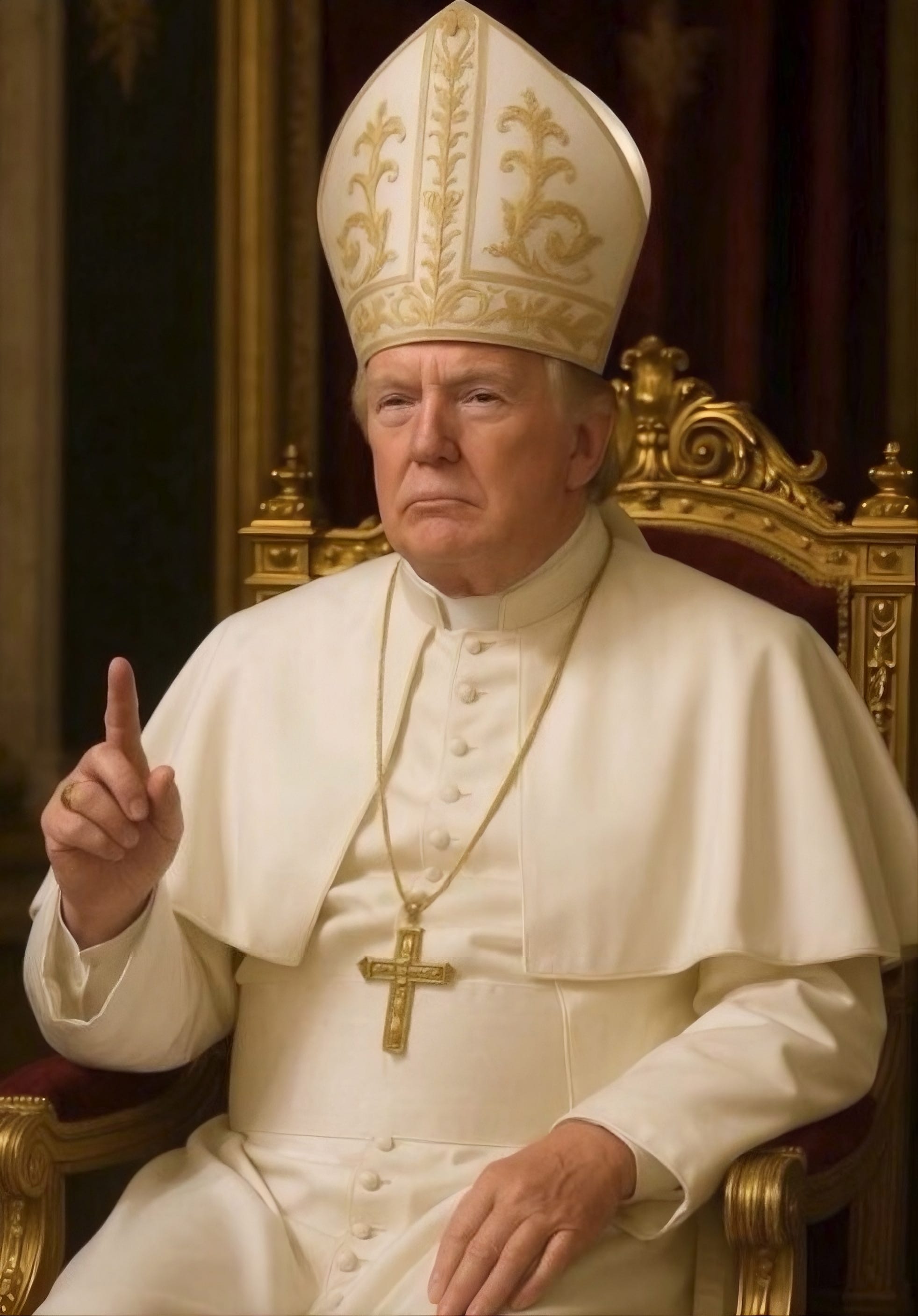
There’s no question that Trump and his most devoted supporters clearly see him as God’s chosen servant to lead and protect Christians, but if there were any remaining doubt about the matter, Trump ended it in May 2025, in the days between Pope Francis’s death and the conclave that would elect his successor. With the Chair of Saint Peter empty, Trump posted an AI image of himself as pope. Just days earlier, Trump had explicitly proclaimed his desire to lead the Roman Catholic faith: “I’d like to be pope. That would be my number one choice,” he said, before boosting a political ally of his, Cardinal Timothy Dolan, who was then serving as the Archbishop of New York.
This week’s AI images were not aberrations. They were the visible continuations of a personality cult that Trump has been building for the past 11 years. While Trump sees himself as the protector and incarnation of “true” Christians everywhere, he also has more worldly models than the pope. Besides talking about his desire to put himself on Mount Rushmore as America’s greatest president (better than Washington or Lincoln), Trump also openly admires dictators around the world for their power.
Of Kim Jong Un, he said in 2018: “He speaks and his people sit up at attention. I want my people to do the same.” Of Xi Jinping, he told Joe Rogan: “He controls 1.4 billion people with an iron fist. I mean, he’s a brilliant guy, whether you like it or not.” He has described Russia’s Vladimir Putin as “very smart,” praised Hungarian Prime Minister Vikor Orbán as “one of the most respected men,” and said of strongmen generally that their total dominant control is itself evidence of genius. What these men have in common — what Trump explicitly identifies as admirable — is unconditional deference. Their people do not argue. Their institutions do not resist.
Trump has reached an accommodation with Putin, Xi, and Kim not because he shares their ideologies, but because they have agreed, implicitly, to stay in their lanes. Pope Leo has not. Leo, the first American pope, is operating in Trump’s domestic political space, commanding the loyalty of sixty million American Catholics, and refusing to render unto Caesar what Caesar demands. He cannot be praised into submission or ignored into irrelevance. He must, therefore, be destroyed. Trump does not believe himself to be the reincarnation of Jesus, but he very clearly believes that he is the rightful leader of all Christians, and that anyone who disagrees is not just incorrect, but evil.
A new establishment of religion
In his second term, Trump has moved from imagery to institution — building what functions as a state church, but one whose loyalty runs to him personally, not to historic Christian teaching or freedom of speech. Defense Secretary Pete Hegseth introduced a “Secretary’s Christian Prayer and Worship Service” at the Pentagon in May 2025, held monthly during work hours. The Labor Department followed. A Consumer Financial Protection Bureau advisory board opened its proceedings with a White House official delivering a Christian prayer: “Thank you for your son, Jesus, who died for our sins.” Federal employees told CNN they felt participation was compulsory.
The administration then codified the broader project. New Office of Personnel Management guidance established that federal workers can tell colleagues to “rethink his religious beliefs,” and that supervisors may post invitations for employees to join their church. Phil McGraw, a close Trump friend appointed to the Religious Liberty Commission, framed the mission without ambiguity: “We are in a religious and cultural war right now, and every single one of us is a combatant.”
Meanwhile, Trump terminated the U.S. Conference of Catholic Bishops’ refugee resettlement contracts in February 2025, citing — in two terse letters — that the program “no longer effectuates agency priorities.” The USCCB’s Migration and Refugee Services was the largest refugee resettlement agency in the world, operating under a partnership with the federal government that had run across administrations of both parties for nearly half a century. The funding cut forced the layoff of more than half the agency’s staff and the closure of a century-old program. The USCCB sued the administration, citing Matthew 25:35 — “I was a stranger and you welcomed me” — as the theological foundation of their work, and arguing the cuts “undermine the Constitution’s separation of powers.”
The distinction is not about the separation of church and state. Christianity that consecrates Trump is institutionalized. Christianity that challenges Trump is defunded and attacked. The test is entirely personal — and it was being applied long before this week.
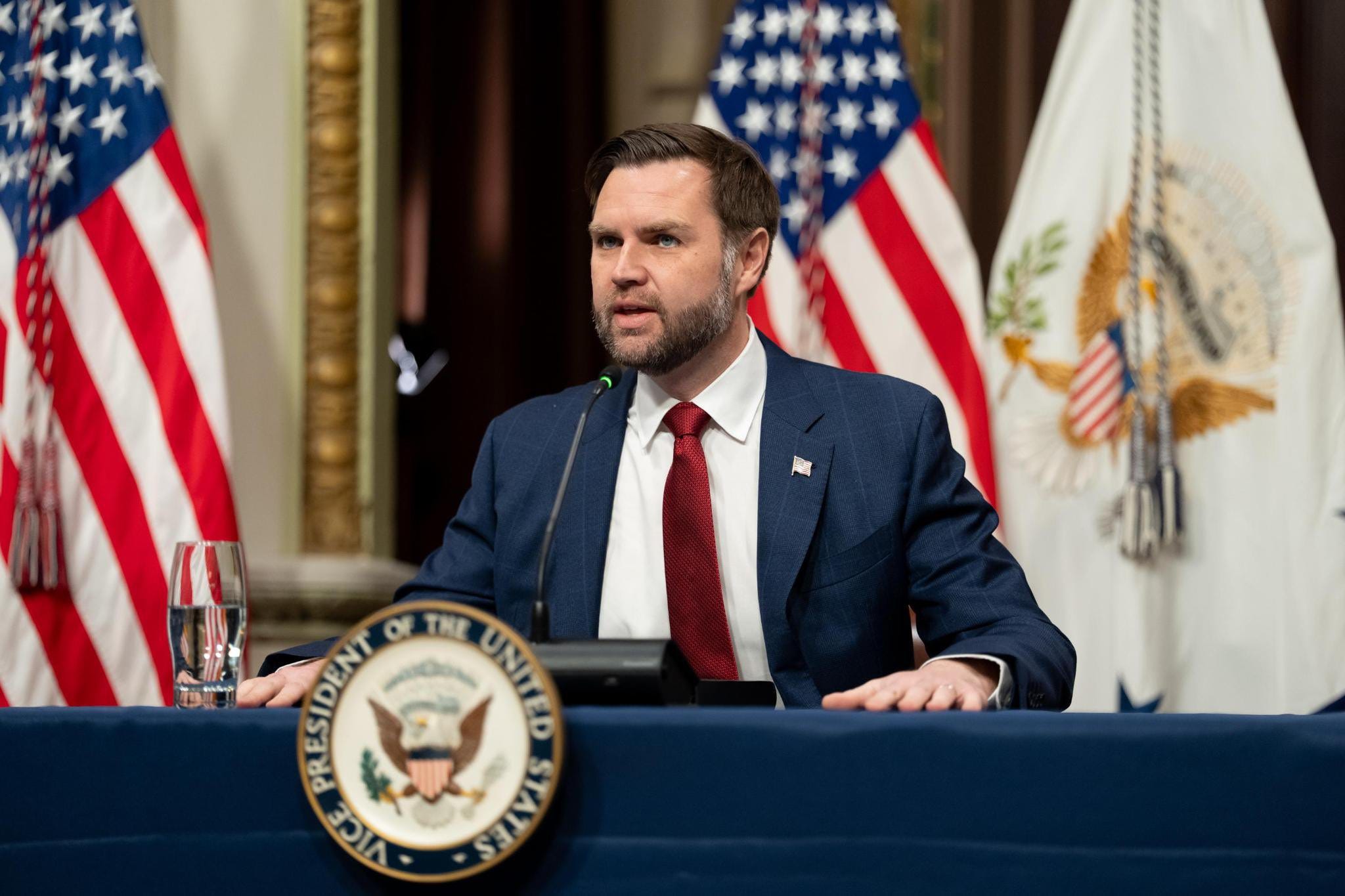
When JD Vance — the first Catholic Republican vice president in American history — invoked the medieval concept of ordo amoris in January 2025 to justify the administration’s mass deportation program, he was doing precisely what Wallnau had done: deploying Catholic theological vocabulary to consecrate MAGA policy. Compassion, Vance argued, flows outward in concentric circles — family first, then neighbors, then fellow citizens, and only then the rest of the world. America first, theologically certified.
Pope Francis responded directly in a February 10 letter to U.S. bishops: “Christian love is not a concentric expansion of interests that little by little extends to other persons and groups.” The true ordo amoris, Francis wrote, is found in the parable of the Good Samaritan — “the love that builds a fraternity open to all, without exception.” Multiple theologians confirmed Vance had gotten Augustine wrong.
Vance’s response was to accuse the bishops’ refugee resettlement programs of padding “the bottom line.” Cardinal Timothy Dolan — whom Trump would later boost for pope — called those remarks “scurrilous” and “very nasty,” which they were, but more importantly, they were consistent with the new civic religion of Trump and his role as the true vicar of Christ.
Christian nationalism is actually Evangelical supremacism
Besides the fact that Trumpism is trying to usurp the papacy, the conflict we’re seeing this week between the president and the pope was also inevitable because Trump Christianity is entirely Protestant in its theology. While Catholics like Supreme Court Justices Clarence Thomas and Samuel Alito have contributed the governance theories of American reactionary Christianity, the people who actually run the show are the largest group: Evangelical Protestants.
This became evident in this week’s president-pope controversy as House Speaker Mike Johnson, a Baptist, held a press conference to explain that there is “something called the Just War Doctrine.” He was apparently unaware that Pope Leo is an Augustinian friar who spent twelve years leading the religious order of Saint Augustine, the man who invented the Just War doctrine.
Vance, a former Evangelical, went further at a Turning Point USA event, warning the pope to “be careful when he talks about matters of theology,” adding: “That’s one of the things that I try to do, and it’s certainly something I would expect from the clergy, whether they’re Catholic or Protestant.” The casual equivalence of the papal office with any other clerical role is itself a Reformation-era idea. Luther said something similar in 1520.
On Fox News, Vance argued it would be “best for the Vatican to stick to matters of morality” and let the president handle public policy, a perfectly Protestant viewpoint that is utterly unrecognizable to someone who actually knows Catholic teaching that matters of religion and state are fully within church’s purview.
Bishop Daniel Flores of Brownsville put the Catholic position with quiet clarity: “The successor of Peter teaches. This is his office. If what he teaches doesn’t sound like what we want to hear, we should admit the likelihood that the problem is in what we want to hear and not in what he teaches.”
“I’m not afraid of the Trump administration,” Pope Leo said on his way to Africa this week, after Trump called him weak and Vance told him to be careful about theology. “To put my message on the same plane as what the president has attempted to do here, I think is not understanding what the message of the Gospel is.”
He’s right — and the reason he’s right is structural, not political. The Catholic Church cannot pass Trump’s test. Not because it’s the kind of gay communist institution that MAGA Evangelicals imagine it to be, but because its authority is grounded in something that does not bend to personal loyalty: a tradition running from the Gospels through Augustine and Aquinas and twenty centuries of popes, a teaching office that exists precisely to speak its long-held doctrines, regardless of who it offends.
While Trump’s inhumane deportations and Middle Eastern wars are the target of papal criticism today, the church has refused to compromise its doctrines on ordaining women or allowing same-sex marriage. The difference is that Catholic Democrats like Joe Biden recognize and respect religious freedom—including for doctrines they dislike. Trump wants everyone to bend the knee to him. When Trump attacks religious authority, proclaims that he should be pope, defunds Catholic charities, and has his Protestant allies explain its own founding theologian back to it, he is not disagreeing with the church on policy. He is rejecting the premise that any authority exists above his own.
Christ’s authority, in the theology of Trumpism, runs through his real anointed — the man God spared in Butler, the man “God Made” to attack the Satanic communists, and the man who depicts himself as a golden idol.
While regular Christians see Jesus as the Word of God made flesh, Trump Christianity sees him as the incarnation of will to power. He is their Antichrist, not in the Biblical sense, but in the Nietzschean one. The cult of Trump has never had a need for a pope. That fact is now evident for everyone to see. Trumpism is not Christianity with a political edge, it’s a competing religion — with its own iconography, its own doctrines, its own clergy, and its own avatar of God.