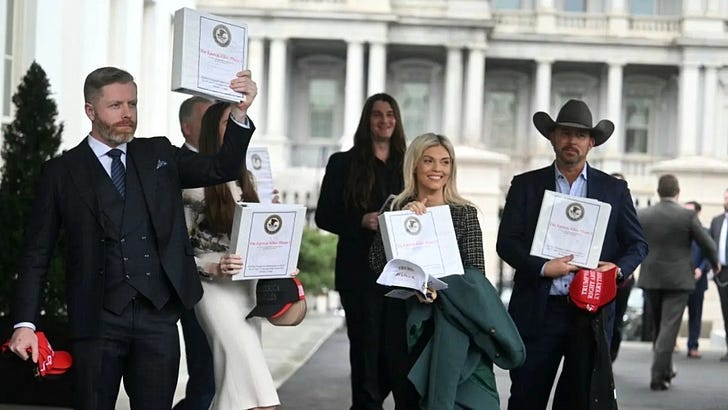


When we hear the term “conspiracy theorist,” most people probably imagine someone who looks a bit like Alex Jones, a middle-aged white guy who’s slightly overweight and loves to scream. And to be sure, there are a lot of people out there like that—supporting Donald Trump as fanatically as possible. But the reality of American right-wing extremism includes many people who look completely different.
Noelle Cook, my guest on today’s episode discovered that firsthand in her research on women who believe in QAnon conspiracy theories, which began, fatefully enough, when she coincidentally happened to be at the Capitol on January 6, 2021. Conspiracism is a new type of religion, one that’s similar to past ones in having doctrines, leaders, and tales of apocalypse—but also different in that it’s much more narcissistic and self-directed than modern-day cults like Scientology or Heaven’s Gate.
This is fascinating research that’s much deeper than the rural diner safaris than had become infamous in American media. Her findings are the basis of her new book, The Conspiracists: Women, Extremism, and the Lure of Belonging, as well as a film documentary about the women she profiles.
The video of our conversation is available, the transcript is below. Because of its length, some podcast apps and email programs may truncate it. Access the episode page to get the full text. You can subscribe to Theory of Change and other Flux podcasts on Apple Podcasts, Spotify, Amazon Podcasts, YouTube, Patreon, Substack, and elsewhere. (Note: Purchasing a book through the links in show notes helps support Theory of Change.)
Related Content
How the sex and drugs counterculture fell in love with Donald Trump and Jesus
Rather than moderate to find more voters, Republicans are using lurid Satanic fables to terrify fundamentalist Christians
How ‘tradwives’ use sex to sell religion
Charlie Kirk was a masterful political organizer, and a dangerous religious extremist
Far-right religion has been offering absurd and unhelpful advice to women for decades
Why conspiracy theories about the famous Rothschild family tell the history of antisemitism
Trumpism isn’t conservative, and saying this is still important
Far-right members of Congress are making the internet a safe space for misinformation
Audio Chapters
00:00 — Introduction
06:13 — QAnon as a religion of narcissism
12:18 — What conspiracism offers middle-aged and older women
20:13 — Media proliferation and political manipulations have made conspiracy belief much easier
28:27 — The women of January 6th faced widely divergent economic circumstances
34:32 — Charismatic evangelicalism as the common starting point for QAnon believers
44:02 — Astrology, space aliens, and QAnon
48:44 — ‘Soul contracts’ and tragic morality
52:49 — Right-wing politicians harm society and then use the nihilism they engender as campaign leverage
55:42 — What do QAnon believers think about the Epstein files now?
01:04:35 — Prevention is easier than de-radicalization
Audio Transcript
The following is a machine-generated transcript of the audio that has not been proofed. It is provided for convenience purposes only.
MATTHEW SHEFFIELD: What makes your book different from a lot of others is that you are providing in-depth continuous conversations with specific people over time. So it’s like a longitudinal ethnography, if you will. And that’s a little different than most studies of misinformation and false beliefs, I think.
Was that something you set out to do deliberately to profile these individuals, or you tried to do it originally as a group?
NOELLE COOK: No, it was not something I set out to do originally. The only reason I ended up doing this is because of the timing and it was during the pandemic and I had entered a graduate program and needed a graduate thesis and in person research was not an option at that time. So I had taken a camera and gotten down to DC on January 6th to get images of the stop the steal rally to try to come up with a visual anthropology project.
Clearly got different kind of pictures than I expected. All of my pictures are on the outside. I didn’t go anywhere near the building, but it was such a surreal experience to have discovered what actually happened that day when I got home and look at these pictures and see so many women, and I was looking at these first 100 women that had been arrested for.
Entering the capital on January 6th and looking at their, their statements of facts and, and what they had done and what they were being charged with, that it really started to strike me. That, that the only similarity between these 100 women was generational. So that is how I started studying women, specifically middle aged [00:04:00] women.
And that population came from January 6th, but quickly within the first year led me down a path into what became known to me as Cons, spirituality. Um, and I had never intended to study conspiracies. I had hoped to. I had deliberately avoided learning anything about Q Anon. because I don’t have that in my personal life.
No one in my family is a conspiracist. Uh, but that is where every one of the women I was following took me. And you mentioned that it’s there’s this, this end depth study, and, and it was, I, I started talking to several women. I probably talked to about 12 people over a course of several months. But I ended up settling on two because it, it’s if I wanted to do what I wanted to do, which was to truly understand them, which is what ethnography demands, uh, ethnography wants you to go into a culture, uh, unlike your own and to observe as a participant and, uh, inhabit these spaces and understand what people are doing and what these practices mean to them.
And so that is what I did is lurked for about a year in different spaces trying to understand what I was seeing because it, it ran the gamut between Q Anon conspiracies to anti-government conspiracies, to going all the way into theosophy and the IM movement that I had never heard of either.
I didn’t ha I don’t have a religious background and so. I, in some ways that probably benefited me because I was able to see so many overlapping similarities in the way belief systems work and how conspiracies can also work as a faith-based system, which is what I’ve kind of concluded at this point.
It’s not that unlike organized religion in many ways.
SHEFFIELD: Absolutely. Yeah. They have doctrines. Absolutely, they do.
COOK: It doesn’t have the structure and the accountability that’s supposed to be built into institutionalized faith-based systems and, and, you know, you can add to which you want, but it operates the exact same way. In fact, many of the women [00:06:00] I talked to who may have actually gone to physical churches prior to the pandemic after those restrictions and in-person gatherings were shut down.
If you ask me as women now, what church they go to, they say, my, my church is here [in my heart].
QAnon as a religion of narcissism
SHEFFIELD: Yeah. Yeah. Well, and that is a thing that makes it harder to help people get out of this type of thinking, because unlike being in a authoritarian religious cult where there is a specific leader and they have things you’re, that they require you to do in places to be. This is choose your own adventure religion.
And so that means, essentially, I mean, it’s, it is a religion of narcissism, so you’re always right. Even if you’re wrong, you’re right. and it’s harder if your predictions don’t work, then you can still come up with a thing to justify it.
COOK: is that different though? This is the question I’m asking myself. I don’t know. Like I’ll ask you, knowing your background, like in some ways though, so you say narcissism, you keep being told things are gonna happen, but they don’t come true. Would you say the same thing then for. People who believe in apocalypse, for example, the people who put the data.
I mean, I know that’s an extreme and we, don’t take that seriously, but there’s a lot of faith-based systems that ask you to keep waiting for something that’s going to happen that you just have to have faith will. Right. I
SHEFFIELD: Yeah.
COOK: So is that narcissism?
SHEFFIELD: There is narcissism in that and and just simply the nature of, I personally know, what God is and what God wants, that is extremely narcissistic.
And so, when you look at religions that have persisted over longer time periods, they’ve kind of burned a lot of that stuff away. In, because they, in their early years they were like that saying, Christianity, the early Christians were saying Jesus is gonna come back during our lifetime. Like that’s the story of the early apostles.
COOK: [00:08:00] Conspiracists believe that too.
SHEFFIELD: Yeah. So, so, but what’s different, I think though, with regard to this, kind of modern religion is that it, it’s self-directed in many ways, and that’s what makes it harder to help people get out of.
COOK: It’s what makes it even more dangerous.
SHEFFIELD: It is. Yeah, absolutely. And so it’s easier, it is both easier to weaponize and harder to falsify because technically, Donald Trump doesn’t tell these people to do anything.
COOK: He doesn’t need to because it’s also a community that operates through signals and codes. The whole thing with conspiracists is to decode things. So if you’re at a Trump rally and you hear that thunder in the background coming from the loudspeakers and it’s playing that song, that’s a wink and a nod to keep the faith, the storm is coming and it’s kind of, to me, what I’ve grown over time, and this is absolutely not to be offensive towards organized religion, but I, as I move from saying these are just these delusional people who have just lost touch with reality.
I, I, of course by the time I’m actually talking to people, I know that’s not true. Right. I know They’re not just mentally mental illness is not the reason here, there, there is the belonging and the participation factor for sure. But. When I started listening to some of the things they would tell me about their pr, their previous practices, spiritually, which was in organized churches, evangelical churches.
SHEFFIELD: Mm-hmm.
COOK: Some of those message, some of the messages in the, it is very easy to swap those for like the cons spirituality realm, because they all talk about a new, a problem being solved. You just have to be patient. You sometimes you have to suffer, right? But then there’s this great reward at the end for that, and if you are a Christian, you believe that’s heaven, that’s your great reward. And if you are a conspiracist, you believe that you’re ascending to earth in five D, which is basically heaven, except you’re still alive, I guess. I’ve never quite under, I still haven’t really figured out exactly what that looks like when we ascend.
Well, I won’t be [00:10:00] ascending, but when we ascend to 5D—
SHEFFIELD: Yeah, you’re not eligible, Noelle.
COOK: I am not, I’m, I am 2D, 3D, I am not, I have not leveled up in the game yet.
SHEFFIELD: Yeah. Well, and we have seen that over the years that a number of even evangelical pastors have, they’ve been forced out by their congregations, actually. Because they won’t preach QAnon religion.
COOK: That’s the other thing the pandemic allowed for, right? Because physical locations were off limits at that point. People did turn online and, right. I mean, normal churches and normal practice was going on, but it also gave people an opportunity, I’m thinking like right now, Chris Keys, for example, who’s this?
Just ab absurd. It’s so absurd. It’s funny, it’s almost like a comedic sketch watching him, but he, got his ministry credentials and now he’s got his keys to Christ’s ministry thing and he’s preaching and he’s absolutely insane. And so, you watch these people online, it’s just you funnel this when you’re funneled this 15 hours a day and you already lack discernment in media literacy.
And again, talking about the population I’m talking about, were the ones that had to kind of muddle our way through how to learn to be safe on the internet. There’s no one teaching us and they don’t use the middle aged women are some of the biggest super spreaders of disinformation studies have shown recently because they indiscriminately retweet without looking who it’s retweeting or looking what the actual messaging content is.
So I think I see so much of this turning into, so many of these people are turning to. Individuals that have no credentials or training for their spiritual practices. And I ended up LA landing right in the middle of some of that. When I first started this research following one of the J six women through her online spaces, in their online groups, I ended up with a whole bunch of people who were part of the Love is one cult because they were bringing those teachings they were doing on YouTube back in the day when Amy Carlson was around and doing it now on Facebook with the same audience ready to [00:12:00] consume what they were selling. So I, it, I we, if people are also, if we’re getting a religion from there too, there are no third space. There’s the Internet’s taken over every aspect of your life, essentially. Your spiritual, your moral training, oftentimes education now too. It’s a big problem.
What conspiracism offers middle-aged and older women
SHEFFIELD: Yeah. It is and generally speaking, and of course there are individual differences, we will say. But you know, there are some general gender differences, especially with regard to conspiracists. And so like, men generally tend to be interested in things about, oh, COVID was a Chinese bio weapon, and we need to have stock up on guns because the communists are coming, and be very interested in the illegal immigrants coming to kill them and things like that. Whereas the women, and not just the women, the individual women you talk to, but also in general women, are responding to some—the trans message, anti-trans message obviously is a big thing for them—but they’re responding in a little bit different ways to some of these men as well. You want to talk about that?
COOK: Yeah. And I think that was another place where they, where this became, I think this burst into the mainstream. I think that this has always existed, but the pandemic really allowed it to kind of burst into the mainstream because the pandemics touched on so many different pieces that women are allowed to participate in.
Right? It was the sphere of womanhood. It was your family’s health, it was your family’s nutrition, it was your family’s education. It was education, moral training, all of those things. And so then when the culture wars happened you could see this is an opportunity in a very patriarchal structure for women to get out front and center, just like they did in the civil rights movement.
Right? Most of the screaming, angry faces. In front of children are white women. And that’s not unlike what we saw during the pandemic with mask mandates and school closures. It was, some of those pictures are very similar to the ones I saw from the [00:14:00] sixties because that’s when women are allowed to be aggressive and still be feminine.
Otherwise you’re trans investigated if you’re aggressive and you don’t fit ideal femininity. But protection of children is an ideal feminine trait. And so they could scream about vaccines, they could scream about school boards. And we watched that and we watched in January, 2021 when Moms for Liberty came out of nowhere and by summer we’re hosting $20,000 table fundraisers.
That was all, funded. Clearly. I did a lot of fundraising and I can promise you I wouldn’t have been able to have a fundraiser in charge that much after six months of existence when I’m selling t-shirts as our main source of income. Right.
SHEFFIELD: well it certainly married to the head
COOK: Yeah, well, yeah. But if you asked them at the time how they’re raising funds, we’re a grassroots organization of just plain old moms.
That’s everything was presented that way too. Remember, we’re talking about a population that’s already invisible in society. We’re past our reproductive use and most of us are either making very little money or aren’t contributing anything to the GDP. So there’s very little use for women over 50 in our culture.
And so what the pandemic did in so many of these issues did, and the culture wars did, is gave women a voice and visibility. If you look at some of the leaders of the movement building that had taken place on the right over the last five, six years, there are a lot of Gen X women there. You look at the women for Trump, you look at someone like Lee Dundas, who was one of the original organizers of the truck convoy.
All of these movement, the right is very good with movement builders, by the way. Right. With traveling revivals essentially. And so there were so many middle aged people doing this stuff that I, I think that somewhere along the lines gen X kind of lost their minds with as they went online because there is no discernment.
And it’s just this amplification of absolutely absurd things. When we filled in our, when I did that documentary in 2023, it all was very spontaneous and unplanned the way it worked out. But the two women in the book, Tammy and Yvonne, were able to meet each other in person for the very first time, [00:16:00] opposite sides of the country.
But because of the online ecosystem that they inhabit that is global. They could finish each other’s sentences automatically. because they’re just basically conversing in memes.
(Begin film trailer)
Yvonne St. Cyr: January 6th was a setup.
Tammy Butry: Was a setup. I made national news hanging out the window!
News correspondent: Test, test. So I’m here with Yvonne at Freedom Corner. You were just convicted for January 6th, and--
Yvonne St. Cyr: I was just sentenced.
Liz Smith: Just feel like the world’s going slightly mad, right?
Yvonne St. Cyr: Right. But that it’s just darkness being exposed.
So we’ve never been to the moon. They’re lying. Um,
Liz Smith: We’ve never been to the moon?
Yvonne St. Cyr: Not through traveling through space.
Yeah. They control the weather. They, they modify heart. There’s a set here.
Liz Smith: Who controls the weather?
Yvonne St. Cyr: The elites.
Tammy Butry: I am like, what the heck? So I go, and this is before I knew about McDonald’s too. I got myself an Egg McMuffin.
COOK: (makes retching sound) What about McDonald’s?
Yvonne St. Cyr: They use human meat,
Tammy Butry: Use human meat.
COOK: Really?
Yvonne St. Cyr: Yes.
Tammy Butry: Yeah.
Yvonne St. Cyr: So when you’re terrified, your adrenaline glands pump adrenaline into your blood and um, they drink the blood of terrified people and that is what keeps them younger. And it also--
Liz Smith: Who drinks the blood of children?
Yvonne St. Cyr: These elite pedophiles.
Liz Smith: My head’s exploding.
Yvonne St. Cyr: I hope that your documentary comes out in time, but. Be to be truth. I think the shift will become before then, and maybe this trip is just meant to help you raise your consciousness.
Liz Smith: How exhausted are you?
COOK: Physically or mentally? I think of the mental exhaustion just comes from the realization of just how far gone so many people in this country are not just this country globally.
(End film trailer)
COOK: So the example you saw in the trailer where they’re [00:18:00] sitting outside Tammy’s home and there, you know, what about McDonald’s, is what I had said. because Tammy was describing a scene of buying an Egg McMuffin or something and they literally both said at the same time, they serve human meat.
I knew this already going into that because I’ve heard, I saw the memes on there, but the fact that both of these women were saying that was really interesting to me, and that happened throughout that day in conversations-- where if you realize everyone is consuming the exact same propaganda, the exact same conspiracies. And when it becomes this silo and this echo chamber where everybody else is saying the same thing, they’re, they’re the group.
The, they’re the chosen, they’re the chosen ones there to share the good news. And the rest of us either get to, choose to purify ourselves or to stay deceived. And that’s another reason I think that it, it really works well with thinking about it as a belief system based in faith. It’s very similar and it and you have your congregation that you believe it with and that you work with in your online spaces.
And then you’ve got today, I lose more hope than ever in trying to just dislodge any of these types of beliefs from people because how do you do that when again, you’re middle-aged and you were raised to believe that your government might do something to actually help you someday, least in the eighties, that’s what we were being fed.
And then you realize now all the people you look at our Health and Human Services department, we’ve got some of the biggest conspiracists in there. We’ve got president who doesn’t believe half of what he says, obviously, but knows how to manipulate his base well enough to tell them they’re all getting med bed cards soon.
So when people with that kind of power and authority just continue to perpetuate this stuff and just string people along for their own purposes, and then you got influencers who will be the next step down, the next level down, take away the authority. Now you got the influencers, the people you spend your whole day with online, and they’re telling you the same thing.
And it’s getting worse and worse every day. I can’t even look at social media anymore because [00:20:00] it’s also happening on both sides. This isn’t just right wing conspiracy territory anymore. I’m seeing the same thing from liberals. There are I, many of them who have continued to say the Butler deniers, I guess, right? That didn’t actually happen.
Media proliferation and political manipulations have made conspiracy belief much easier
COOK: And I agree that things have turned so in the, our shared reality has turned so incomprehensible and insane that I agree that it might be hard sometimes to not pause and say, God, maybe some of this could be possible because lots of impossible things are coming true right now.
But until you have evidence, I think it’s incredibly irresponsible for people with any authority or power to be stringing people along this ways, because these belief systems also have real world consequences, and because they coalesce with so many various ideologies in these online spaces, they can have long-term lasting consequences.
So if you’re a QAnon conspiracist, but you happen to run into a space where there’s a chat about sovereign citizen and you’re able to pick and choose a couple things that make sense, like sovereignty, right? The idea of sovereignty. And now you start using that selectively because you don’t really understand what paper terrorism looks like.
You just mean, you think it means not paying your car registration or your mortgage, right? You lose your house. Like I watched that happen to people over the last six years. I watched the believing things people told them that could come true and have serious real world consequences for that behavior.
But now someone like Yvonne who did lose her house, she did lose her job. Her car was being threatened to be repossessed because she stopped paying her bills and was dabbling in sovereigns and language. What do you do when then this person, whose entire mission was to take her case to trial because she believed she was a divine sovereign being who was placed at the capitol on January 6th for a reason.
She went through the trial, she took the stand in her defense, she ran, read a 40 and five minute letter to the judge telling him she didn’t ize his jurisdiction because she was a divine [00:22:00] sovereign being goes to jail for a year and a half, and then the pardons come down. And she was one of the few that stood for her truth.
She was one of the few who rejected a plea deal. She believed so fully in her mission that she turned her life upside down and but was on appeal. So when the pardon came down, it’s wiped away as if it never happened. So I’m not sure how you would ever convince someone whose entire mission was completely fulfilled.
SHEFFIELD: Yeah.
COOK: And this is because of the authority that has been given by our government and the people that have been actually elected into office. And it is very and once you turn on it, like Marjorie Taylor Green isn’t doing anybody any good because every, either, either you already know that she’s just a political operative who’s, testing the wind to see which direction she’s going or.
They’re just gonna say she’s part of the darkness and can’t be trusted. We’ve got a big segment of this population that does not live in a shared reality, and is willing to act on whatever their beliefs might be, which is a real problem because most of the time it’s gonna have individual consequences and personal consequences to themselves.
But once in a while, you’re gonna get a kid who walks into Mar-a-Lago because he is really upset about how save the children and the Epstein files are being handled. And he’s, he happened to be on the right and he, I believe, a pretty devout Christian. So the conspiracies are a huge problem as far as impacting ordinary people’s lives because people in power are using them in so many ways.
SHEFFIELD: They are. Yeah. And, but it’s also that the conspiracy theories that they do reflect at least some basis of the bad things that the believers themselves have experienced. So in the two women that you may are mainly focusing on in the book, these are women that both have experienced extreme poverty as children, sexual violence [00:24:00] repeatedly raped as children and as adults and domestic violence, drug addiction, homelessness.
So, it’s and then, and the society that, it has no regard for them, thanks to, and the, this is the most horrible irony of it is that, the party that they vote for actually did this to them. But because the party’s able to use conspiracy theories to weaponize them, they actually blame the people who created the programs that have helped them multiple times in their lives.
It’s their fault actually.
COOK: But then we have another problem with men in power. People in power, oftentimes men, for example Tammy had, there’s institutional failure here also that helps these beliefs grow. You know, Tammy had two children that were caught up in something I was sure was a conspiracy when she first named it, because I hadn’t heard about it.
But it was called Kids for Cash. And it took place in the early two thousands in Luin County, Pennsylvania, where two judges who were both Democrats had teamed up with a developer to build a for-profit juvenile detention center because they, I guess for years they’d been trying to replace the county run decrepit facility.
But these judges were getting kickbacks by this developer to see the jo, you know, to get the projects through and then to help keep it built. And this was right on the heels of nine 11 where schools took us, or no, excuse me, not nine 11. I’m trying to remember which crisis in my lifetime. Oh yeah, Columbine.
It was on the heels of Columbine and, and so schools took a zero tolerance policy. And so this, this one judge, uh, Elli c Villa, something, we would walk, go do his scared straight assemblies. If you end up in my courtroom, you’re gonna do time. Sure enough, two of Tammy’s children ended up in his courtroom.
One of them wasn’t even a teenager yet, and both of them ended up in there for incredibly minor infractions that, you know, might’ve gotten to a detention back in the day. They ended up being incarcerated for about two years. Both of them. This was [00:26:00] dismantled when the juvenile justice center in Pennsylvania and Philadelphia, uh, started to get involved when parents started to complain.
But this was a program that was specifically designed to prey on poor people because. If you went into his courtroom, if you’ve been summoned and you did not have a private attorney with you, the clerk of the court would been a friendly way, offer you the opportunity to sign away your rights to counsel and tell you that if we have to wait for a public defender all day, we might be here all day and maybe it will even come back tomorrow.
Most parents are like, okay, got in a playground fight, I’m gonna sign my rights away. Well, he’s gonna get a slap on the wrist and we’re going home. Got two years and this happened to like 3,500 kids. That’s like generational stu, that that goes on. That kind of trauma is like everlasting.
And we have such a history of decade after decade of decade of putting people through that kind of trauma and having broken systems that betrays you, that betray you. You know, Tammy had a child also who committed an adult child who committed suicide in county jail. She wanted to get some therapy.
She couldn’t, she was on a, a waiting list for three months. Right. Well, when you’re also in poverty, your housing is precarious and so she might be waiting on a waiting list and by the time her name comes up, she had to move because she lost that other apartment and now she’s got to get another waiting list.
It wasn’t until she went to jail or prison for January 6th that she got this probation officer. And once she was released, Tammy did 20 days in jail for the picketing and parade and she took a plea. Um, she told the, the that the parole officer, I really had been trying to get some help to deal with all this trauma that’s been happening.
You know this, the last six months of trauma. It was, it took a court order. And a parole officer, a probation officer to get her into a therapist. And she went to a therapist and she started to get some mental health treatment and she has a job now and she’s had a job for two years that she’s held down.
And so she has been working to improve her life, but it was institutional failures and then institutional incarceration that was able to get her any kind of services [00:28:00] whatsoever. It’s really ironic and weird to me,
SHEFFIELD: Yeah. Well, it’s a terrible thing, frankly, that there, there was no help for her until she was in prison.
COOK: I, that irony was just kind of amazing to me actually, that in order for someone like her to get a therapist, it has to come a court order. Because otherwise there just aren’t enough mental health professionals or she doesn’t have the cash for, so yeah it’s really unfortunate,
The women of January 6th faced widely divergent economic circumstances
SHEFFIELD: Yeah. And so, it, so you’ve got so many people who are facing and we should say, not everybody who believes in these things has had such horrible life circumstances. There are
COOK: not at all.
SHEFFIELD: of regular
COOK: one, and that’s one thing people have asked about. That’s one thing people have asked me a lot about is like, how come you only pick these two people? And part of that is because the population I had access to, many of them had an agenda. And when someone has a motivation to either become a, a J six influencer or they want to monetize their platform, I don’t feel like I can really learn again.
I’m not going to trust what I’m learning from them is authentic.
And although, Tammy’s probably a, an extreme example of poverty. Yvonne was not, she was a family that was trying to make it in middle class. Right. Yvonne joined the Marine. She was in Marine for 16 years. She had important ranks and all the way up to drill instructor, gunnery sergeant she lived in a middle class neighborhood and lived in middle class lifestyle.
Then we see someone else in the film trailer that you showed, and her name is Jill. And she was someone that Yvonne knew that I met on that road trip. And Jill has an advanced degree, she’s a psychiatric nurse practitioner and she’s licensed to prescribe in multiple states right now. And part of that is because of the telehealth that took place during COVID.
She was able to take. Her degree and start a telehealth practice. And she’s, as far as I know, still doing that. So we, and Liz in a middle class neighborhood, in a depressed area, but it’s still considered middle class where [00:30:00] she’s at in, in western Pennsylvania. So you have the gamut there.
You look at other January 6th women, these were not just all people who weren’t educated or who were living in the back woods here. There are plenty of people who worked in healthcare. There are plenty of small business owners. One woman has a de medical degree and a law degree, and they came from, I think Yale and Stanford.
So, so some people they ran a gamut, which was also what drew my interest to the photographs I took on January 6th. I wasn’t looking at a bunch of, people, like to make fun of like, what they imagine, MAGA supporters to look like. I see lots of memes or like people missing teeth.
No, it wasn’t like that at all. I was sitting, not sitting. I was. Looking at people sitting next to each other who looked like people I would be sitting next to at a PTA meeting, or I’d run into at the grocery store, might be my neighbor. There were plenty of people that were firmly middle class.
In fact, I did that in the very beginning when I was trying to figure out what I was looking at. And what this pattern was is anybody who’s clothing or gear, I could price out, I was trying to price out what people were wearing to see what we were talking about socioeconomically, because we kept talking about it being poor white people who are drawn to this kind of bigotry and these kinds of movements that some would call hateful.
So, but that wasn’t the case. It, I would say there, I think with the men involved in January 6th, it was a third small business owners, a third white collar and a third working class. So it kind of runs a socioeconomic gamut, which is interesting since it’s gonna hurt a lot of the people in that one third working class position for sure.
And is trickling up into the next one too, by small businesses also. But again, when you’re in a faith-based system, I think that’s why you’re allowed to, I think that’s what allows you to vote against your own interest. because there’s amount, there’s a certain amount of suffering until that day you’re waiting for cops.
SHEFFIELD: Yeah, there is. And well, and it’s, these types of systems are what I call a semiotic loop [00:32:00] in that it’s, it is a meaning system in which everything, even disconfirming evidence is becomes proof of the belief not,
COOK: importantly, and not importantly, but adjacently, it’s a placemaking system also. It’s a it’s your community, it’s your family now. It’s your place, it’s your space. It’s the place you spend most of your waking hours. I mean, some of these people are logging, they’re most, again, middle aged women who are now also sandwiched in our, middle aged.
When I say middle aged women, I’m talking Gen X right now. Nine, I guess we’re not really middle aged. I’m being kind here. 1965 to 1980, right? So we’re that generation now who is also sandwiched in between childhood, extending out an extra 10 years and so that your kid goes to college and then comes back home.
Many people, many of us women have either faced divorce, which led to financial precarity or a difference anyway. Now we’re also looking at our parents who need help. And are aging out. And I, that’s what we personally did for 10 years is taking care of three different sets of parents who were in various stages of Alzheimer’s while I was still getting kids in and out of college.
So it’s, it, you don’t have a lot of time to build relationships in the outside world, and it’s very easy to get stuck in your online space. That’s where your friends live now. That is where you go for advice. That is where you go to dump your personal trauma. There, everybody’s got their private messaging that’s off Maine.
There’s a lot of community building that goes on in dms. Tammy used to go to, in, in world Trump rallies. Not to listen to what Trump was saying, but to scout around to try to find like all of her favorite QAnon influencers like Mickey Larson Olson and that Brooke suit dude. And, because she wants her picture taken with her telegram fam and her favorite influencers.
It’s like looking for the characters of Disneyland. In many ways that was the reason she would go to those things. Not be, it wasn’t political, it was social, and so many of these women, I watched it, that’s exactly what it [00:34:00] is and has become, is a social movement for themselves. More so even than ideology, because that’s flexible.
SHEFFIELD: yeah. Well, and that’s also where the narcissism comes in as well, because, like they, they want to believe whatever it is they happen to believe at that moment, and their family members, rightfully reject it. And the friends they
COOK: Well, not for the reasons you want them to though. Not all of them.
SHEFFIELD: Well, for their own reason, whatever reason, they’re not, they don’t find it persuasive.
COOK: It’s not because they think it’s crazy, it just goes against their own crazy beliefs.
Charismatic evangelicalism as the common starting point for QAnon believers
SHEFFIELD: Yeah, it seems well and actually that is another thing that I did want to talk about. So, so, this, there, there are so many beliefs in this stew here that we’re talking about. And no one has the same beliefs as anyone else. Despite the fact that they can have some apophenic recognition of other people’s, ideas like the cannibal human meat at McDonald’s.
So it’s, but they’re still, it’s just this giant mishmash of nonsense, frankly. Um, but it does, it seemed like, and certainly for the two women that you talked with that, the starting point was charismatic Protestant christianity for in terms of how they got initially into some of the weirder stuff, even though they were both Catholic at birth.
COOK: Yeah, I think most of the women I spoke to had some kind of religious background but weren’t practicing whatever they were doing. Yvonne was in the book, she was going and she, one of her favorite stories to tell is, I was the kid who’d take the bus when I was eight years old to church. And she tells that story because her, she wasn’t, her family wasn’t going.
And so she would go to various churches her friends went to, and many of them ended up being like Pentecostal churches. And she kind of was drawn to that because she liked the energy. It felt, so much of these things are about how you feel, not necessarily what people are saying or what truth is or what, how it makes you feel.
If it makes you feel a certain way, is [00:36:00] gonna keep drawing you back. Which is, goes back to influences online. If they make you feel a certain way, you’re going to keep engaging with their content. And so I think Yvonne found that, but then kind of drifted away from it when she was in the Marines.
And it wasn’t until later when she was seeking something else, that she returned to evangelical Christianity. This time the Church of the Nazarene in Idaho, a church and the Nazarene in Idaho. And that worked out for her and that became her identity for 20 years. And she, and Vonne is the type that likes to jump right into a leadership role or likes to walk right up to the bike racks right up against the police line at the capitol.
She’s got to be in the front. She’s a leader, she’s a drill instructor. And I always hesitate because I’ve, if I say drill sergeant, I’ll be corrected because I different branch and a different status. So a gunnery sergeant. And she, so, so when COVID happened. This is where your narcissism part might come in here because she was scolded by a pastor when she posted a picture of herself with without a mask on when she was with a youth group. It was a mass mandate and her church was asking people to adhere to that. So she was, you know what, yeah. About being scolded. And then when they, and because she was starting to be distant, ostracized on, people were distancing, whatever you want to call it, as her own beliefs, as she was coming to Bible study going, have you seen this movie outta Shes Right.
And then talking about child sex trafficking tunnels and so forth. It got to be too much. And then when she brought in the new age spirituality and started saying, God is a woman, she was saying that for a while. When she was influenced by the online influencers, the remnants of love is one. And then she began calling God, spirit and creator.
But God is still synonymous. All these things are still synonymous, which is really strange. If you’re not looking at people over time, on any given day, you might say, oh, she’s evangelical, but the next day you’re gonna say, no, she’s an Elizabeth. Clear prophet follower. Right? Because the philosophy
SHEFFIELD: she’s a
COOK: am of it.
SHEFFIELD: pagan witch or [00:38:00] something. Yeah.
COOK: A hundred percent. Yeah. It, that’s how much, and I’ve, I, the way I have been trying to describe it to people, especially people who aren’t online, is imagine you are at a trade show, and there might be a central theme to the trade show, but it’s every industry that could participate in that theme, who’s got their wares on display for you.
And so if you walk in and you, first thing you hit is an evangelical boost, okay? You’ll get your traditional religious material and a few, now you’re gonna learn about sovereign citizens over there. And a table across the room has somebody calling themself a politician. And you walk around long enough and you collect all the swag at each table and you dump it out and you end up with two or three things, but you have a key chain, a bumper sticker and something else.
And you might not ever investigate any further into the people who gave those things to you. You’ll just take it. because it feels good now. It works now as another tool to use. And I’ve watched that happen with so many people that have no idea what they’re talking. I keep someone, I know one of these women who’s on Medicaid and can barely survive is online every day encouraging people to get out there and buy their silver and like really wouldn’t.
What if you ever bought silver? It, and so there’s this connect it’s a, it is an alternate reality and it’s a complete disconnect from any kind of, it’s a fantasy game. Many ways sometimes, but it also is a fantasy game that gives you hope. Anyone who’s ever played video games and has to stop, can’t wait.
They’re not, if they’re in a spot where they’re gonna level up or there’s something exciting coming next, all they can think about is getting back to that video game. It’s very much that same mentality. It never stops and lifestyles completely change because of it. Some people that means they don’t make, one person I mentioned who’s not in my book of film, but who I’m aware of is a woman who called herself Patriot Q.
Her name’s Mickey Larson Olson. And I’ve, it’s very sad. I keep seeing posts from her about her daughter who is a nurse or a healthcare professional who has told [00:40:00] her, I’m sorry, your, some of your beliefs are so anti-science, they’re dangerous and they have a new baby and they’re not letting her see it.
And that has happened to people across the country and it, although I feel very sad for her. You know that she’s enduring that pain. I would do the same exact thing if I were her daughter. Right. I mean, it, so it’s a struggle because I don’t know what the answer is to help people. Exactly. I also have to be very careful because a lot of this population’s incredibly hateful to large swaths of the population, whether it be through racism, anti L-G-B-T-Q-I-A rhetoric, anti-trans rhetoric.
I not even Reddit acts, acts of physical violence against these groups. It’s very easy for me, who is a white woman, middle aged, white women, who can pretty much move freely in spaces. Every one of those movement builders I described, I went to in person, no one ever questioned why I was there.
I looked like I fed in. So I, that’s how they operate. And I recognize the privilege I have to say to. We should be talking to people, trying, you can’t do that when the same person was saying, you your life has no value and it’s okay for you to die. I get that. And I know that there’s a lot of people who are going to read my book and think that I’m some, I’m a white woman apologist, for example.
And I’m not. I tried really hard to and I struggled with that in my own personal life. A year, two or three. Some of I, I was like, huh, I’m building relationships, aren’t I? I don’t want to do that. But when you’re talking to someone and you’re learning such personal things about them, over time I found myself developing empathy for parts of their lives.
January 6th was a very small piece of any conversation we ever had. because it was about lives and institutional failure and things that were promised that never materialized. And, I was able to have conversations where there was even some common ground in some of those experiences. So I talk a lot about how online spaces just keep people stuck [00:42:00] and it makes it worse, especially where we’re at today in our political landscape.
And how it really, we really need to try to help them get out and we, but only certain people are gonna be able to tolerate that. Only people are only certain, a lot of people won’t even
be
SHEFFIELD: no one should have to to do that if it’s
COOK: No. And I didn’t try to do that, by the way. That was not my job. Ethnography does not ask you to push back or change minds. It asks you to interpret a different language, essentially. And that’s what I think I did. Although I did gain empathy for the humanity of these women.
I don’t see myself as trying to explain them away to you. I see myself as understanding their culture and their language, teaching you their vocabulary, explaining how they think. They deserve whatever consequences came down for them. I believe that. But, but I also see them as people just like we do with other groups that are incarcerated and do heinous things. Right. I just want to make that really clear,
SHEFFIELD: Yeah. Well, the other thing about going so deep with these people is that, and producing the results of what they think and, how they structure it together is that I think there is a lot of people who are not in these reactionary worlds, that they tend to think that all of them are, like, I dunno, 50 something, white men from Montana or, uh, hillbilly with two teeth and living in Louisiana or something.
And that’s not the reality of the Trump extremism movement. Like, there’s plenty of, as you said, there’s plenty of people that look, like the lady you run into in the grocery store, or there’s plenty of them who are not white.
COOK: I priced out one man’s gear he wore that day between the body armor and all the other things that I could identify through a Google lens, just to see how he was wearing about $850 just on the outside of his clothing, so yeah, that, that idea that it’s just these poor, dumb, and [00:44:00] educated people is just false.
Astrology, space aliens, and QAnon
SHEFFIELD: It is. And yet, these beliefs though they are also just all over the place. And they exist in, like they’re on the periphery of so many other subcultures that may not be connected to them. So, like for instance, astrology is something that is popular among a lot of women.
But also astrology is a huge part of these Q anon beliefs, or, like the belief in that you’re a star seed. You want tell us about that one. For people who don’t know that belief.
COOK: Huh. The star seeded is complicated. The star seeds go back a while again. A lot of these things are lifted from either people who are channelers from the seventies and eighties or science fiction, but the idea of a star seeded is that you were born into your human vessel, to you you’re born, you forget who you were and all that, you know, and you’re here to live this experience as a human.
And there’s oftentimes a lesson involved that you’re supposed to have agreed to before you came to do it. That is what Yvonne believes is that she’s a star seat and that that’s why she believes she was placed at January 6th in the Capitol. It was, she was, because she wanted to go after Trump said things were gonna get wild after January 6th.
It became part of her story. Well, of course I was arrested for that. I was placed there. I was supposed to be there and as a, that she believes she’s this divine being. She also now has, there’s what they also call these waves of volunteers, which also ties into Christianity and other religious beliefs.
This 1 44, the 144,000, I kept seeing 144,000. But I was seeing it such diabolically, different context and people saying it, and I still have a hard time knowing exactly what they’re meaning.
SHEFFIELD: Well, actually that’s from the book of Revelation. It’s from the book of
COOK: But the waves being used across these boards and Yvonne believes that there’s been three waves of volunteers.
That it was the ones, right? So it was boomers, the Gen [00:46:00] Xers and the Gen Zs. So I guess what’s all happening right now is
SHEFFIELD: Wait, Wait, what about millennials? So millennials don’t get anything.
COOK: well, I think this’s, I think Gen X, because Gen X is so much of a part of it, we’re going to ignore millennials. Like we get ignored.
Maybe that’s it, because they talk about, they do skip millennials. They’re talking about the youngest right now. Maybe they’re talking about Gen Alpha, but also Gen Z. They think they’re the ones who, which would make sense that would be a population they would be looking at. Because if you look who delivered Trump to right, the second term, it was white Gen X women and their sons.
Which are, many of them are Gen Z. I’m an elder, gen X. My youngest child is the last year of millennials. So many of these women do have Gen Z sons. That may be why they’re picking that generation, I’m not sure. But all of that is part of the mytho. It’s the 144,000, which also can, it comes from religion.
So they know that’s what it starts to someone who’s here to bring not the truth, help awaken humans. Yvonne’s in the process of remembering who she is now, and she is,
SHEFFIELD: And she also has a huge belief in reincarnation and things like that
COOK: Yes. And that all started with when she found Love Is One. And when she started to get introduced to New age spirituality, that’s when, that’s how she her, one of her children, one of her sons is gay.
She had a real problem with that when she was in the evangelical church. Took him to the pastor. I mean, we didn’t, I don’t think she went as far as conversion therapy, but close. Right. I was horrible about it to him admits that. Today her love and light. Beliefs and her cons, spirituality, her cons, spirituality, beliefs don’t allow for that difference.
Exactly. They explain it away. Well, her’s gay, because in maybe his last life, he was a woman. And there’s still, sometimes there’s gonna be traces of those past lives in the lives following for a couple, maybe a couple of two or three of them. Same thing with a [00:48:00] person who’s trans.
If in the film, in the, it’s not in the trailer, but in the film there’s a scene where Yvonne and I are talking about Tammy’s daughter, Sabrina, who hung herself in the men’s county prison in Williamsport, Pennsylvania who had been denied their hormones their their psych meds. This person had several mental health.
This was one of the people who had been caught up in cash for kids and had a lot of institutional betrayal in their life, and Pam, you would think, who loves her daughter, who had a hard time accepting that transition, but ultimately loves her daughter. But today, we’ll still trans investigate online, she will still make, derogatory comments about the trans community.
‘Soul contracts’ and tragic morality
COOK: And I don’t understand that except for in that conversation in the, when we were filming they were trying to explain to me the, well, I’ll use Yvonne’s quote, you’re fucking with God, is what Yvonne said in the film. It be by transitioning, because if God had intended you in this lifetime to be
SHEFFIELD: And you signed up for it. Like that’s the
COOK: You signed up for it too, right? You signed up for it. That’s part of that pre, predetermined. That’s so soul contracts. When you’re, when you decide to take this human vessel and your soul comes into this human vessel, you are agreeing to all the things you’re going to do before you come onto earth.
Your soul inhabit your vessel. So let’s say it’s a great way, it’s a victim blaming game, essentially. So if I use this example on the film, I know Tammy was sexually assaulted by her stepfather for a couple of years, said she was 11. So I, I if I bring that up and I say, but how does that explain what happened in town?
She signed up for that. Oh, she signed up for that. Okay. How does that work? Well, because her soul needed to learn the lesson of forgiveness this time around, see her soul needs to experience something so horrible that it has to learn true forgiveness. That’s a really messed up way [00:50:00] of living. Right. But
SHEFFIELD: well it is.
COOK: this is explained,
SHEFFIELD: Yeah. Well, and like that is like the, that’s the kind of fundamental contradiction between these beliefs is that they’re totally nihilistic, absolutely nihilistic, but at the same time they have a bizarre kind of hopefulness as well. and it’s
COOK: a method of hope also. Yes,
SHEFFIELD: lot of it is that, you know, many of them have experienced real, sexual trauma.
And like, that’s why they’re obsessed with pedophilia and Pizzagate and the global ring of pedophiles, uh, who are running the world. Because in the, the communities that they come from, these things actually do happen quite a bit.
So like somebody ran the numbers and, you know, they, they found that, uh, of politicians, like people that there are occupation was politician.
The people who were arrested or accused of sex crimes against children, 67% of them were Republicans. And then
COOK: But do you think it’s about party ideology or power structures? I mean, I think it’s power. I think
SHEFFIELD: well, well, I’m not saying Yeah, it’s a power thing but Republican policy, because it is about glorifying power and enabling the powerful, it does
attract people who are more into that. And you see that with Epstein himself, that he. Was kind of a neoliberal Democrat at first.
But then once he was thrown into jail then he would, under Obama, then he, basically was a Republican and he was hanging out with them. And actually in December, 2016, he there’s an email where he says I hung out with the Trump. I’m gonna hang out with the Trump boys all day. And and then the next, I guess day later or something like that, early January, 2017, he emails his associate.
It’s all good now with Trump, there’s so much opportunity. And so, But my point though is that, so, and then you look at evangelical communities, like there, there’s rampant abuse of children and [00:52:00] women. In fact, the day we’re recording this there’s an evangelical pastor named Dennis Roy who was just revealed to have sexually abused women in two different states for nearly 20 years. And he and the people in his congregation that knew he was
doing it, And he got away with it. So like that’s so, like there is something real
COOK: I owe a hundred percent. I
SHEFFIELD: and it’s still in society generally, but like, even like they’ve experienced it more,
COOK: Yeah, especially people with some of these, even some of these fundamentalist religious backgrounds. Right. We, we know that the documentaries are there if you want to watch ‘em and you, the yeah, definitely. There’s de again, that I think it’s because of that extreme patriarchal structure in some ways, uh, the male dominance over female bodies.
That is something that is definitely more obviously on the right.
Right-wing politicians harm society and then use the nihilism they engender as campaign leverage
SHEFFIELD: And that is, uh, I mean, that is the, the real challenges that, uh, you know, as we’ve seen so much institutional failure as we’ve seen so much neglect deliberate, and then also, you know, deliberate screwing people over, um, in various different ways, you know, this, this nihilism that is, has become, just so very common.
And I think everybody kind of feels that, no matter who they are and their situation, it’s easy to to slide into the, this, well, everything is horrible and terrible and but then someday, magically it will be okay.
COOK: Right.
SHEFFIELD: that is, what that’s doing is it’s opting out. It’s doing what Timothy Leary, the drug advocate of the sixties, drop out. Like that’s what this is. It’s dropping out
of
COOK: once.
SHEFFIELD: But it’s dropping out of reality and removing the obligation of both yourself to participate, but also in the people who are your governing officials to make things better.
Like, that’s, that is the terrible irony of Trump in all of this is that, he doesn’t believe in it. I mean, he believes a bunch of [00:54:00] stupid things, but obviously he doesn’t think Q Anon is real, but he uses it. And then he also, his people use, so basically he can dismantle the social welfare system that supports the people who voted for him.
And then blame other people for his actions. And and it’s like how the only way forward is to just say, yes, things are bad, and we’re gonna go after the people who did this to you.
like, it seems like the Democrats don’t want to do that,
COOK: Well, I mean, this Epstein file stuff is what’s just kind of, I’m marveling at it, right? Because I keep I don’t spend a lot of the time in this space as I was doing with research. I need a break and from being in online as much as I was for several years, but I do pay attention to what’s being said about the Epstein files, right?
Because in many ways, guess what Guy? You were right. There is a Kabbalah, powerful people that hurt children and they’re networked and connected globally as true. They’re not taking them into the basement of Comet ping pong, and they’re not there isn’t a meat grinder and they’re not using the blood from matza balls and they’re not selling the meat to McDonald’s to make hamburgers outta, like, that’s the part
SHEFFIELD: not
satanist,
COOK: No. Right. That this is done in now. The problem is there are such weird things that elitist have put together for themselves. Such weird societies like the Baan Grove, there’s some weird stuff going on. Right. But it’s probably more just people abusing more vulnerable people and it’s not Satanic rituals, it’s just plain old sadistic white men or men.
SHEFFIELD: Yeah. Humiliation, rituals. Well, and that’s, yeah, like, that’s the kind of the last thing that I wanted to touch on. So, now that I mean the other thing about the Epstein file release.
What do QAnon believers think about the Epstein files now?
SHEFFIELD: As it’s un undeniable at this point that Jeffrey Epstein was, thick as thieves With Howard Luck, Nik, the Commerce Secretary, uh, and you know, a, a bunch of people who work for Trump currently, and he got a sweetheart deal from the guy who was, uh, his uh, worked in the, in the first [00:56:00] administration, Alex Acosta.
That was why he didn’t go to prison for longer, earlier. And then Donald Trump is mentioned in the Epstein files a million times. And, acted has acted very repeatedly to suppress and to censor them. And, we see that
COOK: A jury found him guilty of sexual misconduct. Right. He owed someone a lot of money in a civil suit. We’ve already, he himself told us he’s okay. He feels entitled to commit sexual misconduct. That was right before the election the first time. Right. He said it straight up, yeah, I’ll grab whatever and whoever I want.
because they let you, that’s what entitled power looks like, right? I mean, and that’s like you do that times all of this. That’s why we’ve got, it’s a, that’s why it is. I, every day I log on and say, who has to resign today? And I’m seeing stuff happening in Europe, but good old Harvard, they’re just letting people retire with, I’m retiring from my professorship, Dershowitz zero institutional consequences.
Summer’s just what, yesterday was it? Yesterday? He formally resigned. Finally. Yeah. I mean, come on.
Can you
SHEFFIELD: Well, and no one who works for Trump has had any consequences. But, so, but I’m curious though. So have you been
COOK: aren’t holding ‘em accountable either.
SHEFFIELD: well, that’s what I was gonna ask you. So when you, so you have, since you were doing the research of the book stayed in touch with Tammy, and like what’s been her, has she had any thoughts about Epstein in the recent few weeks and months?
COOK: While I was writing the book and doing the research, I didn’t, like I said, I just asked questions about why do you believe this and why, what? Learning about her life. I didn’t ever tell her. I, I didn’t contradict. She and I think, had a different situation because of her child suicide.
Her adult child suicide. Because I was, I got, that’s how this all became too personal and I couldn’t do academic anymore, is I helped her out to find some resources during that time. So we’ve gotten to know each other on a, in a way that now she’s read the book. Right. I was worried, how are, how is she gonna feel when I [00:58:00] analyze her?
Right. She loves it. She loves the book. She doesn’t agree with everything I said about the reasons why. I think maybe some of her personality traits drew her here. She doesn’t believe some of the stuff I say that’s false, but that’s okay. She loves the book. But I asked, so we’re at a space, a place now where I can ask her directly, so.
Since I’ve known you’ve been talking about the entire draw to this movement is through Save the Children. Now I’m here as a non conspiracist to tell you, you were partly right there is this cabal and wow, it’s way bigger than I ever imagined. And what do you think about that? Right.
Well, Trump is still, it depends on which group you’re in, but one of those stories is, well, yeah, we always knew he’d be in there because he is a long time FBI informant. He was in there to report back.
Really? So you’re telling me that the three letter agencies are letting. Three generations of children go through or three decades of children go through this kind of abuse because Trump either is so incompetent, he still hasn’t gotten the goods 30 years later. Or what, like, how are you justifying and explaining this stuff?
But again, it’s not about rational thought. It’s not about facts. It’s about how you feel. And right now she’s not feeling like she’s ready to lead those communities that accept her. And that’s my opinion. The refusal to look at the evidence, the refusal to use logic, to me, that’s a social problem.
That’s not an intellectual problem. That’s having to determine whether or not you want to be ostracized from the group you spend your time with. You’re already ostracized from a lot of people in the real world, right? Also, you have to admit you’re wrong and you don’t have special knowledge and things aren’t gonna get better.
That’s another one. You have to accept that. Oh, wow. I’m not going to get all that money. The Corporation of America has owed me that they were supposed to gimme on nine 11 after. All right? That whole ne Sarah, just, Sarah Conspiracy, that’s the one Tammy clings too, because she thinks that will lift her outer generational poverty.
It when she gets that money she’s owed, she signs up for stuff online. If you want to sign, if you [01:00:00] want to be included when this money comes down, sign up here. So you’re giving all kinds of personal information away online, right? Yvonne paid money to love as one toward the ascension fund because all this other money was gonna come out from that, right?
So it’s, again, you, it just doesn’t have anything to do with intellectual capacity or it’s a social problem in lots of ways because it is so many of these women’s identity opportunity to participate and the only place they still belong.
SHEFFIELD: Yeah. Well, uh, yeah, so I mean, like, what,
COOK: So they’re not dealing with it right now because it means giving up too many things.
SHEFFIELD: yeah. Well, and you were not in touch with Yvonne anymore?
COOK: I, I am in touch with her, but not in the same way. Yvonne and I have talked since she’s been out of since she was pardoned. Yvonne is still on her spiritual journey while she was in prison, her devoted husband, of 22 years, who was right by her side when all the publicity was happening for Jan six, decided to cheat on her while she was in jail and left her and served her papers in prison.
So she’s had to kind of heal from some of that. But she is still on the same path. Just got back from Costa Rica doing an ayahuasca trip for 10 days. And she is all in and she now she includes psychedelics in her spiritual practice with Shaman and. Teachers, so she’s getting her God experience on the regular that’s not going anywhere.
So, and I see more and more people as life, let’s face it, life every five years you look around and you go like, oh gosh, you just got, life got a lot harder in this way, and this way. Right? It was like the beginning of the gig economy. You’d go to your day job and then you’d DoorDash at night and everyone was talking about having two, three jobs and it’s still, and it’s still happening.
And when people. When your brain has that much stress and there’s absolutely nowhere to go. You can’t find a, you don’t have time or the spaces to make social connections midlife. You don’t have the opportunities. Right? [01:02:00] Many of us made friends when our kids were little, and then they all went our separate ways and we’re all divorced.
And who where’s my social life? How do I make friends? Right? That is the problem. It’s not just giving up belief systems. It’s giving up an entire identity that you’ve crafted for yourself over the last six last six years that oftentimes has replaced something that had a much longer life.
But because these new beliefs took you so far into an unshared reality, you’re stuck there. And so I feel like it’s just gonna keep getting added to. And I think it’s amazing and that, and people are talking about this, but Hillary Clinton got deposed yesterday. But the Clintons, of course, we’re coming up with the Clintons because they’re getting the lady that did frazzle drip finally. Right. And it’s just kind of crazy.
It’s a, and yet none of them are going to even be curious about what happened in that room or what was learned. All they’re going to see is that one circumstance and call it proof, see?
SHEFFIELD: They’re gonna see that she was called to be deposed and then not bother to.
COOK: Well, that’ll be interesting,
SHEFFIELD: nothing came out of it.
COOK: well, part
of
SHEFFIELD: I think that’s why they wanted it. Sorry. That’s why they wanted it to be non-public. That because, if you could see that they had nothing and that they were asking her and she repeatedly said I never knew him.
I never met him. I had nothing to do with him. Like she said that probably dozens scores of times. And having that on video, like that’s very damaging to this narrative. And so they didn’t want that.
COOK: Right. Exactly. But bringing her in was definitely red meat to the, the people who believe. But see, but that, that same group that, that is gonna celebrate that and believe she’s getting arrested next, is also the same group that said she was executed December 31st, 2018, uh, at Gu Guama Bay. So that’s what’s so confusing here is how do we take, are you gonna take that back and say That was just a crazy conspiracy, or was yesterday a clone or [01:04:00] a crisis?
An actor with the mask, because they say clone also as if cloning someone means putting them in a machine where they come out fully adult and at the same age that you would be, you know, that’s the other problem. That’s not how cloning works. Right. So again, it’s, it’s, you’re right. It, it’s a pick your out.
It’s a gamification of life. It’s a way of dissociating from the everyday stress and anxiety that the real world brings harder than ever. It’s a place of community that participation and belonging for so many of these people. And that is a really powerful combination to give up.
Prevention is easier than de-radicalization
SHEFFIELD: It is. Yeah. And and I don’t know, I’m not gonna ask you to have the answers to, well, how do you get people out of that? because I know there is no easy answer.
COOK: Mm-hmm.
yeah, if there’s one answer, fix the institutions
SHEFFIELD: Mm-hmm.
COOK: fix things. So they work for people, fix things so that people don’t always have someone to blame for why everything falls through, the ground for them.
SHEFFIELD: Well, and help people get mental healthcare
COOK: Yeah. Yeah. That’s an institution to
SHEFFIELD: needs met. And, but, and I would say maybe let’s maybe end the, because these beliefs because they are so multi Ferris and they are adjacent to so many other communities like astrology, like wellness, like, various religious alternative practices or drug cultures like, so it’s it, they’re connected to all these other things that people might not
on the surface, think about it. But you know, like, I, so I think if that’s something to be aware of and to help that I would help the audience, want the audience to, to take away from this is that, if you see people starting to get really into things like the divine masculine or the divine feminine, that should raise your hackles on your back.
Because it means that they might be starting to get into your friend or your family member might be starting to hear some really bad ideas.
COOK: If they’re referred to a shot as a jab,
SHEFFIELD: yeah, that’s right.
COOK: I mean, there’s a lot of ‘em. And the problem is, I know the [01:06:00] vocabulary now. I hear it everywhere. I hear it everywhere. I hear 5, 5, 5. Oh my God. No, it’s
SHEFFIELD: I don’t even know that
one.
COOK: It’s angel number. Angel numbers. 1, 1, 1, 2, 2, 2. Any, their angel numbers, their mess. And each of them has a message that basically every single one of them boils down to, you’re on the right path.
Stay there. Right? It’s people. It’s the, yeah. It’s that’s a big thing. Angel numbers are a huge thing, and I hear that all over the place because of the visibility on TikTok and Instagram. And it’s pretty harmless. The angel numbers are harmless. Astrology is pretty harmless. Numerology is pretty harmless.
It’s when you take conspiracies and you add it to all this stuff, you make it have meaning that oftentimes oppresses. Some other group. That’s when it’s a problem. I don’t care if you think you’re a, I don’t even care if you think you’re a star seed. You can be a star seed. I don’t care. And I don’t care if you have ascended masters.
And one of them’s Prince, the other one’s Michael Jackson and the other one’s Christopher Reeves. because I believe those were all of some of Amy Carlson’s ascended masters. Well, along with St. Germaine Cryon and Robin Williams. And so, you could, that is fine, honestly. But when you say this person doesn’t deserve healthcare, because if God wanted you to grow breasts, you would’ve been born with them.
Right. And you are going to deprive someone else their truth and their spiritual journey. That’s not just contradictory, but it’s hypocritical. And that’s why I can’t take that. That’s the problem. I’m not gonna take you seriously when you bring culture wars in and your beliefs, now you’re as bad as every other fundamentalist religion that exists or other fundamentalist group that makes you pick and choose who you can be with and who’s, who gets to live and who should die.
And that’s the part that I’m having a harder time staying in an ethnographic frame of mind about today is because I was, I’m seeing it. It’s grown so much worse, even since I turned my manuscript in, a year and a half ago or whatever it was. It I’m [01:08:00] feeling that, as you can see, and I know you, so I’m able to do it easier where I act like I feel a lot of anger.
I feel a lot of anger and just immeasurable frustration because just when you think you might see a crack, that could be, nope. Now something else comes out and we’re, and as long as this administration is in power that’s the way it’s gonna stay. And it’s also trickling into the left. There’s a lot of left, there’s a lot of liberal conspiracies going on too.
And I wish we had a way to teach people to be more discerning, but I think that probably went outta the window when we all started loving reality tv. I think discernment has been in short supply for a while.
SHEFFIELD: Yeah. Well, yeah. Well, all right. So for people who want to, um, keep in touch with you, Noelle, what are your recommendations for that?
COOK: I am on X but I am mostly active on Blue Sky and my name is Noelle Cook on both. And I have a website, noelle cook.com that has links to both the trailer and more information about the film and the book. The book is called The Conspiracists Women Extremism and the Lure of Belonging. The film is also called The Conspiracist, so the film is actually just starting to make its cinema run in London and we’ve got about five dates scheduled for April that I get to go do a Q and A for, so that will be fun.
SHEFFIELD: Okay, nice. Well, I hope that goes well for you. All right, well, it’s been good and thanks for joining me.
COOK: Thank you so much for asking.
SHEFFIELD: All right, so that is the program for today. I appreciate you joining us for the conversation and you can always get more if you go to Theory of Change show where we have the video, audio, and transcript of all the episodes. And if you are a paid subscribing member, you have unlimited access to the archives and I thank you very much for your support.
I’ll see you next time.