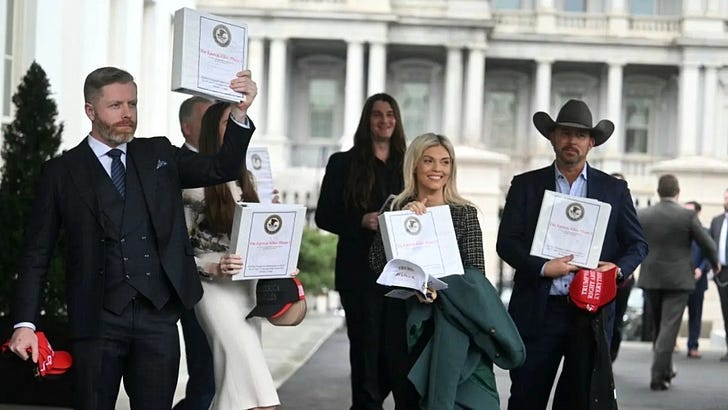


Donald Trump is in serious political trouble. His approval ratings are even lower than they were after the Capitol Putsch, as independent voters have turned against him. He’s even began losing support from fellow Republicans as well, which is a new thing in his political career. It’s easy to see why: tariffs have increased inflation, his war on Iran has been a disaster, gas prices are up significantly, and people are upset about his desecration of American landmarks like the White House and the Kennedy Center.
If you had paid attention during his first term, you’d have seen that Trump has wanted to take over Greenland, bomb Iran, and tariff the entire world for a very long time. But many of the people who voted for him in 2024 did not pay attention, and now they’re feeling betrayed, claiming that they voted for none of this.
The Republican Party is hollowing out from the inside, but despite this reality, Democrats are even less popular than Trump because they have no affirmative vision and largely refuse to run on the policies their voters actually want, such as universal healthcare and ending financial support for Israel’s genocide in Gaza.
So what happens next? No one knows for sure, of course, but to ponder the future, I thought it would be worth looking to the past with my good friend Rick Perlstein who is one of the best historians of the Republican party. His first book on Barry Goldwater’s 1964 presidential campaign is being released in a 25th anniversary edition, and he’s got another one in the works that we talk about in our discussion.
The video of our conversation is available, the transcript is below. Because of its length, some podcast apps and email programs may truncate it. Access the episode page to get the full text. You can subscribe to Theory of Change and other Flux podcasts on Apple Podcasts, Spotify, Amazon Podcasts, YouTube, Patreon, Substack, and elsewhere.
Related Content
Kamala Harris lost because Democrats don’t have a political ecosystem
The economy has collapsed for the middle class, Democrats must admit this and act accordingly
How the American left became post-political, and how to change that
Even Democrats who hate him can learn a lot from Zohran Mamdani
Caving to conservative religious fears does not work electorally
There is no ‘Joe Rogan of the left’ because Democrats stopped being interested in public debate
As Republicans have radicalized, Democrats have become more passive—and less successful electorally
The self-proclaimed ‘popularists’ aren’t doing political science
Audio Chapters
00:00 — Introduction
11:21 — What happens to politically homeless former Trump supporters?
22:31 — The Iran war and Republican antisemitism
28:00 — Democratic decline and the New Deal legacy
39:52 — Politics as teaching
48:35 — Perlstein’s new book: The Infernal Triangle
53:46 — The U.S. left does not practice democracy in its own affairs
Related Content
Kamala Harris lost because Democrats don’t have a political ecosystem
The economy has collapsed for the middle class, Democrats must admit this and act accordingly
How the American left became post-political, and how to change that
Even Democrats who hate him can learn a lot from Zohran Mamdani
Caving to conservative religious fears does not work electorally
There is no ‘Joe Rogan of the left’ because Democrats stopped being interested in public debate
As Republicans have radicalized, Democrats have become more passive—and less successful electorally
The self-proclaimed ‘popularists’ aren’t doing political science
Audio Chapters
00:00 — Introduction
11:21 — What happens to politically homeless former Trump supporters?
22:31 — The Iran war and Republican antisemitism
28:00 — Democratic decline and the New Deal legacy
39:52 — Politics as teaching
48:35 — Perlstein’s new book: The Infernal Triangle
53:46 — The U.S. left does not practice democracy in its own affairs
Audio Transcript
The following is a machine-generated transcript of the audio that has not been proofed. It is provided for convenience purposes only.
MATTHEW SHEFFIELD: It looks like Donald Trump’s political polling ratings are the lowest that they have been at least [00:03:00] up until right after January 6th it looks like. he’s lost the independent vote whereas he has consolidated the Republican electorate to some degree. But he’s lost a lot of them too, it looks like because of his Iran war. And it doesn’t look like, at least as we’re talking today, there seems to be no end in sight for this.
He promised to be something other than a regular Republican and he basically, he’s done everything that your typical Republican does: war in the Middle East, tax cuts for rich people, and then defunding education. And you are a historian, so you have seen these patterns, have you not?
RICK PERLSTEIN: Well, what I always tend to tell newspaper reporters, frequently New York Times newspaper reporters, when they call and ask me for some kind of comparison or parallel or compare or [00:04:00] contrast to other patterns in American electoral history is that if you’re limiting your aperture to the history of American politics inc- under conditions of fascist leadership, you are making a category error.
That we have so much overlapping system collapse. In other words, the very basic idea of politics as the study of power and its application, winning it and applying it. If you’re understanding it according to the categories of, constitutional governance, elections, coalitions, you’re leaving out a whole lot of stuff that we don’t quite understand yet.
So, I’m not even sure how you can explain it or understand it according to past patterns within American coalitions. I mean, just to give one example, how many people within the Trump coalition are so diehard, that when [00:05:00] they get down to the hard kernel, they won’t accept any election result, right?
And then you have this kind of chaotic situation that certainly nothing out of the 20th or 19th century can make sense, or maybe the 19th century, right? Maybe the 1860 election, right? So, I just always ask people to kind of step out on the high wire, and consider the possibility that our very categories, are having a hard time making sense of this.
Just to give an example, as you know from a person who’s spent time in right-wing world, there’s two guns for every American citizen, and a lot of them are in the hands of people who, believe that they’re, they exist to fight tyranny, and people like you and I are the tyrants.
So what happens when this reaches the end of the road? There’s alienation with the last attempt to kind of redeem the unredeemable, to achieve that prelapsarian state that, conservatism promises to people who, go to [00:06:00] politics because just life doesn’t make sense to them.
what happens then? as far as, elections and, voting, right? Of course, as the Republican… people running the Republican Party are working hard to make elections not matter, right? And you don’t have a constitutional republic if people don’t accept election out-outcomes like, Trump has never accepted the election out-outcome in 2020.
SHEFFIELD: Well, or in 2016, if you recall, when he lost to Ted Cruz in Iowa. Remember that? He said that he– it was that Ted Cruz had cheated.
PERLSTEIN: Right, exactly. Yeah. Yeah. And Fox News, if you’ll recall, when they called the the the election for Joe Biden m- because of the results in Arizona they lost a colossal part of their support because they dared, tell the truth about an election. And a lot of their business was picked up [00:07:00] by, Newsmax and OAN until Fox adjusted and adopted the Dominion voting machine conspiracy theory, right?
Maybe to their consternation, but they didn’t lose a lot of business once, all those discovery texts and conversations that, Fox News personalities were proven to have directly lied about what they thought about Donald Trump on the air, right? So, we’re, we’re, we’re, we’re living in a hall of mirrors
SHEFFIELD: Yeah.
PERLSTEIN: and
SHEFFIELD: Well, I think–
PERLSTEIN: not a Newtonian situation.
SHEFFIELD: Yeah. Well, and, and I, I think that that is– Yeah, that’s an important point, and it’s something that I think even now a lot of people on the broader, center to left still don’t get. That, the– for the hardcore Republican base, this is not, just politics. This is spiritual warfare, literally, as they call [00:08:00] it.
And that, they see, the existence of humanity at stake in every single election and in their support for Donald Trump, that even if they don’t like
PERLSTEIN: some of the– Yeah, even some of the smartest, most well-informed places are kinda failing us. One of my favorite shows is NPR’s On the Media, and I just started listening to the, the latest episode. And they pointed out, they had, an episode about how, what does it mean that a lot of conservatives, conservative Christians are beginning to entertain the ass- possibility that Donald Trump is the, quote-unquote, “anti-tri-trust.”
Anti-Antichrist, right? Antichrist. And the guy kind of was interviewed and said, “Didn’t they notice how bad he was before?” And it showed that they don’t understand the theological concept of the Antichrist, which is that the Antichrist for- Disguises himself as a guy who’s gonna achieve all these wonderful things, and then halfway through the deal turns [00:09:00] around and says, “No, by the way, I’m the Prince of Darkness,” right?
So the fact that Trump sucked is actually, Or the, the fact that they loved Trump, is more evidence of why they might consider him the Antichrist. I mean, this stuff is very strange, devious stuff, right? When it comes to people who are abandoning Donald Trump and MAGA, well, one thing to consider is what that means is not that they’re abandoning MAGA and supporting Democrats, constitutional government, liberals.
In the case of the Groypers and supposedly, and these, these, these, there was an article in The New Yorker suggesting that, most young congressional staffers, Republican congressional staffers identify with Nick Fuentes, there’ll be a lot of people who say that Donald Trump failed because he wasn’t authoritarian enough.
SHEFFIELD: That is what Fuentes explicitly said.
There is something that is a little bit different though in that you do have people like Alex Jones and, [00:10:00] who are, who are now become– who have become anti-Trump, and, and most importantly, he is attacking them.
So he allowed many Never Trumpers, to come back. Of course, they were not Never Trump, as it turns out. But, like, once you, once you’re gone, the way that, he’s never forgiven Thomas Massie, for instance, or Marjorie Taylor Greene.
And they, es- especially Greene would, she was trying to grovel for a while, but it didn’t work, because she had a position that he really, you know, he, he, he loves war in Iran. In fairness to Trump he was always actually consistent on how much he wanted to go to war in Iran, and how much he loved m- missiles and bombing Iranians.
PERLSTEIN: ’80s when he said we can just take Karg Island and… Yeah
SHEFFIELD: Yeah, so like they weren’t paying attention. But like, I mean, it, they, [00:11:00] it’s an e- it really is an example though, that issue of, of how even the people who, thought that they were the most devoted to him, that they– he, he had suckered them.
And, and that like everyone is a sucker for Donald Trump and, and, and, or in his mind, everyone’s a sucker.
And if they’re not one now, then maybe they will be later.
What happens to politically homeless Trumpists?
PERLSTEIN: What do you think happens to, like, a politically homeless person who revered Trump, with kind of a Führerprinzip-like reverence? I mean, what, what do you think are the kinda various kinds of off-ramps, kinda knowing folks who, have been living in that mentality?
SHEFFIELD: Well, I think– So the, the model, the safest model for that type of person is what happened after the, the national embarrassment of the Scopes Monkey trial,
PERLSTEIN: Mm-hmm. Yeah, they, leave politics.
SHEFFIELD: They leave politics and, and they b- you know, actually take the Bible seriously of what Jesus said, that, [00:12:00] “My kingdom is not of this world.”
And that they focus, on their own lives and, trying to get away from society as much as possible, get off the grid. Like that’s, it, it’s not a healthy mental
PERLSTEIN: Better for us.
SHEFFIELD: But it’s better for the country and it’s better for them too, frankly, because they didn’t like anybody.
Even, they, they haven’t even with Trump, like they still haven’t liked their fellow citizens. So this is better for everyone if that’s what they do. And in, in an actual more democratic system, they have the right to do that. Like, nobody’s gonna bother them. And it looks like nobody’s gonna k- you know, pass gun laws either, so, they can just go off and do their thing.
So like that’s the safe version of how this ends. But you know, there’s, there’s lots of other unsafe scenarios and, and I think one of the things that, that, that seemed maybe every so often, it makes me wonder if, if in the back of their [00:13:00] minds, the Trump White House people have wondered if they have unleashed, this violent core of wackos onto society, and that that’s part of why he keeps getting assassination attempts, because sometimes they’re his former supporters who are doing that.
PERLSTEIN: Yeah, one of the things that’s happening in my life now is my first book on Barry Goldwater that came out in 2001 is coming out in like a 25th anniversary edition, yeah, in December. And I wrote a new introduction kind of what did the Barry Goldwater movement mean in the age of Trump? And I kind of reread it for the first time in several decades.
And I’d had this kind of lag, this kind of frustration in the back of my mind that I saw a lot more stuff in [00:14:00] the archives that betokened the people who were running the Barry Goldwater campaign, the actual official campaign, being terrified that they had opened a Pandora’s box and always having to put out these fires from these local groups claiming the authority of the Goldwater campaign who were insane, right?
And, just to one example, one, one group, like, one group in Phoenix, I think they call themselves Americans for Goldwater, were broadcasting what they claimed was a conspir- conspiracy to blow up all 50 state capitals and arrange symbol, sig- signal that’s what the Soviet Union was gonna do.
And they were always kind of chasing after these terrify peop- terrifying people and saying, “Don’t use Goldwater’s name.” Right? And I was afraid that that wasn’t in there, but when I reread it, I was like, “Oh, wow, this kind of actually is all in there,” but the, the, the, the kind of the narrative that I thought I was telling in my head was these establishment people winning and prevailing over the crazy people, right?
[00:15:00] And kind of creating a framework within the logic of mainstream politics for a Reagan to win, right? And more and more, I’ve been haunted by, There’s a biography of William F. Buckley that was written by John Judis. It’s kind of the first biography of William F. Buckley, and it’s quite good. I think it came out in the ’90s.
And there’s a footnote in there in which he found a line in one of William F. Buckley’s letters to a friend, that he was afraid that what Goldwater’s campaign was unleashing was, he says, he uses the Russian word, an American Raskolniki, like Ra- Raskolnikov, like in, in like in Crime and Punishment. Now, Raskolnikov, if you’ll recall the novel, is this, he’s basically a, a massively online kind of pseudo-philosopher who lives in his mother’s basement and plays video games all the time on Twitch, [00:16:00] and fantasizes about, an assassination which will prove to the world that he’s a Nietzschean superman, right? And what William F. Buckley seems to suggest is kind of what Steve Bannon did, which is basically politicize all these profoundly alienated people, right?
What was Steve Bannon’s original political act, right? He understood that when he was selling… He had a business selling in, in-game currency, right, way back in the early, 2010s, that this was a group of people who were ready to be mobilized in kind of a pseudo-fascist kind of formation, and he saw Donald Trump as the guy who could do it, right?
So this idea that once you kind of, license, the most alienated people in society to understand their redemption as political through the vector of an authoritarian movement, you’re doing something really, really scary. [00:17:00] William F. Buckley understood that. I think he saw it time and again, and that’s why he was so careful and so busy to kind of police the boundaries of respectability and say, “We’re not gonna win unless we, turn away from violence-” segregationists.
we’re not gonna win unless we turn away from the John Birch Society and the idea that a beloved American figure like Eisenhower is an agent of the communist conspiracy. And I think that’s always been a danger. Now we know that there’s a wonderful historian in n- at Willamette College named Seth Cotlar, and he’s been doing
SHEFFIELD: Yeah, he’s a friend of mine, he’s been on the show.
PERLSTEIN: Seth Cotlar points out is that, like, in the ’80s and ’90s there was this magazine called The Spotlight that was run by this, vicious conspiratorial anti-Semite named Willis Carto that had, like, five or six times the pers- the subscriptions of National Review.
And then if you look at it, it looks exactly like, a Newsmax or an OAN looks like now, right? And we’ve talked about this a lot, there’s this [00:18:00] very dark gothic strain in American politics, and for the longest time, we’ve been depending on sort of the norms of the people in charge to understand that there’s a, there’s a kind of demagoguery that you just don’t dare, because we saw what happened in places like, Germany and Italy and South America, in the 1970s.
And now that those demons are out of the box, I hope elections can contain that, right? But my fear is that there are so many people who are so, out of touch with institutions, with reality, right, that just all kinds of crazy things happen that when civilizations start to unravel. Now, that said, we can still talk about elections.
They’re still important. It’s better to win them than to lose them. It’s better to strong, have a strong coal- coalition than a weak coalition, because I think that the potential in weak electoral outcomes for the authoritarian side, you do, I think, demobilize people, and they just [00:19:00] decide they’re gonna, do video games instead of politics.
So let’s go back to the original question maybe, and talk about, what kind of electoral coalitions are lining up now that the inevitable happens. Another thing is this is almost exactly what happened in the fifth year of George W. Bush’s presidency, when Iraq started going off the rails.
And for him, the the catalyst was when he tried to do comprehensive immigration reform and suddenly discovered that you can’t say, “Be scared of 9/11, brown people because of 9/11,” and then suddenly turn it off and say, “No, we wanna invite more Mexicans into the country.” So, it was inconceivable after George W.
Bush’s electoral victory in 2004 that this cult he had around him in the conservative movement and the Republican Party could possibly break up. But it was, by 2007, it was utterly incinerated, and you began to have people saying George W. Bush is, well You probably did have people saying he was the [00:20:00] Antichrist.
Certainly, I’ve– I have lots of stuff from freerepublic.com of people saying that he was, working for the globalists and was an op, so, but anyway, it’s better to win than to lose, so maybe we can talk about the electrical stuff now, having gi- my long throat clearing about, all the apocalypses to come.
SHEFFIELD: wasn’t thinking of it in terms of elections, just in terms of groups. Because, so I– One of the, to your point about the kind of Trump opening the Pandora’s box even further that, that Buckley and his crew had opened previously. like that’s the story of the Republican Party is the box just keeps opening more and more and more.
And, so but a lot of these people that have… th- there is a weird paradox because, like th-th-this isn’t a unifying group. I think we have to, to make sure to say that, because a lot of the, these further right, or anarchist type [00:21:00] people, some of them are, Christian, violent Christian supremacists.
Some of them are ap… Yeah. Some of them are, just people who don’t really know much of anything about, about politics. All they know is that their life sucks, and they, they blame whatever, group people on YouTube tell them to blame. So in this case, it might be women.
in many cases it’s women’s fault that everything is this way, that my life sucks. And and so and they don’t really know anything about ideology, so they don’t care about, foreign policy or tax cuts or whatever. Like, they don’t have any money. So like, to tho- those topics are utterly meaningless to them.
They don’t care about them. and so and, and the thing about Trump that I think was, was, was unique as a Republican, because they’ve been seeking someone like him, the Republican consulting class. They’ve wanted someone [00:22:00] like him for, decades in that he was a celebrity he was somebody who was not very intelligent, and everyone knows that that he’s not, not that smart. And, and that’s actually an asset though for a lot of his fans, I think.
PERLSTEIN: Oh, yeah, definitely.
SHEFFIELD: That they see… That they might, they feel
PERLSTEIN: It’s identity politics, it’s, it’s, like these, these, these, these swells and smart-asses have been putting one over me, on me for decades, and, now one of us is in charge
The Iran war and Republican antisemitism
SHEFFIELD: Yeah, exactly. And and so I think though that the, the Iran war, like that’s it, it’s, they’ve also, the Republican consulting class has spent, so many decades kind of cultivating a low-level antisemitism as well. And now you have Trump literally saying, or sorry, Marco Rubio, the secretary of state, literally saying, “Well, Israel kind of bullied us into doing this war.”
PERLSTEIN: [00:23:00] Right.
SHEFFIELD: it, it, this is, it was, this is Nick Fuentes’ dream to have a politician say that.
PERLSTEIN: Yeah,
SHEFFIELD: and and it, and for all we know it, that it might even be true in this case,
PERLSTEIN: mean, it’s basically Netanyahu is trying to bull- tried to bully American presidents into this war,
SHEFFIELD: Yeah, that’s right. So he’s been…
PERLSTEIN: been a Netanyahu, and he finally has found someone who’s dumb enough to take him up on the offer.
SHEFFIELD: Exactly, yeah. And, and, and of course, just like all the past presidents had said to Netanyahu, “Well, your intelligence doesn’t look very good. You say it’s gonna be a cakewalk, that it’s gonna be over quick, they’re all gonna be dead, and they’ll surrender. No we don’t think so.” And of course, as you said, Trump is the o- is the first one dumb enough to actually take that shit seriously.
And, and it, and it makes no sense. Like, there’s this peop- people have some people at least have cultivated this idea that the Israeli intelligence oper- apparatus is just omnipotent and knows everything, and it’s like, are you forgetting [00:24:00] October 7th? Like, that was right in their backyard where they supposedly have all these assets.
Do you really think that they would know what’s going on in Iran?
PERLSTEIN: No, that’s playing into their own hubris.
SHEFFIELD: It is. And so, but you know, like, so this, this low-level antisemitism that Republican politics has be- kind of, built itself on to a large degree Trump has played into that. And, and so, it’s a, in a way that I don’t know, that he can really, even if he somehow manages to get the war over Quickly.
I don’t think that he can come back from that I don’t with, with this set of people because it is a permanent stain of betrayal on what he had told them, or at least what they thought he had told them
PERLSTEIN: Well, there have been a lot of betrayals.
SHEFFIELD: Not to them though . As far as they know,
PERLSTEIN: I mean, why didn’t they pick up on the fact that, he wasn’t [00:25:00] gonna bring back coal, I mean, there’s been so many betrayals. But let’s say you’re right. Yeah. I mean, that this is just kind of too ridiculous and too big to kind of, for him to redeem.
I mean, obviously the, the authoritarian playbook is to scapegoat, right? To figure out some kind of scapegoat that, kind of stabbed the nation in, in the back. But yes, they’re not very supple with this kind of stuff. We all fear some kind of Reichstag incident. Of course, our capacities for actually doing the job of securing the nation, right, have been eviscerated.
Some of us have pointed out that, one of the consequences of McCarthyism was they, fired or hounded out of their jobs all the people who were experts on Asia by accusing them of, being communists, and supporting Mao instead of Chiang Kai-shek. And lo and behold, you got the Vietnam War because, the, the, the structure of expertise just wasn’t there for the people who would have warned that this was a [00:26:00] disaster, right?
Now you have the, who know m- who knows how many, cyberterrorism experts have been DOGEd out of existence. I mean, one, one thing I don’t even see the media even talking about, I, I, I, I’m, I almost fear it’s like kind of a you can’t handle the truth attitude, is the possibility of a cyberattack, that, Iran, should they choose to pull the trigger, could, unleash some serious chaos, that could dwarf 9/11. What happens then? Do people rally around the fr- flag? Does… What, what does Trump do? What do the Democrats do? I guess I keep on returning to this fear that, defeating Trump politically isn’t defeating, the conditions that make Trump so dangerous politically.
In a place like Chicago, when gang violence went down, went, went, went way up, decades ago it was because the cops did a successful job decapitating the gangs , so [00:27:00] the gangs started going after each other, right? What happens when, if the Republican Party is, leaderless, right?
I mean, how do people… What does that look like, right?
SHEFFIELD: Yeah. Well, and it’s– Yeah, and it’s that, that larger question though of, understanding that the political defeat of this, subset of people, that should only be the beginning of it.
PERLSTEIN: Right. Well, then, then you get into what, you can’t beat something with nothing, so what is the Democratic Party proposing as an alternative? And I both, think we both understand that this is… We’re not run… The, the Democratic Party are not run by wartime consiglieri, right?
And, um It’s, it’s a real…
there’s, there’s not… There’s some very exciting young leaders who get, cut off at the pass at every turn, and, we’re hoping for some kind of generational turnover and, it might be now or never.[00:28:00]
Democratic decline and the New Deal legacy
SHEFFIELD: Yeah. Well, let’s, let’s go into the history on that, though. Like, why do– How, how do you think that this came to be? So, like, o-obviously the, the decline in popularity of Lyndon Johnson was a huge thing, and the blowout win of Nixon in ’72, like, in, in your your, your favorite period historical period.
Like, that was– seemed to be when it started, when this
PERLSTEIN: Yeah. I mean, for a lot of different reasons the Democratic Party in the wake of FDR and the New Deal had a really sweet political situation that they set up that joined the making of policy with the selling of it in terms of politics in a very salubrious way, right?
I always point out that after the New Deal, Al Smith had this line, when he, he was the Democratic presidential nominee in 1928, and he turned viciously [00:29:00] anti-Roosevelt and basically became a conservative. And he would complain, “We’re screwed. The liberals are in power forever ’cause no one shoots Santa Claus.”
Building so many dams, goosing the economy through Keynesianism, right? Basically the idea that the US Treasury was, basically being used to bring more people into the middle class than any society had ever achieved.
SHEFFIELD: and it was terrible.
PERLSTEIN: What’s that?
SHEFFIELD: terrible, a terrible thing in his view.
PERLSTEIN: That was a terrible thing. Right.
Exactly. Because it meant, more people had… Society became less hierarchical. You couldn’t boss people around. People had more prospects. It was, it was terrible for elites, right, in a lot of ways. But it was so successful that there was pretty impressive elite buy-in, on the level of corporations.
And a big part of what my, four-volume, series of histories of basically what happened to the New Deal order, right? [00:30:00] first you get Nixon very successfully kind of playing to white middle cr- class grievance, right? and basically saying, basically introducing the zero-sum idea that all these out-groups gain at your expense, right?
Even though at the time when Nixon was beginning his crusade, and Reagan too, um You know, the rising tide was in many ways lifting all boats. so the real tragedy for that was the onset of, stagflation and, things like the first Arab oil embargo and the various energy crises and all these things that America wasn’t really prepared for.
we thought that we had kind of figured out the economy, that we would have kind of [00:31:00] widely shared growth and prosperity forever. a really good example is, an energy expert who told Richard Nixon that energy was soon gonna be so cheap that it was not gonna be metered. I mean, it kind of sounds like how people kind of…
The, the, the optimists kind of talk about, AI these days. And suddenly the economy did become something that looked a lot more zero-sum. The historian Jefferson Cowie, who recently, won a Pulitzer Prize for, his book, “Freedom’s Dominion,” which talks about how, the Southern tradition of defining freedom as domination over African Americans largely.
He points out that in his book, “Staying Alive,” that one of the one of the Supreme Court cases that approved an affirmative action program for people who, weren’t allowed to enter apprenticeship programs ’cause they were Black at this certain factory that when the [00:32:00] Supreme Court handed down the permission for this, supreme Court handed down permission for this affirmative action program, the factory that was affected had been shut down, right? So all these policies that were based on kind of creating more broadly shared equality were set up for a society that had consistent economic growth. So stagflation, stagnation the end of American economic dominance as the rest of the world kind of recovered from World War II, various kinds of hubris.
you had foreign competition. it made it a lot easier for economic elites particularly, to do things like saying the problem is that we, we’re, the taxes we pay are too high, right? And the problem is we have too many regulations, and the state is too strong, and affirmative action is the problem.
And then kind of more and more opportunistic demagogues could begin to tell, the [00:33:00] white people who eventually became the Trump coalition but were first the Reagan coalition, that The problem is those people over there, right? Demagoguing and othering. And so that’s like the, the biggest picture of…
And then the problem is for the Democrats, you had a lot of people saying, “Well, maybe the problem is we did go too big on the New Deal. We did go too big on the Great Society.” And the Great Society, especially Lyndon Johnson’s policies, were based very much on the idea that America’s bounty was permanent, and we’re gonna share the bounty, right?
And so you begin to see all kinds of policy entrepreneurs within the Democratic Party, most prominent among them Jimmy Par- Carter, saying what America really needs is austerity. And once people like Jimmy Carter and then, and then, Bill Clinton, and then Barack Obama too [00:34:00] begin to say, “Well, we’re demanding too much of the government,” right?
They’re taking away… They’re eating the Democrats’ seed corn, their most powerful message, which is basically, Santa Claus, right? They’re shooting Santa Claus. The Republicans are shooting Santa Claus, and Democrats are beginning to say, “Well, the problem is the government is too big.” And a lot of this stuff was structural, right?
I mean, th- there was very little you could do because, in fact, America’s economic dominance was, waning for various kinds of reasons. But there were very few people in the Democratic Party who had the kind of maturity and foresight to say, “Wow, we have to make this kind of a temporary condition and figure out a way to get back to the basic structures that make social democratic left-of-center party, party, parties, parties powerful,” right?
What they deliver to people. They deliver the goods, right? They make it easier to get into the middle class and to stay in the middle class. And that’s, that’s, [00:35:00] that’s basically the story I t- tell in my next book. the, the third of it that’s about the Democratic Party is about, very cynical and corrupt people basically meeting Republicans halfway and, saying, “We have no choice.”
This is the Democratic Leadership Cou- Council. This is, Rahm Emanuel, and it’s abetted by, corrupt journalistic class, I call them the aristocrats, who, love the idea of cutting off social democratic programs at the knees, right? And it’s very hard. this is, this is, this is very deep, basic structural history of the 20th century, right?
The socialists in Weimar Germany used to say antisemitism is the socialism of fools, right? In other words, you sell people scapegoating- You sell people hatred, and it’s kind of psychological wage they get instead of, what they believe socialism delivered, which was, broadly shared [00:36:00] equitable prosperity.
SHEFFIELD: Yeah. Yeah. Well, there, there’s a– I think there, there, there’s also a mistake that was made by the further left, so the progressive side of the Democratic Party during that time period that, that they didn’t make the public campaign to explain what it was that Roosevelt had done and Truman and,
PERLSTEIN: Yeah. Well, there are always people who did that, but yes, there are a lot of people
SHEFFIELD: They didn’t do it enough. And
PERLSTEIN: Because they, they, they took it for granted or they s- they, they, they,
SHEFFIELD: they just thought everybody agreed
PERLSTEIN: enemy of the good.
SHEFFIELD: Yeah. And, and, and it’s a contrast between, when you look at the post-World War II left in the UK or in Germany or France. Like, they actively worked not just to get the government more involved in the economy, but also to remake the social order to be more egalitarian, including in businesses.
And so you, you [00:37:00] saw, like th- this explicit partnerships between unions and businesses.
PERLSTEIN: Like in Germany they have what they call co-determination, where literally they have members of the union, sometimes even shop floor people or even janitors who are on the board of directors, right? Written into the law. So if that sort of thing had happened in America, right, and it, people thought that that was…
in the early 1960s, there was… You read this stuff and it’s crazy. You, you, the smartest kind of social scientists were saying, “Oh, the, the, the communist world and the capitalist world are converging. We’re also kind of, we’re all kind of converging on this mushy kind of egalitarian social democracy.”
And it seemed to be happening. And then all this other stuff happened. But yeah, I mean, if Americans had, six months paid leave if they had a child, if they’re able to go to a doctor without getting out their checkbook, this very basic social democratic stuff, is it possible for a Reagan or a Trump to succeed?
They talk about, oh, the right one in Sweden, and you’re like, “Yeah, way out.” They’re going from, [00:38:00] eight months of paid leave to seven months of paid leave or something like that. Yeah, and that’s why, to g- To, we’re, we’re both a bunch of, fuss budget pessimists, but like when we look at someone like,
SHEFFIELD: They’re
PERLSTEIN: Mamdani, I mean, that’s the way and the light, right?
I mean, free, free childcare, will, will make people’s lives easier. And when you deliver the goods, the voters deliver the goods. The, the, the, the saying of the head of the Democratic Party when, in the ’50s was, “Tax, tax, tax, spend, spend, spend, elect, elect, elect.” And of course, Mamdani faces all these structural barriers like The New York Times.
suddenly like everyone in, who reads the… like everyone in the national news knows who the, head of the city council is in New York because every article is, “Mamdani faces trouble from the city council,” right? I didn’t know who the city council leader was in New York under Bloomberg, right?
Under, Giuliani, right? Or, oh my God, the people who, have second homes in New York that are worth more than $5
SHEFFIELD: upset.
PERLSTEIN: are upset and [00:39:00] they’re gonna leave. And, this is covered like, like the, like with, with, with breathless, kind of daily, kind of horse race coverage.
And as so often is the case, when it comes to liberatory politics, all we have is the people, right? All Zohran Mamdani has is, his ability to mobilize ordinary human beings to say, “No,” to refuse this austerity. And that’s why leaders are so important, and we have some good ones now.
So, I’m a little optimistic about that. But you know, it’s… I mean, I, to me, maybe, maybe, the Rick Perlstein 50 years from now will say the watershed was when, Barack Obama, who, gave, Zohran Mamdani a scolding phone call during the election, sat down with him to read to children, to do a photo op, and said, “Wow, I gotta, I gotta get on this guy’s coattails,”
SHEFFIELD: yeah. Yeah. Well, that’s something I just wrote about, so yeah.
PERLSTEIN: Were right.
Politics as teaching
SHEFFIELD: And well, the, the other thing though that, that Mamdani does that is m- so much better compared to other Democrats is [00:40:00] that he actually is always communicating.
PERLSTEIN: Yes. “Politics is teaching,” is what Olof Palme said, the Social Democratic leader of
SHEFFIELD: Oh, that’s actually a great phrase. Yeah. It… And that’s
PERLSTEIN: is teaching, yes. And there are so few Democrats who could put themselves in the position of being a teacher because they’ve, they’ve made the soul of wisdom, responding to this notional dead center of ideological opinion.
So it’s like they… there’s this great word in, in, in, in Democratic politics, which is a lie, right? We’re incrementalists, right? But Barack Obama, the, the, the, the, the, the, the, Obamacare, was not incrementalist. When you say we’re, we’re, we’re doing an incremental thing, you say, “This is the goal, and these are the steps along the way.”
Once Obamacare passed without a public option, right, and the ability of states to like, like opt out of Medicaid, they didn’t say, “Okay, this is great. Next we’re gonna do this.” That would be increment- incrementalist. Instead it was like, “Stop complaining, we’re incrementalist. [00:41:00] You can’t get everything at once.”
SHEFFIELD: We checked the box. Yeah. Now, now you have to talk about another subject.
PERLSTEIN: Move, you gotta, you gotta… I mean, Overton window is, is a wonderful metaphor, and as we know, the Republicans are really good at constantly kind of moving the center to the right. Whereas Democrats have this fantastical notion that if they repeat back to the public what they believe the public already believes, that the public will reward them with trust.
But no, people require leaders. There’s a great line in the Bible, “Without vision, the people perish.”
SHEFFIELD: Yeah. Well, yeah, and it’s and, and on the teaching point, I mean, the other thing is that the Republican Party. So it’s, it’s tragically iron- ironic for me is that in after Mitt Romney lost in 2012 when I was still on the right I wrote a, a, a big paper for a a Republican donor, and I published some of it in “The American [00:42:00] Spectator,” in which I said, The media, you have to invest in the media. “Stop trying to beat the media. Become the media,” was my phrase. And they
PERLSTEIN: which is what Roger Ailes said to Nixon in 1970.
SHEFFIELD: Oh, oh, did they? Okay. Yeah. So but and yeah, and, and they didn’t listen to me at that time, but then when Trump came along and got ensconced, they did. So like I, I of course had left, and they did everything that I told them to do.
PERLSTEIN: Well, I’m trying to tell them, I got my Substack, rickperlstein.substack.com, and one of the things I pointed out was, I made this argument about politics as teaching, and I pointed out how, I’ve been doing, kind of digging down Glenn Beck’s site, The Blaze, and kind of doing a little tutelage, every week about how they do what they do.
And, they have a whole category of how… This is getting to the issue of, back to the original issue of what will happen if people get dissatisfied with Trump. They have this whole basically, I guess we call it a vertical, of people saying, “You feel this [00:43:00] cognitive dissonance. Here’s how to solve that cognitive dissonance.”
Like, there was this one that said “Here’s the best response to what the Pope is saying.” Right? So they kind of teach you to think like a conservative, which is something that Rush Limbaugh was really good at. His greatest skill was some- dittohead would, would call in and say, “Rush, I love you.
I’m a mega ditto guy. I just heard this thing that really confused me.” Right? And he might say, “Well, Barack Obama said he’s gonna lower taxes for 95% of wage earners. I thought that Democrats all wanted to raise taxes.” And this was true. In the, the, in, in, in Barack Obama’s original stimulus, there was a tax cut of an average of $3,000 for every wage earner, and it was 97% got the tax cut, right?
He promised 95%, he delivered 97%. And Barack Obama, I’ll never forget it, told the guy, “Well, here’s what you… Here’s, [00:44:00] here’s how you think about that. Just remember that whatever Barack Obama says, he means the…” Rush Limbaugh. “Whatever, whatever Rush Limbaugh said– Whatever Barack Obama says, remember that he means the opposite.”
So, all of a sudden, someone had, all the conservative Dittoheads had something in their back pocket, right? A, a leader like AOC or Mamdani is very good at teaching people how to interpret what conservatives say, right? Instead of, instead of, someone like Rahm Emanuel or Bill Clinton who says, ” Wow, how can we imitate what conservatives say in order to pick up on the popularity of what they say?”
SHEFFIELD: Yeah. Well, and, and, and, and as a project, I think that one of the things that should be done with, a lot of money is on the left is, is explaining to conservatives… ‘Cause like, th- there is a real division between conservatives and reactionaries, right? And
PERLSTEIN: We, we’ve been, we’ve been putting off this argument,
SHEFFIELD: [00:45:00] Yeah, okay, we, we should have that. But okay, but, but, but at lea- the, the, the complete wackos, the people that were in the box,
PERLSTEIN: Sure. We can say that there are levels of extremity.
SHEFFIELD: The same epistemology, I agree with you. But overall though, like, the people that enable them, so like, the country club Republicans or the business class Republicans, those people, they didn’t learn the lesson of, of the economic lesson of post-World War II, which is that this was a time when the government, y- or around the world in every country basically was massively investing in the economy, massively
PERLSTEIN: you, and m- and made you a corporate titan richer.
SHEFFIELD: And that’s what I was gonna say, yeah. And so like, but the broader left hasn’t taught that lesson to the business class because, and, and ultimately, and, and we keep seeing with Trump also that not, not only are his tariffs, destructive to American businesses, but also this, this, his corruption and his [00:46:00] instability.
Like, the businesses need stability more than anything else because
PERLSTEIN: That was one of Milton Friedman’s number one lessons about why regulation is bad, because it creates instability.
SHEFFIELD: Yeah. Well, and, and you can use that, turn that around in the opposite direction, and it’s a, and it, and it’s I think everybody can agree that, especially on tariffs where one day they’re on and one day they’re off and,
PERLSTEIN: and the business class is so brainwashed, they’re so high on their own supply that, the, the stock market is basically stable even though the, global economic system is at greater risk than it ever has been since 1929.
SHEFFIELD: Yeah. Well, and then but in terms of the targeted industries, like they haven’t even been helped. So like manufacturing, American manufacturing
is
PERLSTEIN: were helped by Joe Bi- by, by, by, by by Biden,
SHEFFIELD: they were. Yeah. And so like these are, these are things that, again, it, it’s, it i- it just goes like I, I love that teaching quote, Rick, because it’s so [00:47:00] true because like, enabling these anti-government extremists is not good for anyone. And so y- but you have to explain that in terms that people understand and in terms that are relevant to them.
PERLSTEIN: Yes, and, and Roosevelt was great at that. He would say, “Why do we need to enter World War II? Why do we need to give… Why do we need to give weapons to England?” It wasn’t, “Why do we need to get into World War II?” Why do we need to basically sell weapons to, to, to England? He said, “Well, if your neighbor’s house is on fire, lend him a hose because your house might be next.”
Brilliant. Brilliant stuff. And he would say, he would, he would, he would, he would, he would, he would just explain things in very clear metaphors. Truman would, too, with good guys and bad guys. And I mean, Democrats think that they’re, kind of more sophisticated and more cool when they, as, as, as this one consultant points out, they explain the brownie recipe instead of explain the brownie.
SHEFFIELD: Yeah. Yeah. [00:48:00] Well, and, and they– And that happens whenever you look at the, just their interviews and for print media. Like, the Democrats will talk about process, they’ll talk about, “Well, we’re gonna do this and that.” And then the Republicans will just be like, “And then we’re gonna stop these communists.”
PERLSTEIN: for Mamdani. He says, when he gets heckled by a guy, he says, “I’m gonna make a… I’m gonna make New York affordable for that guy, too.” Right? And he’s so disciplined, right? He doesn’t say, “I’m gonna show how much more sophisticated I am than you by explaining some sort of, dis- you know, like digression.
He never digresses. He stays on message.
Perlstein’s new book: The Infernal Triangle
SHEFFIELD: Yeah. Well, okay. So let, let’s go back though to your– You just sent off your, your latest book to your publisher recently.
PERLSTEIN: I did,
SHEFFIELD: talk, talk, tell, tell us more a bit about it.
PERLSTEIN: Well, I don’t have a publisher actually. We’re, we’re shopping it around to a publisher. So if you got a pub- company, make me an offer I can’t refuse. But it’s called The Infernal Triangle: How America Got This Way, and there are, basically three force fields of American politics [00:49:00] that…
whose act- interactions make everything screwed up. One is very familiar to all my readers, which is the increasing authoritarianism of the Republican Party and the right. The other is very familiar. It’s the fecklessness of the Democrats in coming, in kind of coming up with and explaining a, a persuasive alternative.
And the media, which, in a lot of ways I think I make the case quite explicitly and successfully, served people in their role as citizens in a self-governing nation about as well as the state media did in the Soviet Union. Basically, all kinds of up is down stuff, that the economy was bad, in 2024 during the election when it was actually good.
When crime was, making it seem like crime was up when it was actually down, right? Making it seem like the American people held Bill Clinton in contempt for lying about sex when actually his approval ratings were [00:50:00] consistently in the 60s and 70s when the media was, baying for his head.
So when you combine those three things and show how they work together basically what I’m trying to do is give my readers skills in pattern recognition. Say, “Oh my God, that, that thing you describe happening in, 2005 with the Republican response to, Hurricane Katrina,” which they explained the government’s failure, by claiming that the problem with what happened in Katrina was government itself, right?
That’s exactly what they’re doing now, right? When you explain the Iraq War and how, that was sold to the public, oh, that’s exactly the way Donald Trump is talking about the Iran war, right? when you hear a Democrat say, “We need to figure out We need to get spokespeople who talk exactly like Republicans because the Republicans are successful, right?
they were saying that, in 2002, right, after [00:51:00] 9/11, right? And then you have this project which I’m sure you ran across in which these consultants raised $20 million to use AI to figure, figure out the speech cadences of popular podcasters on the right so they can, go in a lab- laboratory and manufacture one for the left instead of finding some organic voice that, excites people of his own volition.
So that’s what I’m doing. It’s, it’s doesn’t quite achieve what I wanted to achieve because I had to s- skip a bunch of stuff about Barack Obama. That might have to be volume two. And yeah, I’m just enjoying myself substacking, rickperlstein.substack.com.
SHEFFIELD: Cool. Well, okay. So, but on the media point I think there’s… Do you, do you get into, I think that a lot of people on the broader left, they think that there is a liberal media. They really do believe in it despite all evidence. I think, oh, yeah, I think so. What do you think? You think people do?
PERLSTEIN: I [00:52:00] mean, I think that one thing that may shock people is how much MSNBC was, even when they kind of made the pivot to being sort of, a more Democratic Party-oriented liberal outlet, how much they became a vector for some of the worst parts about the post-9/11 Bush administration. Like, Joe Scarborough was one of the, biggest boosters of the Swift Boat Veterans for Truth, so I think that hopefully people will understand, Well, one of the things I try and do is I always say that all throughout this period from, 2000 to 2026, basically the present, there’s always the best places to go for the truth have always been these kind of semi-Samizdat kind of alternative left-wing voices.
Whether it was, a magazine like Mother Jones, which was always on the case, about the Oath Keepers as, basically pointing towards something like January 6 all along when CNN was [00:53:00] laundering them as kind of, constitutionalists or it’s being– The book is gonna be dedicated to a blogger who passed away in the year 2007 named Steve Gilliard, who wrote under a pseudonym on Daily Kos and then on his own blog and came up with the best analyses of why the Iraq War was gonna end up exactly the way it ended up, right?
So there are always these kind of alternative voices. They’ve always been there. The will to kind of, tell the truth without fear or favor is indomitable, right? So hopefully, what the book will serve to do is get people to critically look for media sources that don’t do, what I complain the agenda-setting elite political media did all along.
The U.S. left does not practice democracy in its own affairs
SHEFFIELD: Mm-hmm. Well, and yeah, and I think that there is this the, the, the left in the US has, has faltered not just because of a failure to teach, but also a failure to practice democracy. Like, that’s the other [00:54:00] thing in terms of, like when you look at given people, who are, let’s say, I don’t Harvard professor or Atlantic columnist or whatever, like they just keep getting more gigs added onto them.
And it’s like they don’t need the money. Whatever time they’re putting into it, it’s probably not very much and they’re fobbing it off onto a research assistant.
PERLSTEIN: Of the things I talk about is how the, how open the right has been to new voices and how it’s been basically al- always cultivated, in part because young people aren’t intuitively conservative. How much energy, investment, openness they’ve provided for young people. And that’s why you have a Democratic Party where, so many people died in office after Donald Trump introduced his budget that it failed.
The big beautiful bill passed because there weren’t enough Democrats who were alive to defeat it, right? [00:55:00] And, I mean, I think that’s a real test of character, whether you’re willing to, let go and pass the torch to a new generation, right? The people who had the pass, the torch passed to them as a new generation in the Kennedy era, a lot of them are still holding on, like grim death.
And I try and, you
SHEFFIELD: a real
PERLSTEIN: I, try and, make mentorship, mentorship so much a part of my practice, because, as Thomas Jefferson said, “The world belongs to the living,” and a lot of people in my generation and older, we don’t even kind of grasp the political field, because we’re using incumbent categories that made more sense to us when we were coming up.
SHEFFIELD: Yeah. Well, I, I’ve recently been thinking about the possibility that just as a loose analogy, that epistemically the Democrats are Catholic and the Republicans are Protestant.
PERLSTEIN: Yeah, I think that’s, that’s interesting. Although, I mean, Protestantism is a paradoxical thing where every church, is [00:56:00] supposed to be on their own. But because the people who are attracted to certain kinds of Protestant denominations often are kind of followers in their basic kind of intuitions everyone kind of moves in the same direction on the right because everyone moves in the same direction on the right.
Whereas liberals are liberal, and we’re pluralist, and it’s it’s harder to herd the cats. But yes, I really like the metaphor of kind of the elite that runs the Democratic Party as a kind of Vatican-like formation, under this Capitol dome that is trying to, They just fear not being in control, and, like I’ll give you a really good example. The things we’ve been saying of, the s- are the same criticisms. This is the value of history for doing this kind of work that people have been making since, the year 2000. Like, I have an op-ed from 2000 that sounds like it could have been written after the two- 2024 election. There was this same kind of, reckoning. Why did we [00:57:00] lose? let’s do these big, think tank reports about what we can do for next time.
They always end up doing the same thing next time. But, one of the things was called, the Democracy Alliance, and a bunch of… They’re like, “Oh, they had a bunch of billionaires who gave away money for, for conservative infrastructure. We need to get together our rich people in order to give away money for, our infrastructure.”
And the problem was in order to get a grant from the Democracy Alliance, because there was such a, so much of an ethic of control among these people, the only way you could even fill out the forms is that you had to have a big 501[3] infrastructure apparatus for your group. they knew how to fill out forms, right?
So, the money ended up going to the same people who did the exact same things. Whereas, a Sheldon Adelson, like was, perfectly willing to rip off a $10 million check and said, “Do with it what you want,” and it’s a very, it’s a paradox because, Right-wingers are authoritarian, and we’re supposed to be pluralist.
But that fear, that pluralism, creates a [00:58:00] fear among the people who control the resources that, well, look at this. Like, oh my God, we got this guy who has millions and millions of listeners, Hasan Piker, but he says some really stupid stuff, right? Well, sometimes when you have a party and, you have an ethic of solidarity, you know you’re not gonna agree with everyone.
I’m not endorsing Hasan Piker. I think he’s kind of a jackass. But the fact that he’s been up- held up as, what happens when you don’t control the messenger, right? The fact that he’s become a symbol of what’s wrong with, the attempt to, broaden voices in the Democratic Party is very telling, there are plenty of people who have big audiences that are actually quite, responsible and thoughtful.
SHEFFIELD: Well, and it’s like, not being able to control someone, that’s politics.
PERLSTEIN: Yeah, that’s politics, right?
SHEFFIELD: literally politics, and if you, if you don’t like how that works, then maybe you should tr-try something else.
PERLSTEIN: One of the greatest challenges for an executive in a democracy is to [00:59:00] harness movement energy without being harnessed by movement energy, right?
And Franklin Roosevelt was very good at doing that when it came to the labor movement, which was a very off the reservation kind of, bunch of folks. they sat down on the floor of all those GM factories and shut down the American economy, but he stuck with them nonetheless. And the way Ronald Reagan held, handled the Christian right.
he gave them just enough rope that he, they could kind of pull for him, but he didn’t show up at their, at, at, at the, the Christian Right. For example, the pro-life rallies, he’d, he’d, show a video so he could kind of distance themselves. And that’s a challenge. that’s a leadership challenge.
And, but if you just say, well, movement energy, kind of grassroots movement energy, all this spontaneous… Wow, you’re in a political party where there are people who are willing to literally risk death to face down a policy they don’t like, namely, the takeover of our cities by ICE, right?
That’s a really powerful [01:00:00] resource for a political party. So you have to be able to figure out a way to make that part of your party, right? and, make sure that, you’re not enabling people who are, beating up cops, which they weren’t, right? You see what I’m getting at.
SHEFFIELD: Yeah. Yeah, exactly. And yeah, and, and, and being willing to just let off of the reins just a little bit
PERLSTEIN: A little bit. Yeah
SHEFFIELD: i-in a way that, that lets people have what they want and, and feel
PERLSTEIN: And the Barack
SHEFFIELD: be who they are.
PERLSTEIN: Was really good at that actually. In fact,
SHEFFIELD: That’s the weird paradox,
PERLSTEIN: They gave an enormous amount of leeway to their organizers on the ground. There’s a really good book about that. And then as soon as, the election happened, they, famously shut it down. But it really was true.
They call it the snowflake model. It’s like basically you can create your own snowball rolling down the hill, and as long as you hit your targets, and do your metrics, we don’t really care how you do it. And there was, It was, it was completely based in what [01:01:00] Howard Dean had done in 2004.
Of course, the Democratic establishment shut him down because the idea of someone who was against the unpopular war was terrifying to them because they all had supported the war, right? But it’s all in the book. So, hopefully by the end of the year, you’re gonna be able to read it. In the meantime, check me out on the Substack.
And I’m gonna go fishing because this is really stressful.
SHEFFIELD: All right. Sounds good. Thanks for being here again.
All right, so that is the program for today. I appreciate you joining us for the conversation. And you can always get more if you go to theoryofchange.show, where we have the video, audio, and transcript of all the episodes. And if you are a paid subscribing member, thank you very much for your support. And you have unlimited access to all of the archives.
And you can become one if you would like to, which would be great, if you go to patreon.com/discoverflux, or you can go to flux.community to subscribe on Substack. And we also do have free subscriptions on there as well. And if you aren’t already subscribed on your favorite [01:02:00] podcast app, please do fix that.
and you can give us a review on there as well if you can’t afford to subscribe. That actually is helpful. The more reviews, the better. and I appreciate that every one of them. And if you are watching on YouTube, make sure to click the like and subscribe button so you can get notified whenever there’s a new episode.
Thanks a lot. I’ll see you next time.