
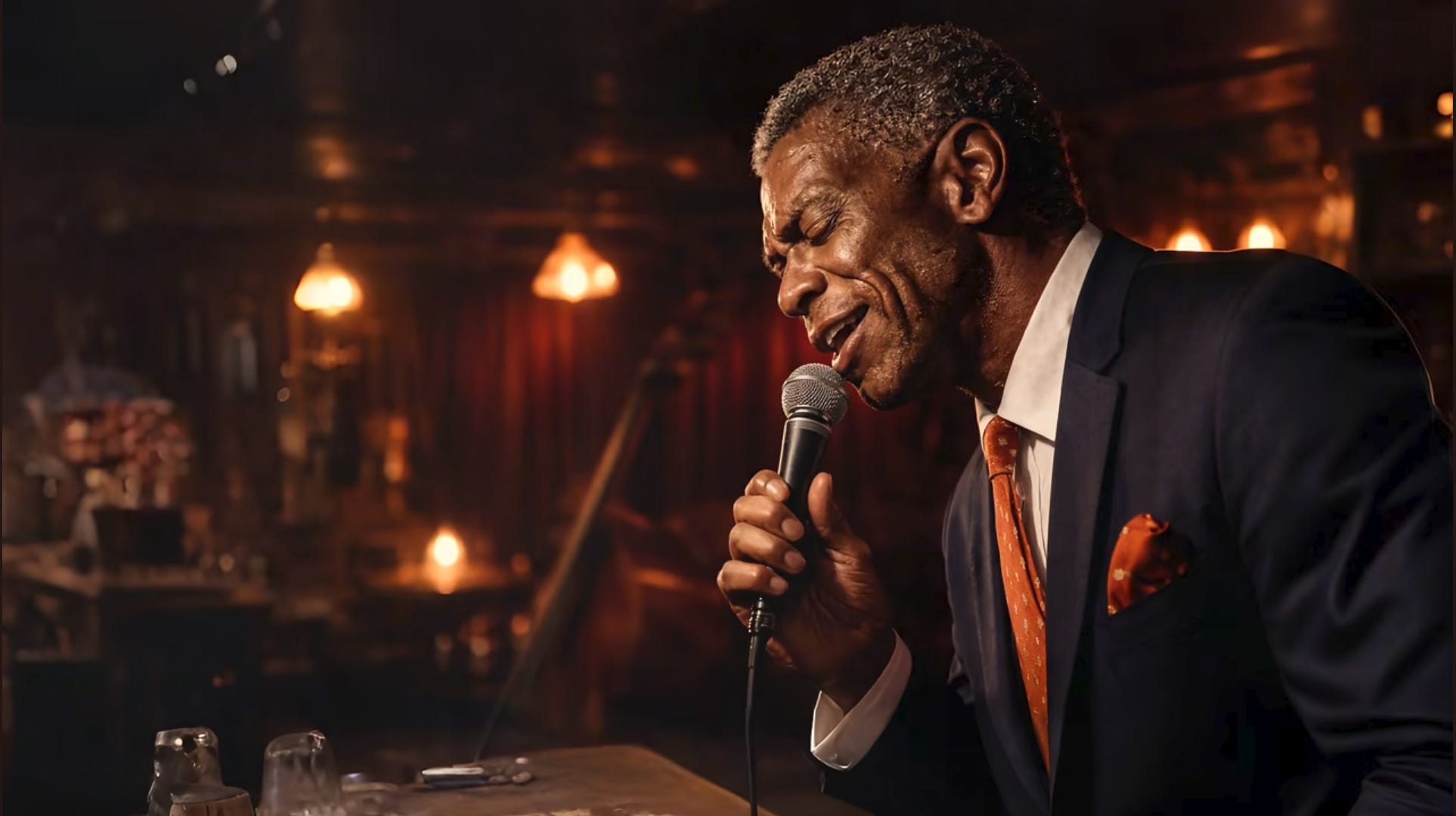
Eddie Dalton’s raspy and melodious voice carries through the air, telling tales of a lifetime spent in the school of hard knocks, as the blues band backing him weaves soul into every rubato-inflected syncopation and chord progression.
“We’re just passing through time, like the wind through the pines, just small little pieces in a bigger design,” he croons in his hit, “Another Day Old,” sounding like a reincarnated Muddy Waters.
The fans are impressed:
“This song is part of my testimony,” the top-rated YouTube comment on the video reads. “This song has touched the depth of my soul,” reads another.
Despite the rave reviews though, neither Eddie Dalton nor his band are real. They’re AI-generated fabrications released onto the internet by someone going by the name Dallas Ray Little, according to Showbiz411. Is that a real name? Your guess is as good as mine.
Related Content
ChatGPT and its imitators have minds, but they lack the somatic reasoning that powers humanity
Adult media superstar Siri Dahl on how AI is changing her industry
Why imagining aliens’ viewpoints can help us understand science better
In an increasingly isolated society, people are turning to conspiracy theories for community
How you think about minds influences how you see the world
Whoever is behind the scenes at “Crusty Records,” they have found a formula for success. Eddie Dalton’s classic-sounding blues is racking up the sales and the downloads, with several cracking the top 5 on Apple Music and being viewed millions of times on YouTube.
Computer-generated soul music is not just real, it’s becoming a phenomenon.
The Dalton persona is just the latest AI-generated artist to gain millions of fans, a trend that has not yet attracted much attention from the mainstream media. Last year, a fabricated country singer named “Breaking Rust” had a number-one hit on Billboard’s Country Digital Song Sales chart. In September, the music company Hallwood Media awarded a $3 million contract to Mississippi poet and designer Telisha Jones after her virtual singer, Xania Monet, had a number-one hit on Billboard’s R&B digital downloads. “How Was I Supposed to Know” was released 7 months ago and already has 9.6 million views on YouTube.
There’s more than a little irony to that song title. AI-generated music has become so good now that it is essentially impossible to discern a human-made tune from one made by a computer. In a study commissioned last year by the music service Deezer with 9,000 people in 8 countries, 97 percent of respondents were unable to tell if provided songs were done by humans or AI.
Do people really want to know if a song they’re being presented wasn’t performed by people? In the Deezer survey, 80 percent of respondents said they wanted AI-generated music to be labeled as such.
Still, knowing that a song was computer-made doesn’t seem to mean that people would avoid it. The poll found that 66 percent said they would listen to an AI song at least once; only 45 percent of respondents said they wanted an option to filter out all AI-made music.
As of this writing, Deezer is the only music streaming service that requires uploaders to tag AI-generated content as such. No such rules are in place on the other major services like Spotify, Apple Music, or YouTube. According to Deezer, 34 percent of all songs it receives daily are entirely AI-generated.
We don’t know the technical backstory behind Breaking Rust or Eddie Dalton, but Jones has said that she uses an AI music generating software called Suno to set her own lyrics to music.
“She’s been writing poetry for a long time,” Jones’s manager Romel Murphy told Billboard, arguing that words sung by the Xania Monet character are what draws people in. “It’s just the lyrics, and they are pure.”
Whether that’s true or not, the music industry as a whole has not taken kindly to Suno and rival service Udio. In June of 2024, the Recording Industry Association of America (RIAA) filed a lawsuit against the companies that was joined by numerous studios and musician groups.
“These corporations steal our work to create sound-alikes, effectively forcing us into a ‘training’ role to which we never consented,” the Music Workers Alliance said in a statement. “Their more expensive subscriptions allow users to commercialize the outputs, placing us in unfair competition with an inexhaustible supply of knock-offs of our own work, published without any credit or acknowledgement of our role in their creation, and yet capable of displacing us in record production, film, video, and television scoring, and other markets.”
As they so often do with major new technologies, legislatures have done little to stand on one side or the other. President Donald Trump has decided to stand on the side of AI companies, however, signing an executive order in December of last year after Republican congressional allies failed to muster support for a federal ban on state AI regulations. California Gov. Gavin Newsom defied Trump earlier this week with his own executive order requiring AI companies to watermark generated videos and images, and to prove that they have policies against the creation of violent pornography and child abuse material.
The Trump executive order is expected to face legal challenges since it conflicts with dozens of state laws regarding AI. The U.S. Supreme Court declined to hear an appeal of a March 2025 mid-level court ruling that entirely AI-generated art could not be copyrighted because a human had not created it. That seems about right to me.
AI companies have been sued by numerous media publishers around the world for copyright infringement, but thus far, no major nations have stepped forward with definitive rulings on whether the technology firms owe damages.
Wherever governments decide to come down on AI-generated art, its legal status isn’t the only question it raises. What is it exactly about art that matters? Is its value how it makes us feel, or is it knowing that fellow human beings with stories and minds made it? Can we really say that auto-tuned artists who use the same lyricists and beat-mixers are really doing something unique? Should women who don’t fit the Vogue profile be excluded from music fame?
These are not simple questions. Last month on Theory of Change, adult model Siri Dahl and I talked about this in the context of erotic media, but these are questions facing all art in the age of generative AI. While many musicians have come forward to speak against AI in their industry, top producer Timbaland, known for his highly templated, production-driven approach to pop and R&B, is also a huge booster of Suno.
“My Thriller, to me, is this tool. God presented this tool to me,” he told NPR.
Regardless of one’s stance on AI music though, it’s worth considering whether beauty is the sum total of conception, training, story, and performance—or can these be separated and valued on their own? Should an artist’s face and body determine whether she is heard? Is beauty literally in the eye of the beholder, or does it live in the interaction of artist and spectator?
I won’t pretend to have these answers. Maybe there aren’t any definitive ones. What matters right now is that we’re asking the questions. Because at the end of the day, we’re more than just another day old.